
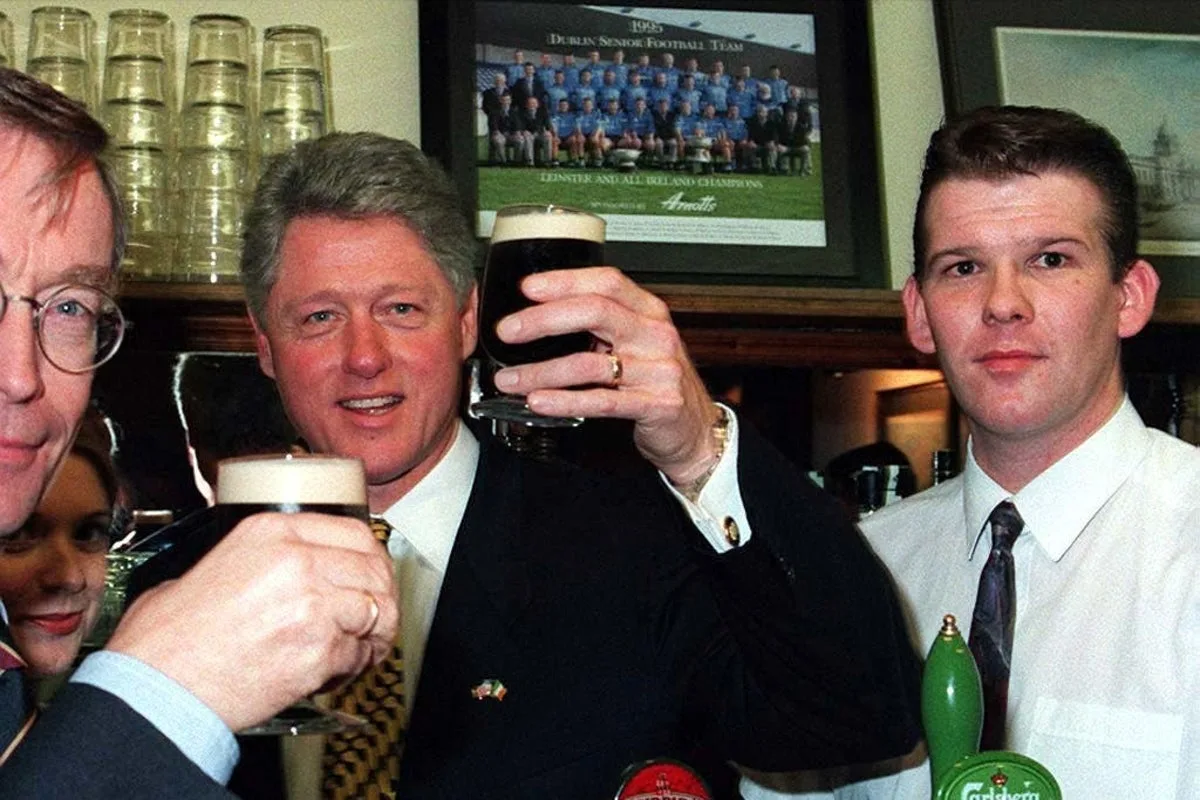
Newly declassified documents have revealed that the White House sought to prevent a photograph of US President Bill Clinton shaking hands with Sinn Féin leader Gerry Adams during his landmark 1995 visit to Belfast. The papers, released annually by the National Archives in Dublin, detail extensive diplomatic efforts between Irish and US officials to plan the Clintons' trip to the island of Ireland.
A letter from David Donoghue, Irish joint secretary of the Anglo-Irish Secretariat, noted that “the Americans would prefer to avoid a handshake photograph between the president and Adams.” The correspondence also revealed that the British side insisted the Northern Ireland Secretary Patrick Mayhew host a reception at Queen's University Belfast, expanding the guest list to 300 people to create a broader community event and make it easier for unionists to attend alongside Sinn Féin.
The documents show that representatives would form “pods” at the reception, including a UUP pod and an Alliance pod, determined on a pro rata basis according to electoral strengths. While one-on-one meetings were planned with John Hume and David Trimble, there was a “general US reluctance” to meet alone with Adams, Ian Paisley, or John Alderdice.
Clinton and Adams had first shaken hands in March 1995 at the White House during St Patrick's Day events, but after photographers had left the room. On the morning of November 30, before the Belfast reception, Clinton met Adams on the Falls Road and shook his hand, a moment captured by an official White House photographer. Clinton later described the handshake as a “big deal,” saying it felt as though “the pavement was about to crack open.”
The files also include a genealogy expert's research dismissing claims of Clinton's Co Fermanagh ancestry as “fantasy,” though acknowledging possible roots elsewhere in Ulster. Despite this, the White House still wanted aspects of the Cassidy lineage added to the visit. Plans for the Clintons' Dublin visit from December 1-2 1995 showed a US embassy official estimated a “50/50” chance the visit would go ahead.




