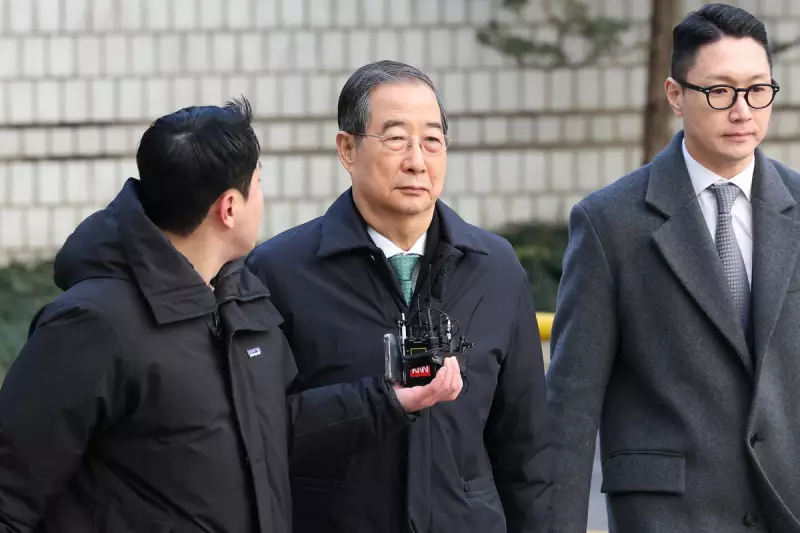
In a landmark ruling with profound implications for South Korean politics, a Seoul court has sentenced former Prime Minister Han Duck-soo to 23 years in prison for his role in what has been declared an act of rebellion. The verdict centres on the controversial imposition of martial law by then-President Yoon Suk Yeol in December 2024.
Court Declares Martial Law Decree an Act of Rebellion
The Seoul Central District Court delivered its televised verdict on Wednesday, 21 January 2026, determining that President Yoon's martial law decree constituted a rebellion against the constitutional order. The court characterised the dispatch of troops and police officers to Parliament and election offices as "a riot" or "a self-coup" serious enough to disrupt regional stability.
This represents one of the gravest charges within South Korea's legal system, with the independent counsel recently demanding the death penalty for Yoon himself, who faces accusations of masterminding the rebellion. The court is scheduled to rule on Yoon's specific rebellion charges on 19 February.

Former Prime Minister's Key Role in Constitutional Crisis
Han Duck-soo, who served as President Yoon's prime minister and was appointed to the nation's second-highest post, becomes the first official from that administration to be convicted on rebellion charges related to the 2024 martial law declaration. He served as one of three caretaker leaders during the martial law crisis, which ultimately led to President Yoon's impeachment and removal from office.
The court found that Han played a pivotal role in Yoon's rebellion by attempting to provide procedural legitimacy to the martial law decree through a Cabinet Council meeting. Additionally, the court convicted Han of falsifying the martial law proclamation, destroying evidence, and lying under oath during proceedings.
Immediate Imprisonment and Surprising Sentence Length
Following the court's ruling, Han was immediately taken to prison to begin serving his sentence. Unlike President Yoon, who has been detained for months, Han had remained free prior to sentencing. The 23-year term came as a surprise to many observers, as the independent counsel had previously requested a 15-year prison sentence.
Judge Lee Jin-gwan delivered stern remarks during sentencing, stating that Han, as prime minister, neglected his constitutional responsibilities to instead participate in Yoon's rebellion in the belief it might succeed. "Because of the defendant's action, the Republic of Korea could have returned to a dark past when the basic rights of the people and the liberal democratic order were trampled upon, becoming trapped in the quagmire of dictatorships for an extended period," the judge declared.
Broader Political Fallout and Legal Precedent
This landmark verdict is expected to establish a significant precedent for future rulings involving President Yoon and other associates who face similar accusations. The case represents a dramatic chapter in South Korea's political history, highlighting tensions between conservative and liberal factions within the government.
President Yoon, who identifies as conservative, has steadfastly denied all rebellion charges, maintaining that his actions aimed to garner public support against the main liberal opposition party, which he claims obstructed his political agenda. Speaking at a separate court session last Friday, Yoon denounced authorities for their rebellion investigations as "frenzied," arguing they involved "manipulation" and "distortion" of facts.
Multiple Legal Proceedings Continue
Yoon currently faces eight criminal trials, including his rebellion case over the martial law decree and various other allegations. Last Friday, the same Seoul court sentenced Yoon to five years in prison for defying detention attempts, fabricating the martial law proclamation, and denying Cabinet members their rights to deliberate on his martial law decree.
Han Duck-soo maintains his innocence despite the conviction, asserting that he told Yoon he opposed the martial law plan and denying most of the charges against him. Legal experts suggest he is likely to appeal Wednesday's ruling, potentially prolonging this high-profile legal battle that continues to captivate South Korean society and international observers alike.