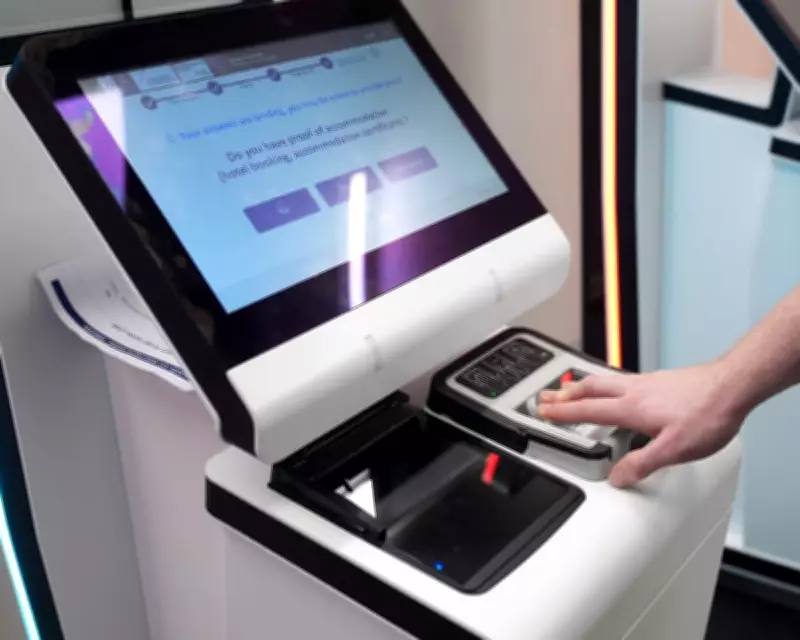
Travellers passing through the new EU entry-exit system (EES) have faced severe delays at border checks, with some waiting up to three hours, according to airports and passenger reports. The system, gradually introduced since October 2025, came into full effect on Friday across the Schengen area, which includes 25 EU states plus Iceland, Norway, Liechtenstein and Switzerland.
Hundreds of readers responded to a callout from the Guardian, sharing experiences of travel to Europe since the rules took effect. While some reported smooth journeys, many described significant delays that caused some to miss flights. Common issues included fingerprint recognition failures, extra delays for families with children, lack of guidance at kiosks, and having to repeat registration on each leg of a trip without explanation from staff – or no staff available to assist.
Missed Flights and Financial Strain
Dave Giles, 47, an IT manager from Raunds, Northamptonshire, missed his flight home from Copenhagen on 12 April after attending a music festival with his family. Despite arriving hours early, he encountered long queues at passport control. “When they called the gate and we got down towards passport control, there was a queue of probably 80 to 100 people in front of us and only three kiosks checking passports,” he said. “Before long, one of those closed.” Staff tried to hold the gate open, but it closed seconds before he reached the front. The disruption cost him around £2,000, including new flights, accommodation, extra parking, and a car hire from Heathrow to Stansted. He does not expect reimbursement, as insurance and the airline refused to cover the costs.

Georgia, from London, experienced a four-hour delay on arrival at Pisa airport on 10 April. Pregnant and five months along, she found the wait arduous. “There were no staff in sight to advise on waiting times,” she said. “People with infants but no special assistance, or any seating. People in the back of the queue became very hot, stuck in a windowless corridor for hours.” She sat on the floor and had to inform others she was pregnant to get space. Water was only handed out at the front of the queue, about four hours in. She has since cancelled a planned trip to Paris and is anxious about future travel to Europe.
Difficulties for Families and Elderly
Stuart MacLennan, 49, from Oban, Scotland, found travelling with children particularly challenging. He flew from Glasgow to Málaga on 11 April, where multiple arrivals caused long queues. “There was no real direction as to where to go,” he said. After half an hour, they were moved to a different line for families with children under 12, then queued for two-and-a-half hours. His return journey was worse, with a three-and-a-half-hour wait for under-12s. He now wants to avoid busier European airports.
Many travellers reported that self-service kiosks for registration were either not in use or malfunctioning. Dylan Thomas, 23, an HR associate from Lincolnshire, faced two-hour waits on a trip to Madeira on 15 March and on his return from Brussels via Eurostar on 6 April. “It was ridiculous,” he said. “There must have been about 20 machines, but they all had plastic wrapping on them and couldn’t be used. There was only one person manually checking everyone.”
Paul Coleman, a retired volunteer from Southend-on-Sea, described a three-hour wait at Kraków airport in early February, where staff resorted to using their own mobile phones because cameras on the machines were not working. “They got their mobile phones out and took pictures of us. It was just crazy,” he said. “There was no explanation, no apology.”

David, 75, from Durham, highlighted the impact on elderly passengers. On a trip to Gran Canaria in February, he was kept on the plane for 30 minutes due to queues at Fuerteventura airport. “The first single queue was huge, which everyone had to join, even those who had provided their biometrics previously,” he said. “They should be separate. Better signage would speed the process up.” He described non-EU passport holders being herded into an area with glass partition walls, with insufficient seating and no toilet facilities. “It really is a mess,” he added, noting that airlines have abdicated responsibility, simply telling passengers it is their job to get to the gate.
The overriding sentiment among travellers is inconsistency. “You’ve got no idea what’s going to happen when you hit these airports,” one passenger said.