
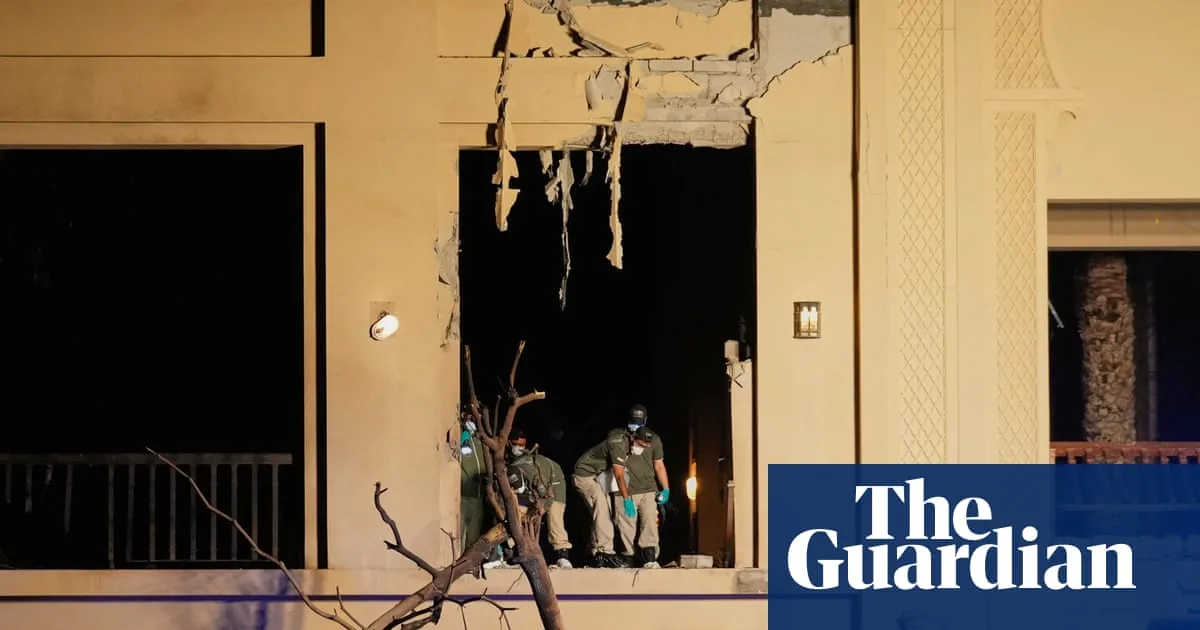
An Iranian missile struck the Fairmont hotel on Dubai's Palm Jumeirah on Saturday, setting the five-star property alight and injuring four people, as the US- and Israeli-led war against Iran rapidly escalated across the Middle East. Social media footage showed fires near the hotel entrance, while residents described widespread interceptions of incoming missiles over the city.
Dubai authorities later confirmed that debris from an intercepted drone caused fires at the Burj Al Arab hotel and Dubai International Airport. An incident at Zayed International Airport in Abu Dhabi led to one fatality and seven injuries, according to a social media post that was subsequently deleted. The Dubai media office said civil defence teams had brought the situation under control and that no injuries had been reported at the Burj Al Arab, although part of the airport sustained minor damage.
A Dubai resident said everyone was "very scared" as the situation deteriorated. "There is footage of missile interceptions all over the city," they said. "I am packing a suitcase just in case … not that we can leave, because airspace is closed. It is the thing we have all been frightened about happening, and now it has."
The attacks extended to other Gulf states. In Bahrain, an Iranian drone flew into a high-rise building in an apparent targeted strike, engulfing the skyscraper in flames. The country's national security agency was also hit, and a missile appeared to strike the large US naval base. In Kuwait, a drone crashed into the main airport, injuring employees and damaging the facility.
In Iraq, bases belonging to the Iran-backed Popular Mobilization Forces were struck by either US or Israeli forces, killing at least two members of Kataib Hezbollah. The group, along with Yemen's Houthis, warned they would respond by attacking US military bases across the region. The conflict, dubbed Operation Epic Fury by Washington, has already expanded far beyond the geographic scope of the previous war in June 2025, which was largely confined to Israel and Iran.
Throughout the region, anxiety mounted. In Lebanon, long queues formed at petrol stations, flights from Beirut were cancelled, and shoppers stocked up on essentials, mindful of the 2024 war with Israel. Hezbollah, an Iran-backed group that had previously described the killing of Iranian supreme leader Ayatollah Ali Khamenei as a red line, issued a statement condemning the US and Israel for violating the UN charter, but made no mention of aiding Iran. Arab states, including Qatar, condemned the Iranian strikes as a violation of their sovereignty, with Qatar calling them a "direct assault on national security". In Jordan, fires broke out in the northern city of Irbid after missile shrapnel fell from intercepted attacks.




