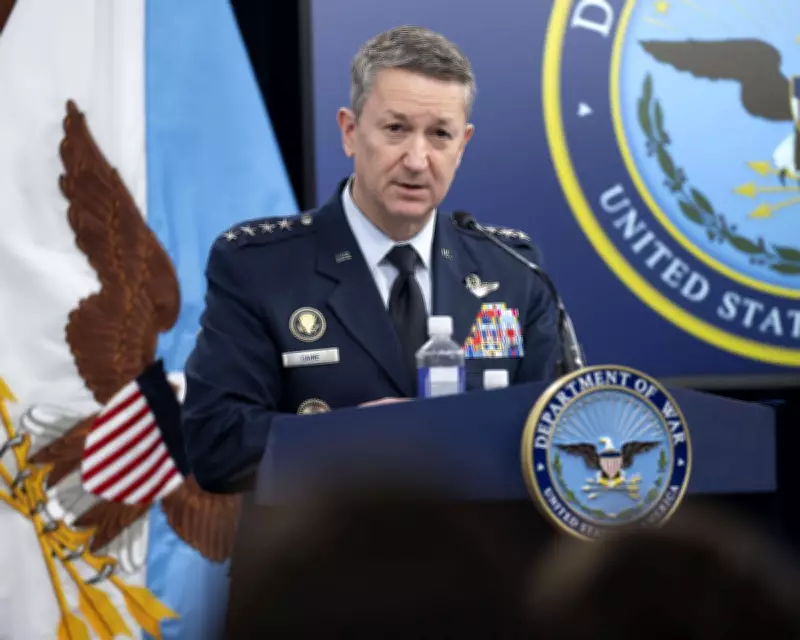
General Dan Caine, the chair of the joint chiefs of staff, was photographed at the Pentagon in Washington DC on March 4, 2026, as tensions escalate over maritime security in the Middle East. According to recent US intelligence assessments, direct attacks by Iran on oil tankers are now viewed as a greater risk than mines in the critical Strait of Hormuz. This key transit passage for the global oil trade has been effectively shut down by the Islamic Revolutionary Guard since the onset of the US-Israeli war against Iran, leading to significant disruptions in energy markets.
Escalating Threats in the Strait of Hormuz
The Trump administration, alarmed by potential Iranian preparations to mine the strait, conducted strikes against 16 mine-laying vessels near the area on Tuesday. US Central Command released video footage showing munitions hitting nine vessels, most of which were moored at the time of the attack. However, intelligence sources reveal that the more potent threat lies in the risk of large-scale direct assaults by Iran, such as swarms of one-way attack drones or a series of shore-to-ship ballistic missiles.
Intelligence Insights and Strategic Challenges
Two individuals familiar with the intelligence, speaking anonymously due to the sensitivity of the details, emphasized that even a single missile or drone breaching defenses could devastate or sink a tanker. This gives Iran considerable leverage, despite the US launching what a senior administration official described as its largest attack against Iran in the conflict to date. The complexity of protecting tankers is heightened because US navy destroyers, even if escorting vessels, might not intercept every incoming missile. Additionally, convincing ship crews to navigate through the strait remains a challenge, even with potential risk insurance from the Trump administration.

Mines, while a concern, were considered more straightforward to address, as the US had prepared in advance for Iran's potential attempts to mine the strategically vital waterway. Approximately one-fifth of the global oil trade passes through the Strait of Hormuz, making its security paramount. The issues surrounding tanker protection were discussed in a classified briefing to top lawmakers on Tuesday, with Democrats emerging deeply critical of the administration's approach. Senator Chris Murphy highlighted the difficulties in reopening the strait safely, noting in a social media post that current strategies are insufficient.
Impact on Global Oil Markets and Recent Attacks
The Strait of Hormuz, connecting the Persian Gulf to the northern Arabian Sea, has been a focal point of conflict since February 28, when the Islamic Revolutionary Guard effectively shut it down, stranding numerous oil tankers. This supply cut has contributed to a steep increase in oil prices, translating into higher gas costs for US consumers. Energy Secretary Chris Wright stated in a CNN interview that the US has destroyed many weapons Iran might use against ships and expects regular traffic to resume in "a few weeks," though details were sparse.
Despite these assurances, fear of Iranian attacks has led virtually all ship operators to halt tanker passages through the strait. On Wednesday, at least three vessels were hit in and around the area, including a Japanese container ship and two bulk carriers transporting loose cargo like grain. Only one of these, the Mayuree Naree from Thailand, was in the strait during the attack, with the others located in the Persian Gulf, according to marine tracking data. Iran has claimed responsibility for the assault on the Mayuree Naree.
Geopolitical and Economic Ramifications
The coastline of Iran runs along one side of the Strait of Hormuz, putting military and civilian vessels at risk of shore-launched attacks as they enter or exit the gulf. A White House spokesperson redirected inquiries about the strait's risks to Donald Trump's Truth Social post, where he threatened military retaliation if Iran attempted to place mines. The recent US Central Command strikes followed this warning, underscoring the volatile situation. As the conflict continues, the global economy faces ongoing pressure from disrupted oil supplies, with policymakers and intelligence agencies closely monitoring developments to mitigate further escalations.