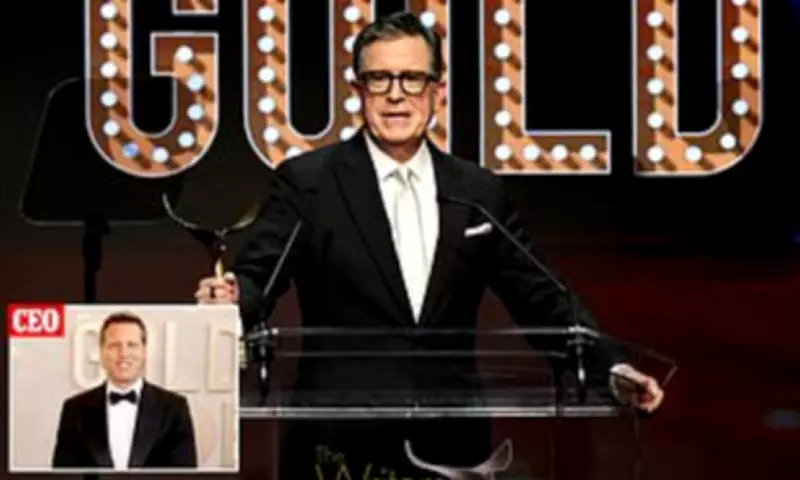
In a pointed speech at the 78th Writers Guild of America Awards, soon-to-be-cancelled late-night host Stephen Colbert, 61, launched another verbal assault on his corporate bosses at Paramount, this time over allegations of censorship. Colbert was receiving the Walter Bernstein Award, named for the blacklisted Hollywood screenwriter who defied studios during the McCarthy Era, when he delivered his barbed remarks.
Drawing Parallels to Political Repression
Colbert began by calling the award "a great honour" while questioning the "implied parallel" with a man of such stature who stood against political repression. "This is not the 1950s. This is not the Red Scare. And, as far as I can tell, no one in late night is fomenting a revolution," he stated, before quoting a famous 1970 poem about propaganda and delivering a punchline.
"As we know, the revolution will not be televised. It was going to be televised, but then Paramount bought it," Colbert quipped, drawing laughter from the audience. This was followed by a reference to a July Puck report that painted his Late Show as a financial failure, coming just days after showrunners revealed CBS would air its final episode in May.
Financial Jabs and Sarcastic Commentary
"Evidently, the revolution was losing, like, $40 million a year - it had to go," Colbert said, using sarcasm to cast doubt on the figure cited in the Puck piece. He continued, "I guess the revolution is thinking about starting a Substack," enjoying himself as he mocked the situation.
The rest of his speech largely avoided direct mention of the cancellation, which CBS has insisted was "purely a financial decision" driven by declining advertising revenue. However, Colbert and several others remain unconvinced by this explanation.
History of Criticism Towards Paramount
Days before CBS announced the show's cancellation, Colbert openly criticised Paramount for a $16 million settlement it reached with former President Donald Trump just prior to a long-pending merger with Skydance being finalised within weeks. Colbert labelled the move "a big fat bribe."
In an episode last month, after handing his wife an expensive ring as a guest, he joked, "I was going to charge it to CBS, but they seem a little tight on cash right now." Earlier this year, he ridiculed the FCC's "equal opportunities" rule after agency chairman Brendan Carr complained about his increasingly politicised content.
Political Allegations and Corporate Leadership
In November, Senator Elizabeth Warren used the show to accuse David Ellison, the then-new boss of a post-merger Paramount, of attempting to buy news organisations like CBS to promote conservative propaganda. Ellison, Hollywood tech scion, was tapped as Paramount's chief executive over the summer and has denied any role in Colbert's cancellation.
"I've never met Mr. Ellison, and I'm sure he's a fine fella," Colbert said at the time, again speaking with heavy sarcasm. Similar barbs have been levelled on-air in recent months, highlighting the ongoing tension.
Award Recognition Amidst Controversy
Colbert, an outspoken critic of Donald Trump, was honoured by the Writers Guild on Sunday for his "creativity, grace and bravery." The award also applauds "a willingness to confront social injustice in the face of adversity," a description that seems fitting given his recent public clashes with Paramount.
As his show approaches its final episode, Colbert's remarks at the awards ceremony underscore the deepening rift between the host and his corporate overlords, blending humour with serious accusations of censorship and financial mismanagement.