US-Israel-Iran Ceasefire on Verge of Collapse Amid Accusations and Continued Strikes
A ceasefire agreement between the United States, Israel and Iran appeared to be on the brink of total collapse last night, following accusations from former President Donald Trump that Tehran was blatantly breaching the terms of the deal. This comes as missile attacks continued to rain down across various locations in the Middle East, severely undermining the fragile peace.
Ceasefire Unravels Just Days After Announcement
Merely two days after the US president announced a ceasefire intended to halt the six-week-old conflict, the situation has rapidly deteriorated, seemingly spiralling out of control. The agreement, which was heralded as a potential de-escalation, now faces critical challenges that threaten its very existence.
Strait of Hormuz Blockade Remains a Critical Sticking Point
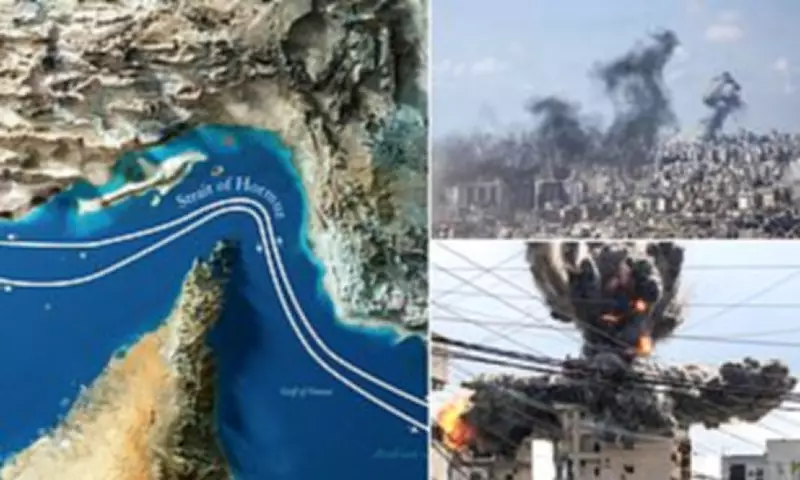
As of Thursday, there was no indication that Iran was lifting its near-total blockade of the strategically vital Strait of Hormuz. Iranian authorities have cited Israel's ongoing military attacks on Lebanon as a primary justification for maintaining their grip over this crucial global shipping route. The Strait handles approximately twenty percent of the world's oil and gas shipments, and its effective closure has had immediate international repercussions.

Since the ceasefire was announced on Tuesday night, only a minimal number of vessels have managed to pass through the Strait. Reports indicate that the Islamic Republic is demanding exorbitant tolls from shipping companies for guaranteed safe passage, a move that has drawn sharp criticism and further complicated diplomatic efforts.
Trump's Public Accusations and Iran's Demands
Donald Trump publicly accused Iran of 'doing a very poor job' of permitting ships to transit the Strait, casting significant doubt on the effectiveness and durability of the ceasefire deal. In a social media post on Thursday, Trump wrote, 'Iran is doing a very poor job, dishonorable some would say, of allowing Oil to go through the Strait of Hormuz. That is not the agreement we have!'
This statement followed a provocative message from Iran's Supreme Leader, Ayatollah Mojtaba Khamenei, which was broadcast on Iranian state television. Khamenei denounced the US and Israel as 'criminal aggressors' and demanded 'blood money' as compensation. 'We will undoubtedly demand compensation for every single damage inflicted, the blood money of the martyrs, and the diyah of the war-wounded,' the Supreme Leader declared.
Israeli Military Actions and Regional Escalation
Meanwhile, Israeli Prime Minister Benjamin Netanyahu has firmly refused to de-escalate the war against Hezbollah, vowing to continue striking targets 'with force, precision and determination.' The Israeli Defence Forces (IDF) have sustained attacks on sites affiliated with the terror group, operations which have also resulted in civilian casualties. Further strikes were reported in the capital city of Beirut on Thursday night.
Netanyahu had earlier ordered his ministers to pursue direct talks with Lebanon, with a key objective being the disarmament of the Iran-backed Hezbollah. However, even as he spoke, Israel's military issued new evacuation orders for southern suburbs of Beirut and later confirmed it was striking Hezbollah launch sites in Lebanon, warning that the militant group might expand its rocket fire 'in the coming hours.'
Diplomatic Moves and Conflicting Interpretations
A State Department official announced that Israel and Lebanon are scheduled to hold talks in Washington next week, amid growing concerns about the ceasefire's longevity. The discussions are expected to be facilitated by the US ambassador to Lebanon, Michel Issa, and the Israeli ambassador to the US, Yechiel Leiter. The representation for Lebanon remains unclear at this time.
Iran asserts that Israel's ongoing attacks on Hezbollah constitute a violation of the ceasefire agreement, a claim that both Netanyahu and Trump have explicitly rejected. Despite this, Trump has reportedly urged Netanyahu to scale back strikes in Lebanon, particularly after Israeli actions in central Beirut on Wednesday resulted in over 300 fatalities, according to Lebanon's Health Ministry.

Retaliatory Attacks and Broader Regional Threats
Hezbollah has launched retaliatory missile attacks on Israel, targeting military infrastructure in the northern city of Haifa. The Israeli military stated it responded by striking approximately ten Hezbollah rocket launchers. In a significant regional escalation, Iran was also accused of orchestrating a drone attack targeting Kuwait's National Guard, causing substantial damage but no casualties. Kuwait's Ministry of Foreign Affairs condemned this as a 'flagrant violation' of its airspace and a breach of international law, stating it undermines the US-Iran ceasefire.
Economic Impact and International Concerns
The blockade of the Strait of Hormuz has precipitated a sharp increase in global oil prices, affecting gasoline, food, and other essential commodity costs far beyond the Middle East. Sultan al-Jaber, head of the United Arab Emirates' major oil company, highlighted that around 230 oil-laden ships are currently waiting to transit the Strait and must be allowed 'to navigate this corridor without condition.'
Iran's deputy foreign minister, Saeed Khatibzadeh, told the BBC that his country would permit ships to pass in accordance with 'international norms and law' only once the US ceases its 'aggression' in the region and Israel halts its attacks on Lebanon. With accusations flying, military actions continuing, and the vital shipping lane obstructed, the prospects for a sustained peace appear increasingly bleak as the region braces for further instability.