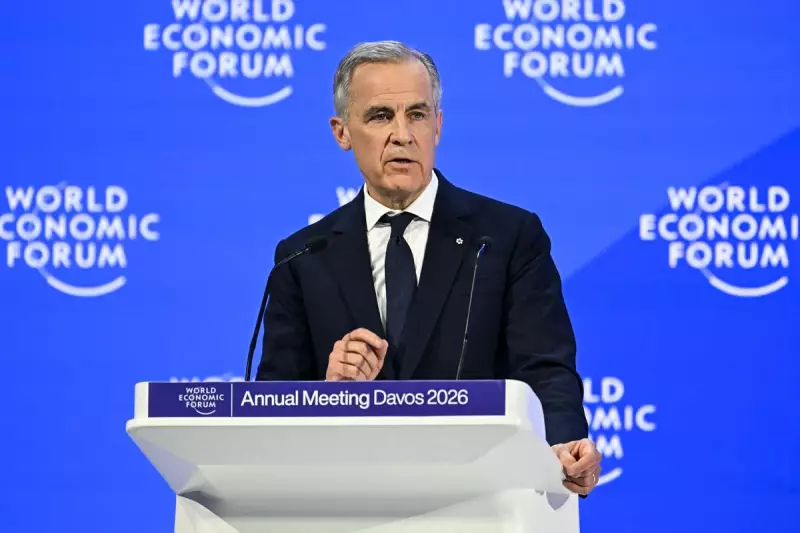
Canadian Prime Minister Mark Carney received a standing ovation at the World Economic Forum in Davos yesterday after delivering a powerful warning about a fundamental "rupture" in the global order, delivered against a backdrop of escalating tensions involving former US President Donald Trump's threats to impose tariffs over Greenland.
A Stark Warning on Global Fractures
Addressing the prestigious annual gathering, Mr Carney declared that the established international system is in the "midst of a rupture" and emphatically stated it is "not coming back." While he avoided directly naming Mr Trump, the context of his remarks was unmistakably shaped by the former president's recent threats to levy tariffs on European nations that refuse to support his ambitions regarding Greenland.
"Canada strongly opposes tariffs over Greenland," Mr Carney asserted, positioning his nation firmly alongside Denmark in support of its sovereignty over the vast Arctic island territory. He called for focused strategic talks to navigate the brewing crisis, framing it as part of a broader, dangerous shift in geopolitics.

The End of a 'Pleasant Fiction'
In a speech that switched between English and French, Carney argued that the world is witnessing "the end of a pleasant fiction and the beginning of a harsh reality." He painted a picture where great power rivalry is resurgent, with the most powerful nations acting without limits or constraints, forcing a recalibration for all.
"It seems that every day we're reminded that we live in an era of great power rivalry, that the rules-based order is fading, that the strong can do what they can, and the weak must suffer what they must," he said, invoking the ancient wisdom of Thucydides to describe a modern predicament.
The 'Power of the Powerless' and Living in a Lie
Drawing inspiration from Czech dissident and later president Václav Havel's essay "The Power of the Powerless," Carney used the metaphor of a greengrocer displaying a sign he doesn't believe in to avoid trouble. He likened decades of international cooperation under a partially false narrative to "living within a lie"—a system sustained by collective performance rather than truth.
"For decades, countries like Canada prospered under what we called the rules-based international order," Carney noted. "We knew the story was partially false... This fiction was useful." However, he declared that "this bargain no longer works," emphasising that the rupture is not a mere transition but a fundamental break.
Economic Integration Weaponised
The Prime Minister warned that great powers are increasingly using the tools of globalisation as weapons. "Great powers have begun using economic integration as weapons, tariffs as leverage, financial infrastructure as coercion, supply chains as vulnerabilities to be exploited," he stated.
This environment, he argued, forces middle powers like Canada to pursue "strategic autonomy" in critical areas such as energy, food, critical minerals, finance, and supply chains. Yet, he cautioned against a retreat into isolation, warning that "a world of fortresses will be poorer, more fragile and less sustainable."
Canada's 'Value-Based Realism'
Outlining Canada's response, Carney described a new strategic posture rooted in "value-based realism"—a term he credited to Finnish President Alexander Stubb. This approach aims to be both principled, upholding sovereignty, territorial integrity, and human rights, and pragmatic, recognising divergent interests and incremental progress.
"We are no longer just relying on the strength of our values, but also the value of our strength," Carney proclaimed, detailing a domestic agenda of tax cuts, removing internal trade barriers, and mobilising a trillion dollars in investments across energy, AI, and critical minerals. Defence spending is set to double by 2030.
Building Coalitions Beyond Old Alliances
Internationally, Carney highlighted a rapid diversification of partnerships. Canada has secured a comprehensive strategic partnership with the EU, including joining its defence procurement framework (SAFE), and signed a dozen other trade and security deals across four continents in just six months. New partnerships with China and Qatar were concluded in recent days, with negotiations ongoing with India, ASEAN, and Mercosur.

He emphasised a strategy of "variable geometry"—forming different coalitions for different issues based on shared values and interests. On Ukraine, Canada is a core contributor; on Arctic sovereignty, it stands with Denmark and Greenland; and within NATO, its commitment to Article 5 is "unwavering," backed by new investments in radar, submarines, and personnel.
A Call to Middle Powers
Carney issued a rallying cry to intermediate nations, arguing that in a world of great power rivalry, "if we're not at the table, we're on the menu." He warned that negotiating bilaterally with a hegemon from a position of weakness is not true sovereignty, but "the performance of sovereignty while accepting subordination."
"Middle powers must act together," he urged, advocating for combined strength to create a impactful "third path." This means naming the new reality honestly, applying consistent standards to allies and rivals alike, and proactively building the institutions and economic resilience that reduce vulnerability to coercion.
Canada's Path Forward
Leveraging Canada's assets as an energy superpower, holder of critical minerals, and home to sophisticated capital and talent, Carney expressed confidence in the nation's course. "We are taking the sign out of the window," he declared, moving beyond nostalgia for an order that will not return.
"We believe that from the fracture, we can build something bigger, better, stronger, more just," Carney concluded, framing this as the essential task for middle powers who have the most to lose from fragmentation and the most to gain from genuine, honest cooperation. His speech marked a definitive call for a new, more resilient architecture of international relations, built from the rupture of the old.