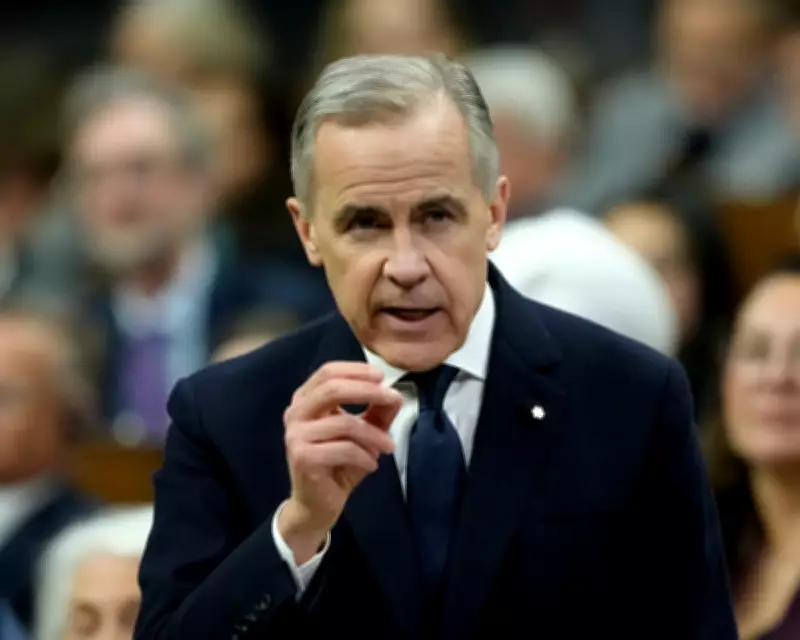
Former Bank of England governor Mark Carney has positioned himself as the leading voice advocating for a significant realignment in global politics, urging democratic nations to form a powerful coalition outside the traditional spheres of American, Russian, and Chinese influence.
The Growing Consensus for a New World Order
Jonathan Freedland's analysis of Donald Trump's recent actions and inflammatory rhetoric has found strong resonance with assessments from both Mark Carney and former Prime Minister Gordon Brown. All three prominent figures have independently identified the urgent need for countries committed to maintaining international peace, promoting collective approaches to trade and security, and resolving disputes through established arbitration processes to unite in a substantial new body.
There is mounting agreement among political observers and policymakers about the necessity for a non-aligned coalition of middle powers - those nations with significant global influence but not classified as superpowers. Within this emerging movement, Mark Carney has distinguished himself as the spokesperson most capable of articulating a coherent platform around which nations of goodwill can effectively cluster and coordinate their efforts.

The Challenge for Western Leadership
To embark on what Carney terms the "third path," political leaders including Keir Starmer must demonstrate considerable courage in persuading their electorates that this ambitious international venture will require substantial long-term investment and commitment. This represents a formidable political challenge that could potentially fracture already sceptical and disillusioned voting populations who have grown weary of international entanglements.
The crucial work of convincing citizens that without such a collective endeavour their current way of life and democratic values cannot be assured must begin immediately. As Peter Riddle from Wirksworth, Derbyshire observes, the window for establishing this new framework is narrowing as global tensions continue to escalate.
A Rugby Analogy for Political Disruption
Richard Woolerton from Cosby, Leicestershire offers a compelling sporting analogy to explain the current political landscape. He compares Donald Trump's approach to that of William Webb Ellis, who famously picked up the football during a match in 1823 and ran with it, thereby creating the entirely new game of rugby with its own distinct rules and physicality.
Similarly, Trump has grown frustrated with established political conventions and has effectively "picked up the ball and run," not merely changing the political game but enforcing his own version of it. Like a classic bully who appoints himself as referee, Trump alters rules to suit his purposes as he progresses.
Woolerton argues that Trump's opponents continue to operate according to outdated political conventions, attempting to trip him up with traditional parliamentary tactics when what is required is a more forceful approach. Mark Carney's Davos call for middle powers to unite takes on particular significance in this context - these nations locking together like a rugby scrum could form the necessary barrier to halt this free-running political disrupter before he causes further damage to international norms and institutions.
Reconsidering Democratic Safeguards
Dr Lorens Holm, Reader Emeritus at the University of Dundee, highlights a crucial domestic dimension that complements the international concerns. While Freedland focuses appropriately on international relations, Holm notes the parallel problem of how to restore and safeguard democracy within America itself.
The constitutional principle of "checks and balances" was originally designed to prevent any single branch of government - legislative, judicial, or executive - from accumulating excessive power. However, the Trump administration's approach to governance has revealed this system's limitations, particularly when confronting a leader who refuses to adhere to established norms and conventions.

Holm observes that America's constitutional safeguards ultimately depend upon consensus and good faith, offering little protection against actors determined to circumvent traditional constraints. The current situation demands a serious, non-partisan debate about whether more durable mechanisms are needed to replace or substantially reinforce the existing checks and balances system with more binding and enforceable powers.
This comprehensive reassessment would ideally involve representation from all three branches of government and transcend traditional party divisions, though it would likely require initial leadership from the Democratic party to gain momentum.