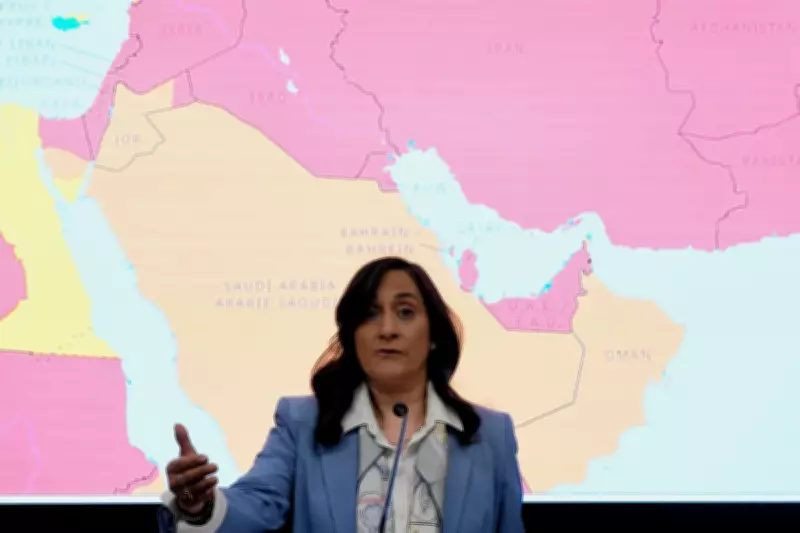
Canada has confirmed it was not consulted regarding the recent U.S.-Israeli military strikes against Iran that ignited the ongoing war in the Middle East. The nation's Foreign Minister, Anita Anand, has firmly stated that Canada has no intention of participating in any offensive military operation, emphasising a foreign policy centred on de-escalation and humanitarian protection.
Diplomatic Stance on Regional Conflict
In a brief telephone interview with The Associated Press conducted ahead of her diplomatic talks in Ankara with Turkish Foreign Minister Hakan Fidan, Minister Anand stressed Canada's unwavering priorities. "Canada was not consulted, did not participate in the military action, and has no intention of participating in the offensive military operation," Anand declared. She elaborated that Canada's foreign policy is fundamentally "focused on de-escalation and the protection of civilians and humanitarianism generally."
Consultations in Turkey and NATO Dynamics
Anand arrived in Turkey for high-level consultations on the volatile regional situation as hostilities continue to rage. During a meeting with Turkish Vice President Cevdet Yilmaz, both officials concurred that "de-escalation is of the utmost priority and that the war in the Middle East needs to end in the interests of civilian lives."

This diplomatic engagement occurs against a backdrop of heightened NATO activity. Since the war's inception, NATO air defence systems have successfully intercepted three ballistic missiles fired from Iran toward Turkish airspace. This aggressive action necessitated the alliance's deployment of an additional Patriot missile defence system on Turkish territory to bolster regional security.
Response to U.S. Calls and Alliance Commitments
The conflict has been exacerbated by Iran's blockade of the strategically vital Strait of Hormuz, a move that has driven global fuel prices sharply higher and severely disrupted international supply chains and travel. U.S. President Donald Trump recently called upon NATO allies and other major powers to assist in reopening the strait, issuing a stark warning that the alliance faces a "very bad future" if they refuse to cooperate.
When questioned about Canada's potential involvement should a NATO member state come under direct attack, Foreign Minister Anand provided a measured response. "We will take all decisions concerning the alliance in conjunction with the alliance," she stated, underscoring a commitment to collective decision-making within the NATO framework.
Clarifying Canada's Position and Broader Concerns
Canadian Prime Minister Mark Carney's initial support for the strikes on Iran has been a point of contention. He later qualified his stance, expressing support "with some regret," characterising the military action as an extreme manifestation of a fracturing world order. Minister Anand, however, insisted there has been no substantive change in Canada's overarching foreign policy.
"It has been our long-standing position that Iran is a destabilising force in the Middle East and in particular, Iran's proliferation of its nuclear capacity," Anand affirmed. She clarified that Prime Minister Carney's nuanced position does not represent an abandonment of this stance but rather reflects a commitment to supporting regional stability, backing Gulf states under attack, and prioritising the safety of civilians and critical infrastructure.
Focus on Lebanon and Hezbollah Tensions
The Canadian minister also voiced profound concerns regarding the escalating conflict between Israel and Hezbollah in Lebanon. Anand highlighted that it is the Lebanese civilian population "who are bearing the brunt of the ongoing war."
In a coordinated diplomatic move, Canada, alongside France, Germany, Italy, and the United Kingdom, issued a joint statement on Monday warning of the grave consequences of escalating violence in Lebanon. The statement cautioned that a significant Israeli ground offensive could precipitate devastating humanitarian outcomes and that a protracted conflict "must be averted."
"And we very much are concerned with Hezbollah's attacks on Israel and the targeting of civilians," Anand added. "We want to ensure that there is meaningful engagement by Israeli and Lebanese representatives to negotiate a sustainable political solution."

Turkish Foreign Minister Hakan Fidan, in his own interview with the AP earlier this week, echoed the priority of remaining outside the direct conflict. He ruled out a military response at this stage, acknowledging the effectiveness of NATO's current defensive posture in the region.