Bad Bunny's Super Bowl Performance Packed With Political Undertones
The Puerto Rican superstar Bad Bunny, whose real name is Benito Antonio Martínez Ocasio, delivered far more than just musical entertainment during his Super Bowl halftime show on Sunday. The globally streamed artist used the country's most prominent stage to weave subtle political messages throughout his performance, creating a powerful statement about identity, love, and Puerto Rico's complex relationship with the United States.
Visual and Verbal Messages of Unity and Identity
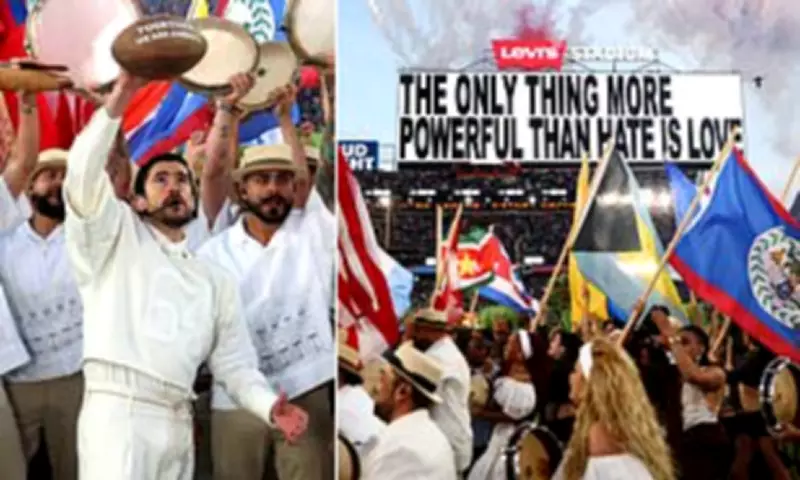
As Bad Bunny triumphantly concluded his performance, the glaring words 'The only thing more powerful than hate is love' flashed across the massive video screen behind him. This powerful statement served as the visual climax to a performance that began with strong markers of Latino identity. The artist transformed the football field at Levi's Stadium in San Francisco into an agricultural plot, performing surrounded by prop sugar cane fields while playing hits like Tití Me Preguntó and Yo Perreo Sola.
Throughout the show, Bad Bunny spoke entirely in Spanish, declaring 'God Bless America!' and telling the crowd to 'believe in yourself' in his mother tongue. He introduced himself with his full Spanish name, Benito Antonio Martínez Ocasio, emphasizing his cultural roots. The performance reached its symbolic peak when Bad Bunny held a football to the camera with the words 'Together we are America' clearly visible.

Puerto Rican Symbolism and Political References
The halftime show contained numerous references to Puerto Rico's political status and ongoing challenges. The stage design included imagery of exploding power grids, a clear nod to the island's frequent and prolonged electricity outages that Bad Bunny has addressed in his music. In 2022, he released a mini documentary titled El Apagón focused specifically on Puerto Rico's electricity problems, which tend to worsen after hurricanes in the Caribbean region.
Perhaps the most politically charged moment came when Bad Bunny waved what appeared to be a lighter blue version of the Puerto Rican flag, a color often associated with the territory's pro-independence movement. The artist has previously alluded to the flag in his song La Mudanza, where he sings about bringing it 'everywhere I want now' - a reference to Puerto Rico's former gag law that made owning the island's flag illegal from 1948 until 1957.
International Representation and Controversial Reactions
Bad Bunny's performance featured a medley of performers rushing onto the field carrying flags from nations across North, South, and Latin America. The artist listed most countries in Spanish before switching to English toward the end of the sequence, naming the United States and Canada before closing with a tribute to 'my motherland, Puerto Rico.'
The show included fellow Puerto Rican artist Ricky Martin performing the track Lo que le pasó a Hawaii, whose lyrics have been interpreted as speaking out against America's rule of Hawaii while offering thoughts on gentrification in Puerto Rico and the island's possible statehood. Notably, Bad Bunny avoided directly mentioning Immigration and Customs Enforcement during his Super Bowl performance, despite having forcefully spoken out against the federal agency when winning three Grammys on February 1.
The performance drew sharp criticism from former President Donald Trump, who called it 'absolutely terrible' and 'one of the worst, EVER!' on Truth Social. Trump claimed the show 'makes no sense, is an affront to the Greatness of America, and doesn't represent our standards of Success, Creativity, or Excellence.' Meanwhile, millions of viewers chose to watch Turning Point USA's alternative 'All-American' Super Bowl halftime show, which featured Kid Rock and honored the organization's late founder Charlie Kirk.
Despite the controversy, Bad Bunny's Super Bowl halftime show represented a significant cultural moment, bringing Latino identity and Puerto Rican political issues to the forefront of American popular culture on one of the nation's most watched television events.