Azerbaijani Security Personnel Confront Protesters in Washington During High-Profile Summit
Security personnel accompanying Azerbaijani President Ilham Aliyev engaged in a physical altercation with demonstrators in Washington, D.C., on Thursday, as the leader attended the inaugural meeting of former U.S. President Donald Trump's newly established Board of Peace. Video evidence from the scene depicts bodyguards punching, kicking, and pursuing protesters who had gathered outside the Waldorf Astoria hotel on Pennsylvania Avenue, located mere blocks from the White House.
Protesters Demand Release of Political Prisoners
The demonstrators, advocating for the liberation of political detainees in Azerbaijan, were forcibly removed from the vicinity of President Aliyev's motorcade. Among those affected was Rahim Yagublu, a 27-year-old Uber driver whose father is currently imprisoned in Azerbaijan on political grounds. Yagublu reported being struck in the jaw and kicked in the stomach during the incident.
Another protester, Adil Amrakhly, aged 35 and residing in Alexandria, Virginia, sustained a leg injury while attempting to evade the guards. He stated that at least four other individuals were harmed during the confrontation. "We intended to hold a peaceful protest to demand freedom for political prisoners in Azerbaijan," Amrakhly explained to the Washington Post.

Official Response and Security Justifications
In a formal statement, the Embassy of Azerbaijan defended the actions of its Presidential Security Service, alleging that protesters had "violently attempted to enter the protected area and took offensive actions against the Presidential vehicle" as the motorcade approached the hotel. The embassy asserted that its personnel "had no choice but to immediately intervene" due to the perceived security threat, emphasizing that any obstruction of a protected vehicle carrying a head of state constitutes a serious concern.
The statement further noted that Azerbaijani security operatives "always operate in strict coordination with the host country." Meanwhile, the U.S. Secret Service clarified that the hotel was incorporated into the event security perimeter because it housed the Azerbaijani delegation, with their role limited to establishing the necessary security infrastructure for visiting dignitaries.
Historical Parallels and Broader Context
This incident evoked immediate comparisons to a 2017 confrontation in Washington where bodyguards for Turkish President Recep Tayyip Erdoğan assaulted protesters outside the Turkish ambassador's residence, resulting in injuries to eleven people, including a police officer. A similar altercation involving Erdoğan's security detail had occurred the previous year outside the Brookings Institution, highlighting a pattern of aggressive behavior by security forces from certain nations on U.S. soil.
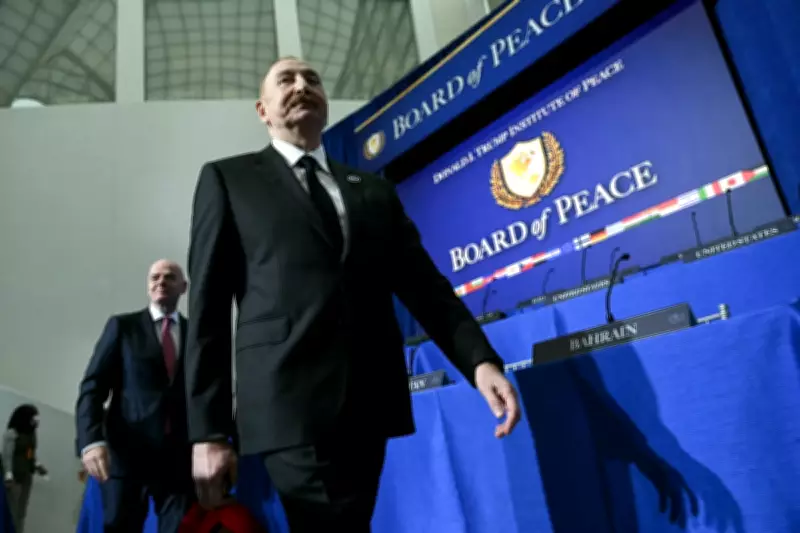
President Aliyev's presence in Washington was for the first assembly of Trump's Board of Peace, a body the former U.S. president announced at Davos last month, describing it as having "unlimited potential" to become "the most consequential international body in history." The gathering primarily focused on the fragile Gaza ceasefire and reconstruction efforts for the devastated coastal strip, attracting over two dozen world leaders, though some U.S. allies such as France, Germany, and Italy opted to participate only as observers.
Azerbaijan was among the nations Trump identified as contributing to a $7 billion relief package associated with the initiative. Prior to the meeting, Aliyev posted on social media about a discussion with Elliot Brandt, the chief executive of the American Israel Public Affairs Committee (AIPAC).
Aftermath and Official Inquiries
In the wake of the altercation, the DC Metropolitan police deferred questions regarding the attack to the U.S. State Department, which did not provide an immediate response to requests for comment. The event underscores ongoing tensions surrounding the visit of leaders with authoritarian reputations to democratic capitals and raises questions about the balance between diplomatic security and the right to peaceful protest.

President Aliyev, who has governed Azerbaijan for more than two decades, has faced consistent criticism for suppressing political opposition and dissent within his country. This incident in Washington further amplifies scrutiny of his administration's conduct on the international stage.