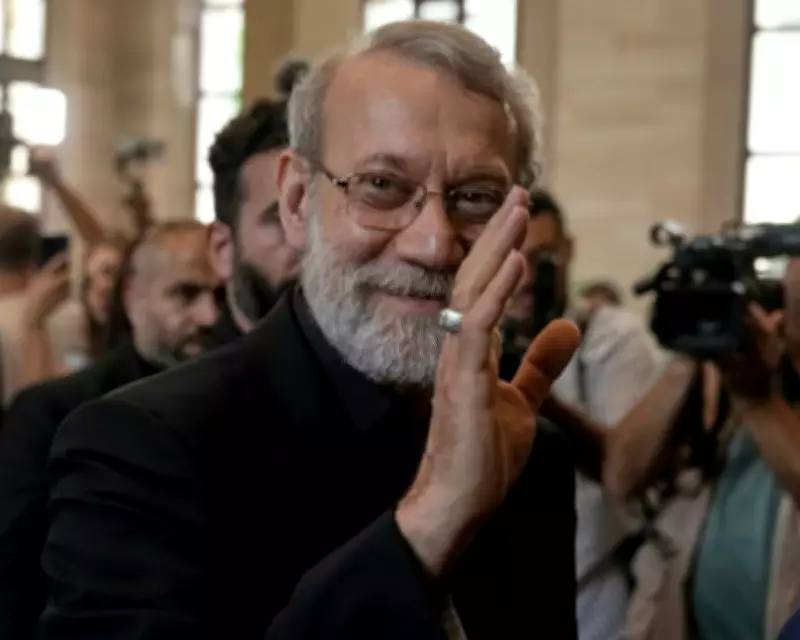
Israel Claims Killing of Top Iranian Security Chief Ali Larijani in Overnight Strikes
Israel has asserted responsibility for the assassination of Ali Larijani, the influential secretary of Iran's Supreme National Security Council, during overnight military operations. The death of this pivotal political figure represents a severe and potentially crippling blow to the Iranian regime, with analysts suggesting its impact could surpass even the loss of Supreme Leader Ali Khamenei at the war's outset.
A Linchpin of Iranian Politics Eliminated
Larijani, aged 67, was always considered a prime target for any decapitation strike against Iran's leadership. His unique ability to operate across multiple strata of politics, coupled with his substantial personal influence both domestically and with key foreign allies like China and Russia, made him indispensable. His removal marks the most significant loss for Tehran since the United States assassinated Qassem Suleimani, leader of the Islamic Revolutionary Guard Corps, in Baghdad in 2020.
The strategic elimination of Larijani confirms that Israel, and potentially the United States, never viewed him as a viable alternative leader for a post-conflict Iran. Ellie Geranmayeh, an Iran specialist at the European Council on Foreign Relations, noted, "Benjamin Netanyahu is currently focused on obstructing Donald Trump's pathways to a ceasefire and subsequent negotiations with Iran. Larijani would have been the key individual to facilitate that process."
End of a Potential Transitional Figure
Larijani was an advocate for a nuclear agreement with the US, despite also supporting brutal internal repression. His assassination not only extinguishes the remote possibility that he could have played a transitional role akin to Venezuela's Delcy Rodríguez but also raises serious questions about whether the United States possesses any credible internal candidates for leadership in Iran.
Former President Donald Trump has frequently admitted his limited familiarity with Iran's internal alternative leaders, many of whom have been killed. Larijani's death starkly illustrates the shallow pool of potential US-backed candidates. Trump continues to refuse endorsing Reza Pahlavi, the son of the former Shah, expressing a preference for an internal figure, despite Pahlavi's efforts to broaden his leadership team to alleviate fears of reverting to a monarchical dictatorship.
A Career Spanning Generations and Institutions
Larijani's special attribute was his capacity to maintain the trust of the powerful IRGC while holding differences with hardliners. His vast experience spanned four generations of Iranian politics. He recently engaged in a failed rearguard action to prevent Mojtaba Khamenei from succeeding his father as Supreme Leader, collaborating with former President Hassan Rouhani to either delay the critical Assembly of Experts meeting or propose an alternative candidate.
Once the transition became inevitable, Larijani demonstrated his trademark pragmatism by appearing on television to describe the appointment as a "manifestation of consensus." Lacking the religious training required to be Supreme Leader, he instead navigated the corridors of high politics, becoming a driving ideological and practical force alongside his brothers—Sadeq, head of the judiciary, and Mohammad Javad, a diplomat and adviser.
From Media to Parliament to Security Council
Larijani's career included serving as head of state broadcasting, where he lambasted the reformist movement, followed by twelve turbulent years as Speaker of Parliament from 2008 to 2020. During this period, he broadly supported the nuclear deal negotiated with the US in 2015. In a previous role as secretary of the national security council in 2006, he had unsuccessfully reached out to the George W. Bush administration for talks on Iran's nuclear programme.
Following Israeli-US attacks on Iran in June 2025, Larijani was appointed secretary of the Supreme National Security Council in August 2025, placing him at the heart of the establishment. In this role, he acted as the crucial link between the military (IRGC) and the civilian administration. He was influential in devising the strategy of warning Gulf leaders that US bases in their territories would be considered legitimate targets if Iran was attacked, making him a more authentic message carrier to Gulf leadership than President Masoud Pezeshkian.
Intellectual and Political Resilience
A trained mathematician and cerebral intellectual who wrote his doctoral dissertation on philosopher Immanuel Kant, Larijani was described by Haaretz as "a brilliant thinker who combines, in an unusual way, a life of contemplation with a life of action." His political shift from conservatism to the Rouhani centre increasingly put him at odds with decision-makers in the Supreme Leader's office.
The Guardian Council barred him from standing in the 2021 and 2024 presidential elections, citing economic conditions under Rouhani and a failure to adhere to simple living principles—a move widely seen as ensuring Ebrahim Raisi's election. His sudden return to power in August 2025 marked a significant political comeback, driven by his invaluable experience with China, Russia, and preparing Iran for further US attacks.
He showed no leniency during the January economic riots, labelling protests as urban terrorist tensions. After Khamenei's death, he quickly appeared on television to offer reassuring, grounded leadership. Despite supporting repression, he remained the figure most likely to restrain hardliners.
In a November 2024 interview, he reflected on the enduring impact of Suleimani and Hezbollah leader Hassan Nasrallah's deaths, stating, "Their martyrdom still feels surreal to me. History repeats itself as great leaders fight, offer themselves as sacrifices for the sake of the cause and pave the way for a new generation of freedom fighters." The critical test now is whether Iran's intelligence gaps and attrition prevent the regime from renewing itself with another generation of leaders.