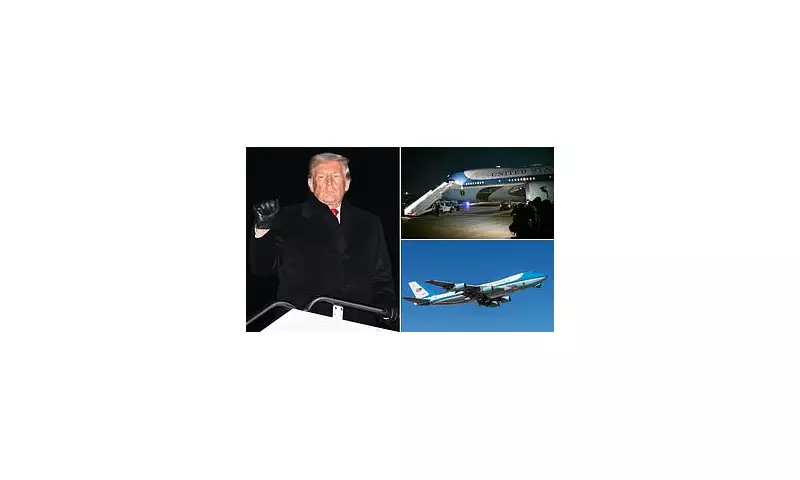
In a fresh blow to the iconic aircraft's prestige, Air Force One was forced into an unexpected return journey on Tuesday, disrupting President Donald Trump's scheduled appearance at the Davos summit. The presidential plane, a modified Boeing 747-200B, developed an electrical fault less than an hour into its transatlantic flight to Switzerland, compelling the crew to execute a U-turn back to Joint Base Andrews in Maryland.
Flight Disruption Amid Diplomatic Agenda
The incident occurred as President Trump was en route to engage with European leaders at the World Economic Forum, where discussions were anticipated to include his administration's interest in Greenland. Pool reporters travelling with the President noted that the lights in the press cabin briefly flickered and went out shortly after takeoff, signalling the onset of the technical problems.
Aging Fleet and Replacement Delays
This malfunction highlights the advancing age of the current Air Force One fleet, which has been in service since the era of President George H.W. Bush in 1990. Successive administrations have recognised the necessity for modern replacements. In 2016, President Barack Obama initiated the process by awarding Boeing a contract to develop new aircraft, as the existing planes were then approaching three decades of service.

Upon entering office, President Trump expressed concerns over the projected costs, successfully renegotiating the agreement with Boeing down to an initial figure of $3.9 billion. However, the programme has since encountered significant delays and budget escalations. The new VC-25B planes, originally slated for delivery during President Joe Biden's term, are now not expected until 2029, with the latest estimates projecting a total cost of $5.3 billion to the federal government.
Interim Solution and White House Reaction
The protracted delays have prompted the Trump administration to seek alternative arrangements. In a notable development, the Qatari royal family donated a luxury Boeing 747-8 aircraft to serve as a temporary Air Force One. The Pentagon has accepted this gift and is currently retrofitting the jet with the requisite security and communications systems. It is anticipated to be operational by February 2026.
Commenting on Tuesday's aborted flight, White House Press Secretary Karoline Leavitt remarked wryly that the Qatari jet was beginning to sound "much better" by comparison.
Historical Context of Presidential Aircraft Issues
While mechanical failures on the current Air Force One fleet are relatively uncommon, they are not unprecedented. The aircraft has experienced a handful of notable incidents over the years.
Incidents Under President George W. Bush
In November 2006, during a visit to Ho Chi Minh City in Vietnam, ground crew discovered that six tires on the landing gear had blown out upon landing. This necessitated President Bush using a backup Boeing 757 for his return journey, while support staff were accommodated on a commercial United Airlines Boeing 747.
Earlier, in July 2004, a wing flap on Air Force One detached from its track while President Bush was travelling to Tennessee. Both instances were resolved without injury to the President or his entourage.
The 1984 Cabin Pressure Loss
The last significant incident involving a designated Air Force One aircraft occurred in 1984 during the presidency of Ronald Reagan. The aircraft in question was an older generation Boeing 707. On September 5th, a relay failure in an air vent system caused a sudden loss of cabin pressure while the plane was cruising at 21,000 feet.
Passengers, including President Reagan, reported discomfort and ear pain. The pilot promptly descended to a safer altitude of 9,000 feet, and the aircraft landed without further incident in Washington, D.C.
These historical episodes, coupled with Tuesday's electrical fault, underscore the operational challenges of maintaining such specialised aviation assets and reinforce the ongoing imperative for a modernised presidential fleet.