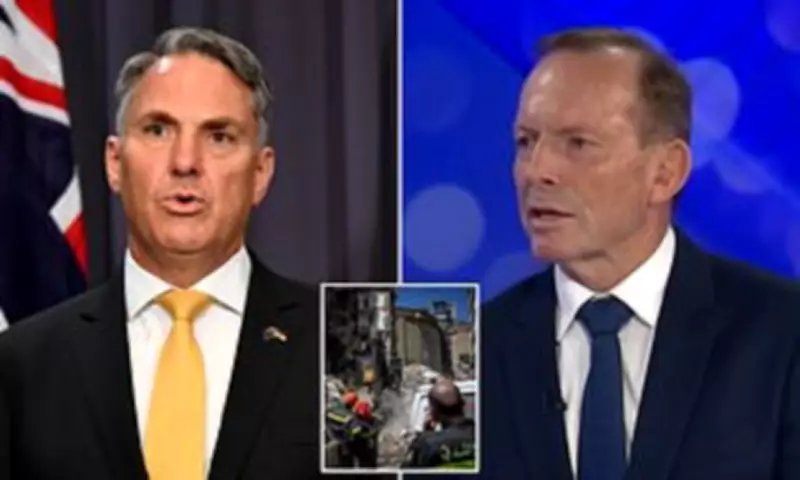
Former Australian Prime Minister Tony Abbott has launched a scathing critique of the Albanese government, accusing it of failing to adequately support allies during the ongoing conflict in the Middle East. In a televised interview, Abbott argued that Prime Minister Anthony Albanese should be doing more to assist the United States as President Donald Trump works to reopen the strategically vital Strait of Hormuz.
Abbott's Call for Greater Australian Involvement
Speaking to Sky News on Friday, Abbott emphasised that the only secure resolution to the conflict would be the complete destruction of Iran's military capabilities. He urged the current administration to proactively engage with the White House to offer Australian assistance. "Frankly, it is not too late even now for our government to make contact with the White House and say 'what can Australia do to help?'" Abbott stated. "That's what I think every Australian Prime Minister would have done."
Abbott highlighted that America both deserves and requires Australian support to ensure freedom of navigation through the Strait of Hormuz, a critical global chokepoint that facilitates approximately 25 percent of the world's seaborne oil trade. The closure of this waterway by Iran has triggered widespread fuel shortages globally, creating significant economic disruptions.

Concerns Over Iranian Tolls and Terrorism Subsidies
Although a temporary ceasefire between the US and Iran has led to the partial reopening of the Strait, Abbott expressed concerns that Iran might begin imposing tolls on vessels passing through. He warned that such charges would effectively create a "subsidy for terrorism" and impose exorbitant fuel costs on Australian industries. "It would mean our miners, farmers and truckers are forever facing absolutely extortionate amounts for fuel," Abbott added, underscoring the potential economic impact on key sectors.
Government Response and Defence of Current Actions
Deputy Prime Minister Richard Marles strongly rejected Abbott's assertions, describing them as "fundamentally ignorant" in the context of ongoing diplomatic discussions. Marles clarified that the United States had specifically requested Australian support for Gulf nations over the past month, and Australia had responded by deploying an E-7 Wedgetail plane to the United Arab Emirates at the onset of the conflict.
"I completely reject that assertion from Tony Abbott," Marles told Sky News. "And I think, in the context of the conversations that have been happening, I mean, Tony Abbott's view is fundamentally ignorant."
Energy Security Agreement with Singapore
Amidst these heated exchanges, Prime Minister Anthony Albanese made an urgent trip to Singapore to finalise a crucial agreement aimed at securing Australia's oil supplies. The deal, signed with Singaporean Prime Minister Lawrence Wong, commits both nations to "make maximum efforts to meet each other's energy security needs" during a period of skyrocketing fuel prices and service station shortages linked to the Middle East conflict.
Albanese emphasised the importance of international cooperation in addressing the global fuel crisis. "It's vitally important that we coordinate our response to the global fuel crisis and cooperate so that both of our economies are more resilient," he told reporters at a joint media conference. "The conflict in the Middle East is a long way from our region, but every nation in our region is being affected by it."
Prime Minister Wong dismissed any possibility of Singapore restricting fuel exports, even if supply issues worsen in the coming months. "We do not plan to restrict exports. We didn't have to do so even in the darkest days of COVID and we will not do so during this energy crisis," Wong affirmed. "I am confident that Australia and Singapore will not just get through the crisis, but we will emerge stronger and more resilient."
This bilateral meeting reinforced the strong trade relationship between the two nations, with Singapore being Australia's largest two-way trade partner in Southeast Asia. More than a quarter of Australia's imported fuel originates from Singapore, while Australia supplies about one-third of Singapore's liquefied natural gas needs.