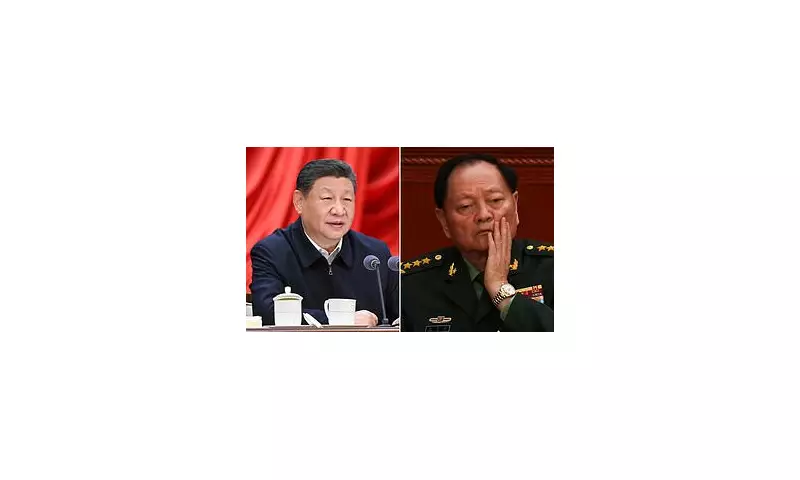
President Xi Jinping has achieved comprehensive command over China's armed forces following the removal of a senior military leader accused of disciplinary and legal violations. This development represents the latest phase in Xi's extensive purge of military officials, raising fresh questions about China's capacity to execute complex military operations, particularly concerning Taiwan.
Zhang Youxia's Removal and Military Implications
General Zhang Youxia, the operational leader of the People's Liberation Army (PLA), has become the most recent high-ranking figure targeted in President Xi's prolonged campaign against military officials. The 75-year-old general, a member of the ruling politburo and one of China's few commanders with actual combat experience from the 1979 Vietnam war, had previously been considered secure in his position due to his childhood friendship with Xi.
His dismissal forms part of a broader anti-corruption initiative that has disciplined more than 200,000 officials since Xi assumed power in 2012. Another commission member, Liu Zhenli, chief of staff of the commission's Joint Staff Department, has also been placed under investigation by China's Communist Party according to defence ministry statements.

Impact on Taiwan Contingency Planning
Military analysts suggest that General Zhang's removal could significantly delay any potential attempt to seize Taiwan by force. As senior vice-chairman of the Central Military Commission (CMC), Zhang was considered central to modernisation efforts within the Chinese armed forces. His absence creates leadership gaps that experts believe would hinder complex military operations.
Lyle Morris, a senior fellow at the Washington-based Asia Society Policy Institute, described Xi's actions as 'a complete cleaning of the house... the biggest purge in Chinese history since 1949'. Morris further warned that the removal could leave the PLA in 'disarray' and stated unequivocally: 'There is no way they could pull off the Taiwan contingency with no senior leaders in charge.'
Structural Changes in Military Leadership
The Central Military Commission has now been reduced to its smallest size in history, with just two remaining members: President Xi himself and Zhang Shengmin, the military's anti-corruption watchdog who was promoted to CMC vice-chair in October. This follows the expulsion last October of the other vice chair, He Weidong, and the removal of two former defence ministers over corruption charges in 2024.
Rumours about Generals Zhang and Liu's fate circulated after their absence from a televised party seminar. According to sources familiar with the situation, General Zhang faced corruption allegations including failure to control family members' activities.
Expert Analysis of Military Capabilities
Christopher K Johnson, a former CIA analyst specialising in Chinese elite politics, noted that while Beijing demonstrates impressive capacity for producing advanced weaponry, the country faces significant weaknesses in the 'software' required to conduct large-scale military manoeuvres. This refers to the command structures, training protocols, and operational experience necessary for complex military operations.
Despite these concerns, Morris suggested that the extensive removals actually indicate President Xi maintains 'a lot of support in the party and is fully in charge'. Last year, speculation emerged about potential power struggles between Zhang and Xi, with reports suggesting General Zhang was less optimistic than the president about China's prospects for successfully seizing Taiwan.
International Context and Diplomatic Developments
The military leadership changes occur against a backdrop of evolving international relations. Sir Keir Starmer is scheduled to hold talks with President Xi next week, aiming to enhance trade relations between the UK and China. The Labour leader hopes to revive the UK-China CEO Council business dialogue forum established by Theresa May in 2018.

This diplomatic engagement follows controversial decisions by Labour ministers to grant China planning permission for what would become Europe's largest diplomatic base opposite the Tower of London, despite espionage and repression concerns. Shadow Foreign Secretary Dame Priti Patel criticised these developments, stating: 'Having surrendered to China over their plan for a spy hub super embassy in the heart of our capital, Keir Starmer is now getting ready to jet off to Beijing and toast it all with Xi Jinping.'
Meanwhile, the Trump administration's recently released National Defence Strategy formally acknowledges China as a military power requiring deterrence from dominating the United States or its allies. The strategy document notes that achieving security objectives 'does not require regime change or some other existential struggle' but rather seeks 'a decent peace, on terms favourable to Americans but that China can also accept and live under'.
The ongoing military purges and leadership changes represent a significant consolidation of President Xi's authority over China's armed forces, while simultaneously raising important questions about operational capabilities and strategic direction in an increasingly complex geopolitical landscape.