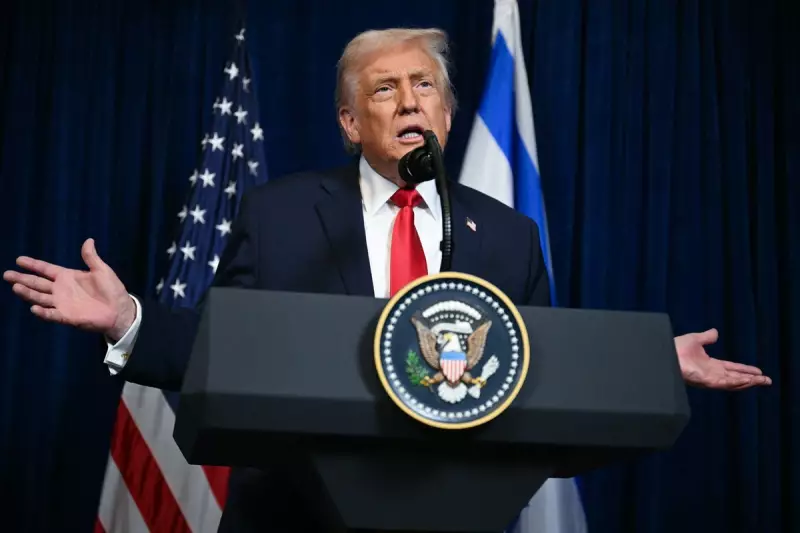
The United States has rolled out a fresh wave of sanctions targeting entities in Iran and Venezuela, directly following a stark military warning from President Donald Trump aimed at Tehran.
Trump's Stark Warning at Mar-a-Lago Talks
The new punitive measures were announced on Tuesday, 30 December 2025, shortly after President Trump hosted Israeli Prime Minister Benjamin Netanyahu for crucial talks at his Mar-a-Lago residence in Palm Beach, Florida. The leaders discussed the fragile Gaza truce and the ongoing threat from Iran.
During the meeting, President Trump issued a blunt threat, stating that if Iran attempted to rebuild its nuclear facilities, the United States would "knock them down." This warning underscored the potential for further military strikes, following US-led actions against three Iranian enrichment facilities earlier in the summer.

Details of the Latest Sanctions Package
The US Treasury Department's latest action imposes sanctions on 10 individuals and firms across Iran and Venezuela. Officials allege these entities are contributing to Iran's drone trade and ballistic missile programme.
The sanctioned parties include:
- A Venezuelan firm and its chairman, accused of purchasing Iranian drones.
- Three Iranian men linked to efforts to procure chemicals used for ballistic missiles.
- A network of Iran-based people and firms connected to the Rayan Fan Group, a holding company already under US sanctions.
Treasury Undersecretary for Terrorism and Financial Intelligence, John K. Hurley, stated the move was about holding both nations accountable for "their aggressive and reckless proliferation of deadly weapons around the world." He vowed to continue action to cut off Iran's military-industrial complex from the US financial system.
Context and Escalating 'Maximum Pressure' Campaign
These sanctions are framed as supporting reimposed United Nations sanctions on Iran over its nuclear ambitions, which Tehran insists are purely peaceful. This forms part of President Trump's revived "maximum pressure" campaign, initiated in February 2025 to block Iran's development of nuclear weapons.
The summer's military strikes came after a week of open conflict between Israel and Iran, sparked by Israeli attacks on Iran's nuclear and military infrastructure. State Department spokesman Tommy Pigott reinforced the US position, accusing Iran of continuing to violate UN restrictions and highlighting that "Iran’s ongoing provision of conventional weapons to Caracas is a threat to U.S. interests in our region."
The coordinated announcement of sanctions and military rhetoric signals a continued hardline approach from the Trump administration, further squeezing the Islamic Republic and its allies while aligning closely with Israeli security concerns.