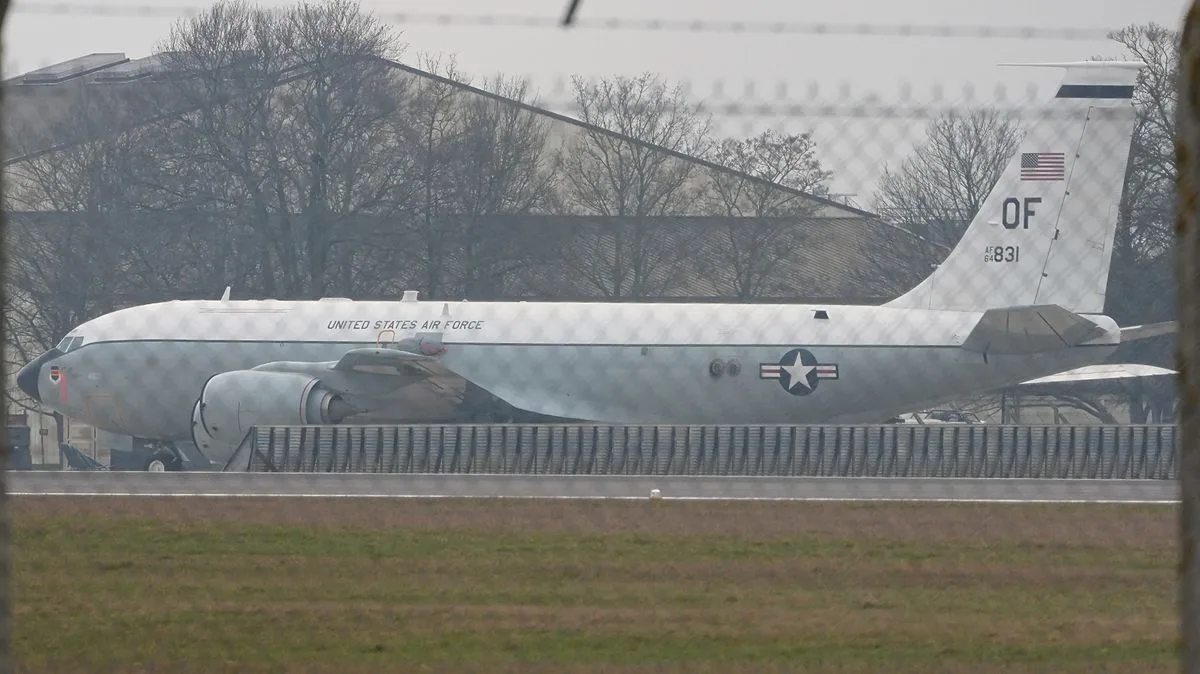
US 'Nuke Sniffer' Aircraft Lands at UK Base Amid Iran Tensions
US 'Nuke Sniffer' Plane Lands in UK Amid Iran Tensions

US 'Nuke Sniffer' Aircraft Touches Down at UK Base as Iran Crisis Escalates

A specialised United States Air Force aircraft, colloquially known as the 'nuke sniffer', has landed at an American airbase in the United Kingdom. This development occurs against a backdrop of heightening geopolitical tensions with the Iranian regime, with US President Donald Trump issuing stark warnings about military deployments in the Middle East.

Deployment of the WC-135R Constant Phoenix

The aircraft in question is a USAF WC-135R Constant Phoenix jet. This unique plane is specifically designed to detect and analyse radioactive particles present in the atmosphere. Its capabilities are crucial for monitoring nuclear activities. Notably, this same aircraft was reportedly deployed to the Middle Eastern theatre just days before President Trump authorised strikes on Iran's nuclear facilities last year.

While the precise reason for its latest arrival at RAF Mildenhall in Suffolk remains officially undisclosed, defence sources have indicated to media outlets that its presence should not be interpreted as a signal of imminent military action. However, its deployment inevitably fuels ongoing speculation regarding Washington's strategic considerations.

Trump's Warnings and the 'Massive Armada'

Speaking at the premiere of a documentary about his wife, Melania, President Trump issued a direct ultimatum to the Iranian leadership. He stated the regime must accomplish "two things" to avert potential military conflict:

  1. Cease all nuclear weapons development.
  2. End the brutal crackdown on domestic protesters.

"They are killing them by the thousands," Trump asserted, referring to the Iranian government's response to widespread anti-regime demonstrations. He further warned of a "massive armada" of American naval power, led by the aircraft carrier USS Abraham Lincoln, currently en route to the region. "We have a lot of very big, very powerful ships sailing to Iran right now, and it would be great if we didn't have to use them," he added.

In a separate statement on his Truth Social platform, Trump emphasised that this fleet surpasses the size of the force assembled for recent operations in Venezuela. He urged Tehran to negotiate a "fair and equitable deal" that includes abandoning its nuclear ambitions, cautioning that failure to do so would result in consequences far more severe than previous attacks.

International Response and UK Stance

The situation has prompted significant international reaction. The European Union has formally added Iran's Revolutionary Guard Corps (IRGC) to its list of designated organisations. This move is a direct response to Tehran's deadly suppression of protesters in recent weeks.

In the UK, Shadow Foreign Secretary Dame Priti Patel condemned the Iranian regime's actions as an "affront to humanity" and reiterated calls for the British government to implement its own ban on the IRGC.

Prime Minister Sir Keir Starmer, speaking during a diplomatic visit to Beijing, focused on the nuclear issue. "The big challenge here is to ensure that Iran doesn't get a nuclear programme," Starmer stated. "We all absolutely agree on that, and we're working with allies to that end. That is the central focus." When questioned about President Trump's recent actions and rhetoric, Starmer reaffirmed that preventing a nuclear-armed Iran remains the paramount priority for international allies.

Humanitarian Crisis in Iran

The political and military tensions are set against a grim domestic situation within Iran. Thousands of people are believed to have been killed in recent weeks as authorities have violently quashed protests erupting in cities across the nation. Accurate casualty figures are exceedingly difficult to verify due to a sustained government-imposed internet blackout, which severely restricts information flow.

According to estimates from the US-based organisation Human Rights Activists in Iran (HRANA), the number of confirmed deaths has reached approximately 6,126. Of this tragic total, an estimated 5,777 were protesters. The scale of the crackdown underscores the severe human rights crisis unfolding alongside the international diplomatic standoff.

Iranian Foreign Minister Abbas Araghchi has responded to the US military posturing with defiance, stating that the country's armed forces are prepared and "with their fingers on the trigger" to deliver an immediate and powerful response to any act of aggression. The arrival of the 'nuke sniffer' in the UK serves as a tangible reminder of the delicate and dangerous state of affairs currently defining relations between Washington and Tehran.




