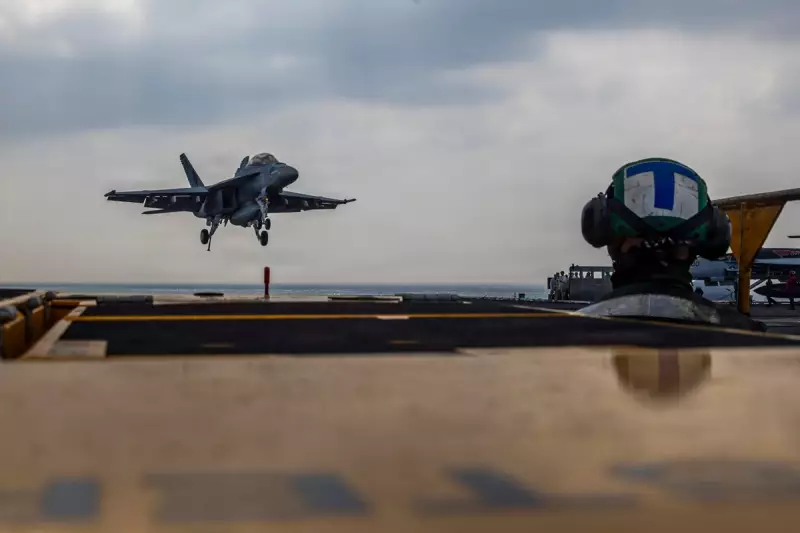
US Aircraft Carrier Strike Group Arrives in Middle East Amid Heightened Regional Tensions
The United States has significantly bolstered its military presence in the Middle East with the arrival of the nuclear-powered aircraft carrier USS Abraham Lincoln and its accompanying strike group. This deployment comes at a time of sustained diplomatic and military friction between Washington and Tehran, primarily concerning Iran's internal crackdown on protesters.
Strategic Deployment and Official Statements
According to a statement released on Monday by U.S. Central Command via social media, the carrier strike group, which includes three guided-missile destroyers, is now operating in the region. The command emphasised that the deployment aims to "promote regional security and stability." Notably, officials clarified that the group is positioned in the Indian Ocean, not the Arabian Sea which directly borders Iran.
This movement reintroduces a substantial carrier presence to the area for the first time since the USS Gerald R. Ford was redirected to the Caribbean in October 2025. The arrival of the Lincoln and its escorts brings thousands of additional U.S. service members and advanced military hardware to the volatile region.

Trump's Warnings and the Iranian Context
President Donald Trump has framed the deployment as a precautionary measure. Speaking to reporters last week, he stated the fleet was sent "just in case," adding, "We have a massive fleet heading in that direction, and maybe we won't have to use it." His comments follow earlier threats of military action if Iran carried out mass executions of prisoners detained during the protest crackdown that began in late December 2025.
The human cost of the unrest remains contested. Activist groups report at least 5,973 fatalities and over 41,800 detentions, while official Iranian figures are significantly lower, citing 3,117 deaths. Recently, President Trump claimed Iran had halted plans to execute 800 detained protesters, a statement Iran's top prosecutor has labelled "completely false." The President has not provided a source for this assertion.
Military Posturing and Air Force Reinforcement
Despite appearing to step back from immediate threats, President Trump has kept military options on the table. Aboard Air Force One last Thursday, he warned that any U.S. action in response to executions would dwarf the scale of last year's strikes on Iranian nuclear sites, which he described as looking "like peanuts" in comparison.
The naval deployment is complemented by an increased U.S. Air Force presence. The military has confirmed that F-15E Strike Eagle fighter jets are now operating in the region. Furthermore, analysts monitoring flight-tracking data have observed dozens of U.S. military cargo planes heading towards the Middle East, indicating a broader logistical build-up.
Historical Parallels and Regional Implications
The current military activity mirrors moves made in 2025, when the U.S. pre-emptively deployed air defence systems, including Patriot missile batteries, ahead of anticipated Iranian retaliation for strikes on nuclear facilities. That earlier escalation saw Iran launch over a dozen missiles at Al Udeid Air Base in Qatar days after the U.S. bombings.
The arrival of the USS Abraham Lincoln strike group underscores the ongoing, high-stakes military diplomacy in the Gulf. It represents a tangible show of force as the U.S. administration continues to apply pressure on Tehran regarding its domestic policies, while simultaneously preparing for potential regional contingencies.