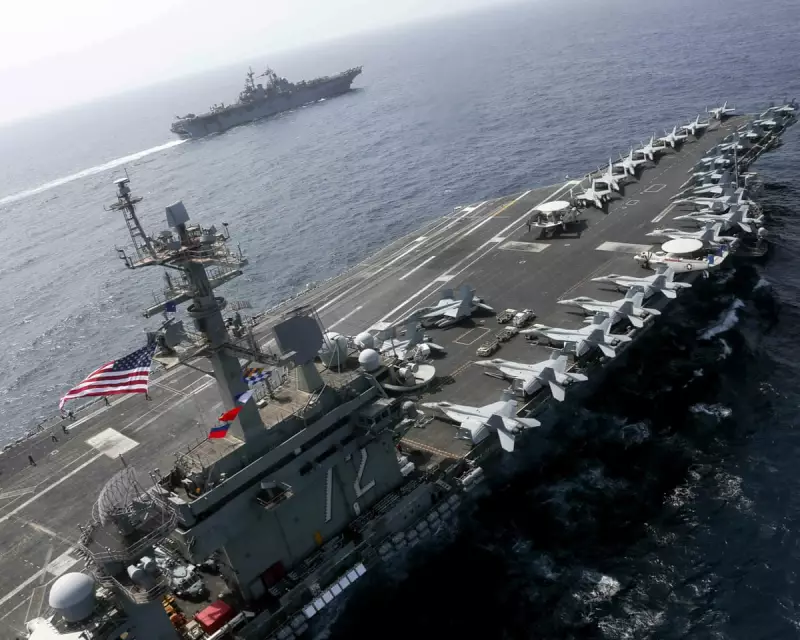
The United States has announced plans to conduct multi-day aerial military exercises in the Middle East, deploying what former President Donald Trump has described as an "armada" led by the nuclear-powered aircraft carrier USS Abraham Lincoln. This move comes amid a tense standoff with Iran, following the Iranian government's crackdown on pro-democracy protesters.
Display of Air Power Amid Escalating Tensions
Air Forces Central, the air component of the US Central Command (CENTCOM), stated on Tuesday that it would hold a "multi-day readiness exercise to demonstrate the ability to deploy, disperse, and sustain combat airpower across the US Central Command area of responsibility." The exercise is designed to enhance asset and personnel dispersal capability, strengthen regional partnerships, and prepare for flexible response execution. While the exact dates, location, and list of military assets involved have not been disclosed, the drills appear intended to showcase US force projection capabilities as tensions with Iran escalate.
USS Abraham Lincoln Arrives in the Region
CENTCOM confirmed on Monday that a large naval deployment, spearheaded by the USS Abraham Lincoln, has arrived in the Middle East. This Nimitz-class aircraft carrier, powered by nuclear reactors, carries several dozen fighter jets and is manned by nearly 5,000 sailors. It is accompanied by several guided missile destroyers equipped with air defences to protect the carrier strike group. This marks the first time an aircraft carrier has been stationed in CENTCOM since the USS Gerald Ford was deployed to the Caribbean in October, ahead of US operations targeting Venezuela's leader Nicolás Maduro.

Additional Military Assets Deployed
In addition to the naval forces, the US has moved a squadron of F-15E Strike Eagle fighter jets to the region, according to reports from the Washington Post. These jets belong to the same unit that participated in strikes on Iran in April 2024. The United Kingdom has also deployed Typhoon jets to the area in a defensive capacity, highlighting the international dimension of the military buildup.
Political Context and Rhetoric
The White House has suggested it could launch new strikes on Iran in response to the government's harsh treatment of protesters, which has resulted in thousands of deaths and many detentions. In an interview with Axios, Trump referred to the US deployment as a "big armada next to Iran" and claimed that Iran "wants to make a deal." He has threatened attacks if Iran carries out mass executions, though he later indicated that "the killing has stopped," temporarily scaling back his rhetoric. However, Trump has left open the possibility of strikes, stating that the carrier group was sent "just in case" and that "maybe we won't have to use it."
Human Rights Concerns and Death Toll Estimates
The crackdown in Iran has led to significant controversy over the death toll. The US-based Human Rights Activists news agency estimates nearly 6,000 fatalities, while the Iranian government admits to just over 3,100. Other activists suggest figures exceeding 30,000, but censorship and an internet blackout have obscured the true scale. These uncertainties complicate international responses and fuel the ongoing diplomatic and military tensions.
Regional Reactions and Partnerships
CENTCOM has indicated that the drills will be conducted in partnership with Middle Eastern nations, including plans with Bahrain for a defensive exercise focusing on counter-drone capabilities. This highlights potential counterattack threats in the event of a US attack on Iran. However, the deployments have strained relations with key US allies. The United Arab Emirates foreign ministry has declared it will not allow its airspace, territory, or waters to be used for attacks on Iran, emphasising neutrality and regional stability. The US air force has committed to conducting all activities with host-nation approval, prioritising safety, precision, and respect for sovereignty.
This multi-faceted military and diplomatic manoeuvring underscores the volatile situation in the Middle East, as the US flexes its military muscle while navigating complex regional alliances and human rights issues.