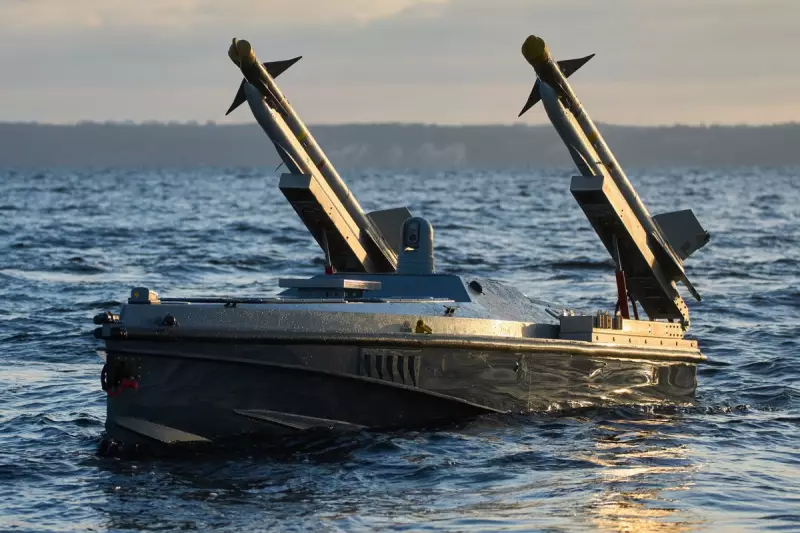
The commander of Ukraine's elite sea drone unit has outlined an ambitious vision for the future of maritime warfare, predicting more sophisticated attacks on Russian forces next year. This comes as Kyiv's fleet of uncrewed vessels has successfully curtailed the operational freedom of Moscow's once-dominant Black Sea Fleet.
Adapting to a New Maritime Reality
In an exclusive interview with The Associated Press, the head of Group 13, a specialised maritime drone unit within Ukraine's military intelligence, stated that the conflict has reached a new phase. The officer, identified only by his call sign "13th", explained that while dramatic, high-profile strikes have become less frequent, Ukraine's drones are effectively limiting enemy movements.
"Today, we've likely reached a plateau," said the commander. "We are effectively limiting the enemy's movements, but those dramatic, high-profile strikes we saw earlier haven't happened for quite some time. That's because the enemy has adapted." He revealed that Russian naval vessels now "barely operate", often venturing only up to 25 miles (40 kilometres) from port to launch missiles before hastily retreating.

The Technology Driving Ukraine's Naval Asymmetry
Drone technology has become a cornerstone of Ukraine's defence, providing cost-effective tools for reconnaissance and strikes. Group 13 operates the Magura family of sea drones, credited with multiple successful attacks on Russian ships. The unit currently deploys two main variants:
- The V5, a smaller model designed for ramming attacks.
- The V7, a larger weapons platform that can be fitted with modified armaments, such as U.S.-made Sidewinder missiles.
In a significant development last May, a Magura drone was used to shoot down a Russian fighter jet, a tactic the commander hailed as a "breakthrough" in naval combat. The officer, who was interviewed in uniform with his face concealed and eyes obscured by tinted glasses, also highlighted the growing role of artificial intelligence. He stated that the next evolutionary step will involve drones using vast archives of operational data to independently search for and classify targets, reducing the workload on human operators.
International Collaboration and Future Prospects
Looking ahead to 2026, Ukraine is actively seeking to expand its capabilities through international partnerships. During President Volodymyr Zelenskyy's visit to Athens in November 2025, Kyiv and Greece announced plans for joint work on maritime drones, expanded training, and intelligence sharing on maritime threats. The commander also indicated that the intelligence service is exploring advanced concepts, including longer-range options, submersible drones, and complex mixed-fleet operations.
Despite Russia's defensive adaptations, the commander remains confident in the strategic impact of the sea drone campaign. "We're working on many fronts to change this situation and create a turning point," he asserted. "For now, I can say this: We haven't lost effectiveness. We've simply reached a point where we're holding the enemy in check." With a "huge amount" of operational data now available to refine AI models, Ukraine's maritime drone forces are poised to enter a new, more autonomous phase of warfare in the coming year.