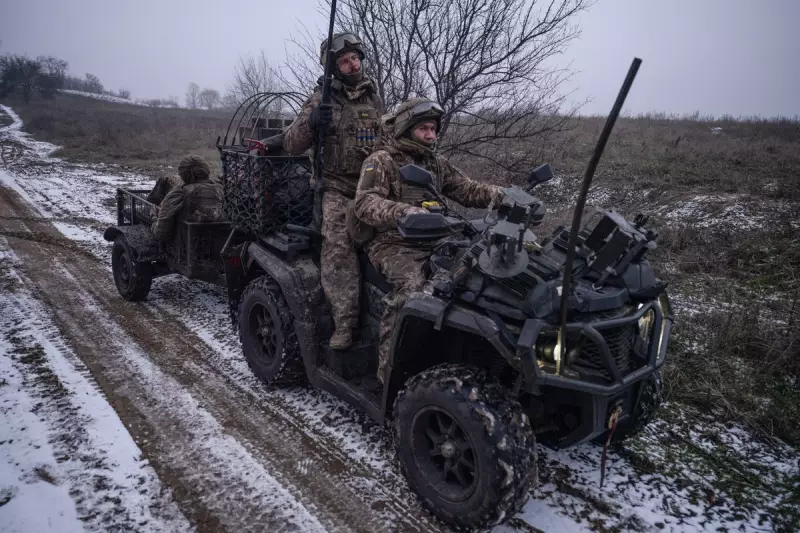
Ukrainian military officials have confirmed the withdrawal of their forces from the strategically important eastern town of Siversk, marking a significant shift in the frontline near Bakhmut. The retreat comes after weeks of intense fighting and follows Russia's earlier false claims of having captured the settlement.
Heavy Fighting Precedes Strategic Withdrawal
In an official statement, Ukraine's General Staff explained the decision, citing a significant numerical advantage held by Russian invaders who applied constant pressure using small assault groups amid difficult weather conditions. The military command emphasised that the withdrawal was conducted to preserve lives and resources, but not before Ukrainian troops inflicted heavy losses on Putin's forces.
Siversk, which had a pre-war population of approximately 10,000 people, forms part of the defensive fortress belt of major Donbas towns still held by Ukraine. Its capture represents a notable, if incremental, advance for Russian forces in the region.

Pope's Plea for Peace Ignored Amid Continued Assaults
The battlefield developments unfolded against a backdrop of diplomatic and spiritual appeals for a holiday pause in hostilities. Pope Leo publicly expressed his profound sadness at Russia's refusal of a proposed Christmas ceasefire.
Speaking to journalists outside his residence in Castel Gandolfo, Italy, the pontiff made a fresh appeal. "I will make an appeal one more time to people of good will to respect at least Christmas Day as a day of peace," he stated, adding a hope that "maybe they will listen to us and there will be at least 24 hours, a day of peace, across the world."
Russia's rejection of the truce was followed by a massive drone and missile attack on Ukraine early on Tuesday, underscoring the continued intensity of the conflict during the festive period.
Explosions in Moscow and Digital Frontline
Meanwhile, within Russia itself, security incidents continued. Several explosions were reported in southern Moscow at the site where Lieutenant General Fanil Sarvarov was killed by a car bomb on Monday. Unofficial Russian Telegram news channels, including Baza and SHOT, reported that a car was detonated, seriously injuring at least two people near a police station.
Russian investigators had previously claimed Sarvarov's assassination, involving a bomb under his Kia Sorento, potentially involved Ukrainian special services.
On a separate front, the digital landscape became a new battleground. Messaging service WhatsApp issued a strong criticism of Russian authorities, accusing them of attempting to deprive over 100 million Russians of private communications ahead of the holidays. The platform reported widespread outages and slowdowns.
A WhatsApp spokesperson argued the restrictions aimed to force people onto less secure, government-mandated apps. This followed a repeated threat from Russia's communications regulator, Roskomnadzor, to completely block the service for alleged violations of Russian law and claims it is used to "organise and carry out terrorist acts."
Diplomatic Moves and Military Claims
On the diplomatic front, Ukrainian President Volodymyr Zelensky revealed that several draft documents, including on security guarantees and a basic framework for ending the war, were prepared following talks between Ukrainian officials and envoys of US President Donald Trump in Miami.
However, the Kremlin downplayed the significance of the discussions. Spokesperson Dmitry Peskov described the talks as a "working process" rather than a breakthrough, stating Russia's priority was to understand Washington's work with Europeans and Ukrainians on a potential settlement.
Concurrently, Russia's defence ministry claimed the capture of the settlements of Prylipka in the Kharkiv region and Andriivka in the Dnipropetrovsk region, alongside strikes on energy and military facilities using Kinzhal missiles. These reports could not be independently verified at the time.
The complex developments across military, diplomatic, and digital spheres paint a picture of a conflict with no respite, even during the Christmas season, as both sides continue to pursue their strategic objectives on multiple fronts.