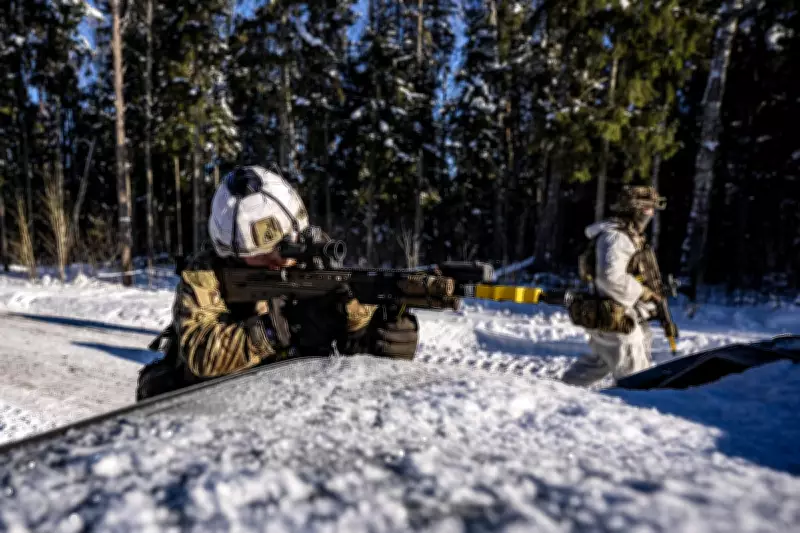
British military personnel are currently facing some of the most challenging environmental conditions imaginable as they participate in a major NATO winter exercise just miles from the Russian border in Estonia. The large-scale drills, taking place at the Tapa military base, are designed to rigorously test and prove the capabilities of allied forces in severe cold weather environments that would be encountered in northern European conflicts.
Extreme Conditions Test Troop Resilience
Temperatures have plummeted to as low as minus 30 degrees Celsius at the camp during this particularly harsh Estonian winter, with night-time readings frequently reaching this extreme level. British soldiers have been navigating through waist and chest-deep snow over recent weeks as part of Exercise Winter Camp, which forms a crucial component of Operation Cabrit - the UK's significant contribution to NATO's Forward Land Forces in the region.
Leadership Praises Troop Adaptation
Captain Hamish MacKellar, from the Royal Anglian Regiment based in Gloucester, commended his troops for taking the formidable challenges "in their stride" despite the extreme conditions. He described how the climate makes every military task incredibly challenging, particularly when soldiers must remain static for extended periods or move through complex terrain while battling deep snow accumulation.

"When you're waist and chest-deep in snow, that challenge becomes exponentially greater," Captain MacKellar explained to reporters. He noted that temperatures of minus 11C recorded on Tuesday felt "positively toasty" compared to previous days, admitting that operating in such climate conditions represented a "very steep learning curve" for all personnel involved.
Morale Maintenance in Freezing Conditions
The captain revealed practical strategies for maintaining troop morale during the extreme cold, emphasizing the importance of constant movement to generate body heat and providing high-quality snacks for energy replenishment. He recounted the emotional experience of the first night when temperatures dropped to minus 25C, praising how well his soldiers have adapted to every demand placed upon them.
"The troops have handled it really well, they've taken it all in their stride, they've adapted to everything we've asked from them," Captain MacKellar stated. "They've put in an incredible effort, they've punched well above their weight over the last few days."
NATO Solidarity Demonstrated Through Training
Lieutenant Colonel Mark Luson, commanding officer of the Royal Tank Regiment, emphasized that NATO feels "stronger than ever" despite recent political tensions within the alliance. The exercise at Tapa military base involves approximately 1,250 troops from multiple NATO nations, including American and French companies operating alongside Estonian partners as part of the Forward Land Force battle group.
Alliance Unity Amid Political Tensions
Recent weeks have seen tensions within NATO following US President Donald Trump's threats to annex Greenland, creating divisions between America and its traditional European allies. However, Lieutenant Colonel Luson confirmed that concerns about the future of the alliance have had no impact on the operational mood at the training range, where NATO troops have gathered specifically to test and prove their capability in extreme cold weather conditions.
"Right now, on this training area, we have got US tank company part of the exercise, we've got the French company as part of the Forward Land Force battle group, and operating alongside Estonian partners as well," Lieutenant Colonel Luson told the Press Association. "So NATO here feels stronger than ever."
Strategic Importance of Winter Warfare Preparedness
The British forces stationed in Estonia and Poland as part of Operation Cabrit represent a critical component of NATO's defensive posture in Eastern Europe. Exercise Winter Camp serves as a vital demonstration of allied commitment to regional security and interoperability between member nations' armed forces. The extreme conditions provide realistic training that prepares troops for potential conflict scenarios in similar environments, ensuring that NATO maintains readiness across all seasonal conditions and geographical challenges.