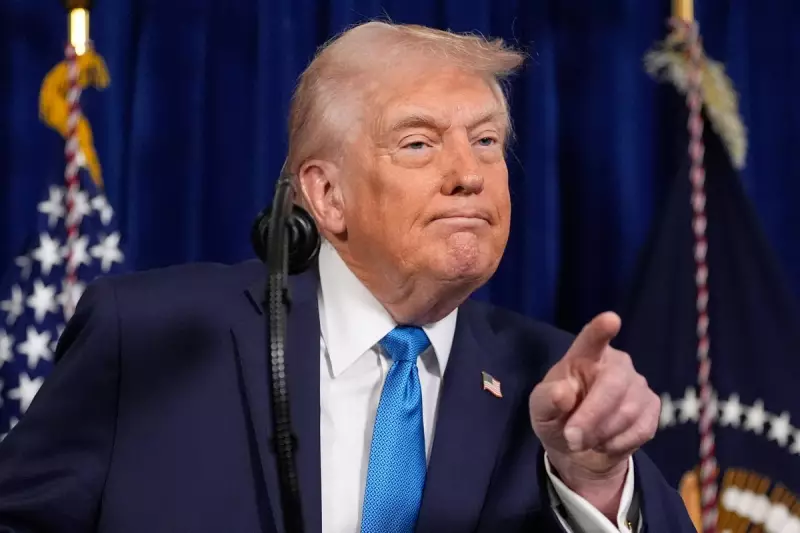
Fresh from a military operation in Venezuela, former US President Donald Trump has dramatically escalated his rhetoric, unsettling allies and adversaries across the Western Hemisphere with renewed calls to acquire Greenland and threats against Colombia and Cuba.
Expanding Ambitions: From Venezuela to the Arctic
The assertive statements, made on Sunday 5th January 2026, follow last week's US-led invasion of Venezuela which resulted in the capture of President Nicolás Maduro. Trump declared the US was now "in charge" of Venezuela, pressing acting president Delcy Rodríguez to fall in line.
On a flight back to Washington, Trump turned his attention northwards, reigniting his long-standing interest in Greenland. He cited national security, claiming the vast Arctic island was "covered with Russian and Chinese ships" and that Denmark, which holds sovereignty, was incapable of managing it. He pointedly refused to rule out using military force to take control.

Trump's ambitions are framed within a revived doctrine of American preeminence. His administration's recent National Security Strategy and references to a modernised "Monroe Doctrine" – which he jokingly called the "Don-roe Doctrine" – signal a sweeping approach to regional influence.
Allies Alarmed and Adversaries Warned
The comments provoked an immediate and sharp rebuke from Denmark. Prime Minister Mette Frederiksen stated Trump had "no right to annex" Greenland and urged the US to stop threatening a close NATO ally. The tension was further inflamed by a social media post from a former Trump aide featuring a US-flag coloured map of Greenland captioned "SOON".
Simultaneously, US Secretary of State Marco Rubio issued a stern warning to Cuba, a key Venezuelan ally. Appearing on NBC's "Meet the Press", Rubio accused Cuban officials of guarding Maduro and managing intelligence within his government. Trump predicted Cuba's economy, already strained by a US embargo, was "going down for the count" following Maduro's ouster.
Colombia and its leftist President Gustavo Petro were also put on notice. Trump, returning to Washington, labelled Petro a "sick man who likes making cocaine and selling it to the United States". When asked about a potential US operation against Colombia, Trump replied, "It sounds good to me." His administration had previously sanctioned Petro and slashed aid over drug trade accusations.
A Hemisphere on Edge
The rapid sequence of events – the Venezuela invasion followed by open speculation about further territorial and military actions – has sent shockwaves through international diplomacy. The European Union, with Denmark's support, has emphasised the need to respect Venezuela's right to self-determination.
The overarching question now haunting capitals from Copenhagen to Bogotá and Havana is clear: in Trump's second-term pursuit of hemispheric dominance, who will be next? The administration's blend of historical precedent, security strategy, and blunt threats marks a volatile new chapter in regional politics, leaving traditional alliances strained and raising the spectre of further instability.