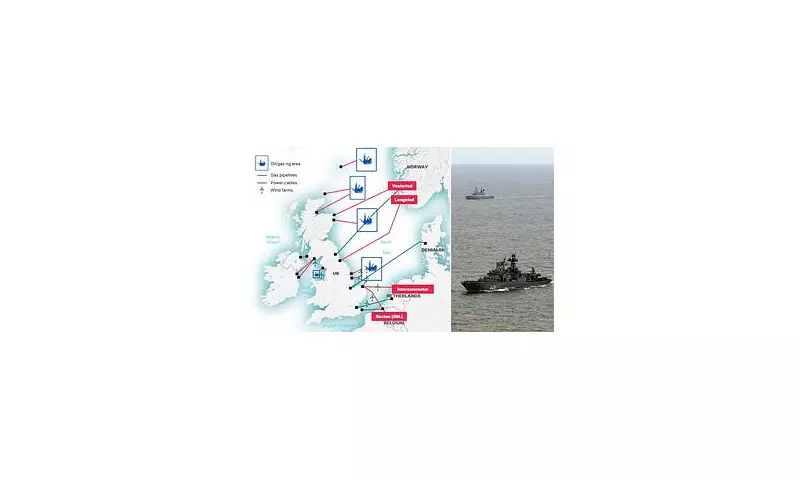
The head of the Royal Navy has issued a stark warning that Britain's critical internet cables and gas pipelines on the seabed are under direct threat from a shadowy and highly capable Russian underwater sabotage unit.
Russia's 'Reset' of Elite Deep-Sea Sabotage Force
General Sir Gwyn Jenkins, the First Sea Lord, revealed that Moscow is once again channelling significant funds into its elite Main Directorate of Deep-Sea Research, known as GUGI. This secretive force, comprised of expert submariners and specialised mini-submersibles, is capable of operating at extreme, crushing depths to carry out what Jenkins termed 'physical action' against vital infrastructure.
'We've seen GUGI's subsurface capabilities restarting,' Jenkins stated. 'We know that they've had some issues with that programme. It appears that they have reset that programme. So we're expecting them to deploy again.' This marks a concerning resurgence after the unit suffered a major blow in 2019, when 14 senior officers died in a fire aboard the deep-diving submarine Losharik.

Mapping and Threatening Vital Lifelines
The unit's primary task is to map and potentially sabotage the dense network of undersea fibre-optic cables and pipelines that keep Britain and its NATO allies connected to the global internet and supplied with energy. Jenkins warned that Russia's underwater reach is 'improving all the time', granting the Kremlin dangerous options.
Concern in Whitehall has escalated following revelations this year that one of GUGI's so-called 'research' ships, the Yantar, was observed loitering over cables linking the UK and Ireland. The vessel can deploy submersibles capable of diving to 6,000 metres. While Jenkins did not specify the exact nature of 'physical action', security experts fear it could involve severing cables or planting explosives at critical junctions.
'You have an aggressive regime with an acknowledged capability, an acknowledged desire to implement sabotage... and you have a facility that enables them to go to depths with submersibles on mapped infrastructure that is sensitive to us,' Jenkins said. 'That doesn't seem like a good combination to me.'
Britain's Response and the 'False Comfort' of an Island
In response to the growing threat, the Royal Navy has forged a new defence pact with Norway, a key partner in monitoring Russian movements through the strategic GIUK gap. It has also announced initial contracts worth £4 million for a new underwater surveillance system named Atlantic Bastion, which will use acoustic sensors and autonomous vessels to detect hostile activity. A further £35 million is anticipated next year.
Jenkins stressed the immediacy of the danger, dismissing any notion of geographical safety. 'We effectively... do have a border with Russia. It's the open seas to our north,' he cautioned, adding that the comfort Britain takes from being an island separated from continental Europe is a 'false comfort'.
The tension was highlighted last month when the Yantar shone lasers at RAF aircraft near Shetland, prompting a rare public rebuke from the Ministry of Defence. Defence Secretary John Healey warned the UK had 'military options ready' if such behaviour continued.
Jenkins expressed concern over the risk of miscalculation, noting an 'opaqueness' in how Russia understands its own escalatory actions. His warning aligns with mounting alarm from other security chiefs. MI6 head Blaise Metreweli has accused Russia of 'testing' the UK through sabotage and cyber attacks, while the head of the Armed Forces warned Moscow seeks to undermine NATO.
Healey summarised the challenge: 'We are living in a new era of threat which is less predictable and more dangerous.' He confirmed that Russia is actively mapping undersea cables and networks, stating that the Atlantic Bastion project is designed to 'detect, deter and defeat those who threaten us'.