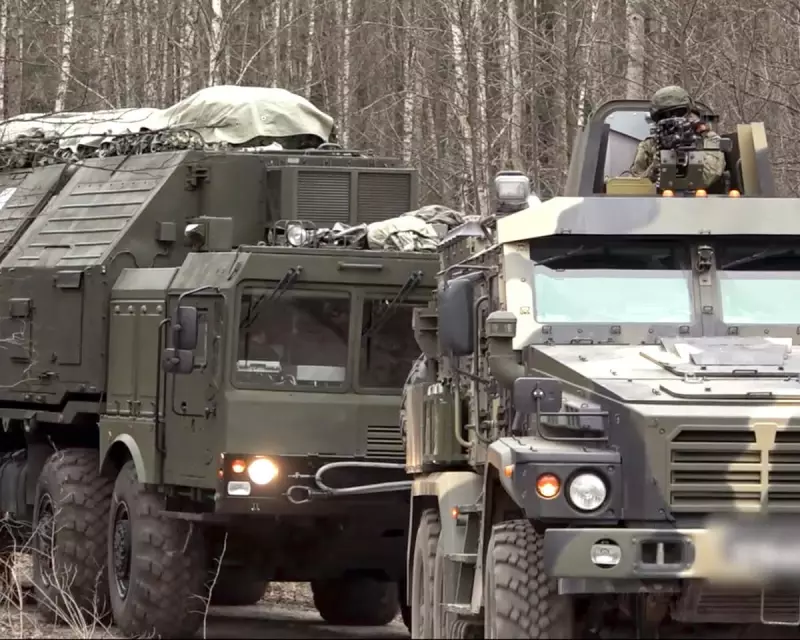
Russia has announced the deployment of its latest nuclear-capable missile system to Belarus, a move that dramatically escalates military tensions in Eastern Europe. The Kremlin linked the decision to what it described as a large-scale Ukrainian drone attack on President Vladimir Putin's residence, a claim vehemently denied by Kyiv.
A Choreographed Display of Force
Footage released by the Russian defence ministry showed the new Oreshnik missile system being transported through a snowy forest. The video depicted soldiers camouflaging combat vehicles and raising a flag at an airbase in eastern Belarus, close to the Russian border. Analysts view the release as a carefully staged attempt to intimidate European nations and prepare the Russian public for a potential further escalation in the war against Ukraine.
The deployment, confirmed by Belarusian President Alexander Lukashenko, who stated ten such systems would be stationed in his country, symbolically reduces the flight time for a Russian missile to reach an EU capital. President Putin announced the systems were entering active service during a meeting with his military commanders on Monday, where he reaffirmed his intention to seize more Ukrainian territory, including the city of Zaporizhzhia.

Unsubstantiated Claims and Diplomatic Fallout
The missile move came a day after Russian Foreign Minister Sergei Lavrov warned of "reprisals" against Kyiv, alleging a Ukrainian attack involving 91 drones targeting Putin's palace in the Novgorod region on Sunday night. However, the Kremlin has provided no evidence to support these allegations. Putin's spokesperson, Dmitry Peskov, stated on Tuesday that no proof would be offered as all missiles were allegedly shot down, and he could not comment on the absence of debris.
Reports from independent Russian media and local residents contradict the official story. They noted no sounds of explosions or anti-aircraft fire, no air raid alert, and a lack of the usual mobile phone footage documenting such incidents. In response, Ukraine's Foreign Minister, Andrii Sybiha, labelled the Russian narrative as fabricated. "Almost a day passed, and Russia still hasn't provided any plausible evidence... No such attack happened," he stated on social media platform X.
International Reactions and Peace Efforts
The incident has stirred international reactions, with US President Donald Trump angrily endorsing Russia's account, stating Putin had informed him of the attack directly. Meanwhile, Sybiha expressed irritation with countries like India, Pakistan, and the UAE for expressing concern over the unverified reports.
Ukrainian officials shifted focus to ongoing diplomatic efforts, following President Volodymyr Zelenskyy's two-hour meeting with Trump in Florida. Discussions centred on a 20-point peace plan involving US post-war security guarantees for Kyiv. Zelenskyy suggested the Russian accusations were "fake news" prompted by the progress of these talks, aimed at derailing any positive outcome.
With a key European conference on the conflict scheduled for 6 January in France, commentators warn that the situation is perilous. "If the potential ceasefire monitoring will be done by the same people who now believe what Russia is saying – we are in big trouble," said Phillips O'Brien, a professor of strategic studies at the University of St Andrews.