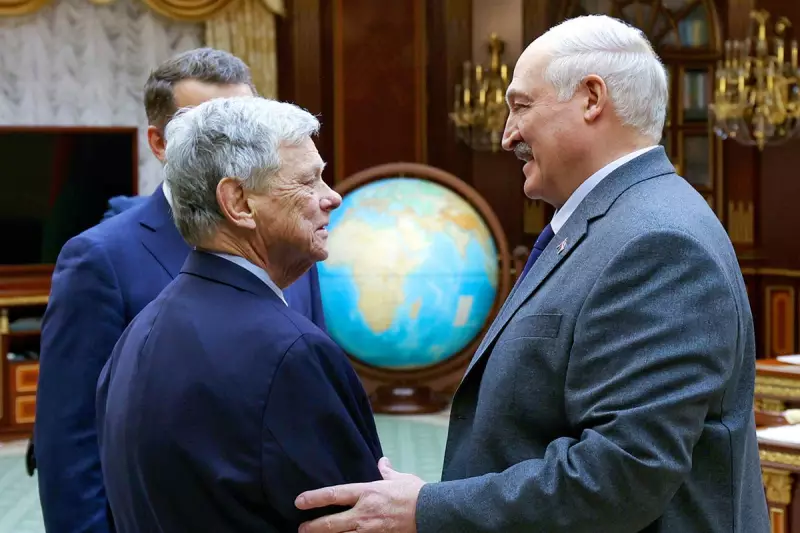
Belarus's authoritarian president, Alexander Lukashenko, has confirmed that Russia has stationed its newest nuclear-capable missile system, the Oreshnik, inside his country. The announcement on Thursday, 18 December 2025, comes at a pivotal moment in diplomatic efforts to end the war in Ukraine.
Deployment Details and Strategic Implications
President Lukashenko stated that the Oreshnik intermediate-range ballistic missile system arrived in Belarus on Wednesday and is now entering combat duty. He provided no specifics on the number of launchers or missiles deployed. This move follows a statement a day earlier by Russian President Vladimir Putin, who confirmed the Oreshnik would be operational this month.
Putin issued a stark warning during a meeting with senior military officials, declaring that Moscow would seek to expand its territorial gains in Ukraine if Kyiv and its Western allies reject the Kremlin's conditions in ongoing peace negotiations. The deployment significantly escalates military tensions in Eastern Europe.

Capabilities and Threats of the Oreshnik System
The Oreshnik, whose name translates to 'hazelnut tree', represents a major advancement in Russian missile technology. Putin has repeatedly boasted that the system is impossible to intercept, with its multiple warheads capable of plunging towards targets at speeds of up to Mach 10.
Russian state media has claimed the missile could reach a Polish airbase in just 11 minutes and NATO headquarters in Brussels within 17 minutes. A key feature is its ambiguity: there is no way for defenders to discern whether an incoming Oreshnik carries a conventional or a nuclear warhead until impact. Putin has warned that a conventional strike with several of these missiles could be as devastating as a nuclear attack.
This deployment is not Russia's first nuclear-related move in Belarus. The country already hosts several dozen Russian tactical nuclear weapons, and its territory was used as a launchpad for the full-scale invasion of Ukraine in February 2022. A revised Russian nuclear doctrine in 2024 formally extended its nuclear umbrella over Belarus.
Diplomatic Context and Lukashenko's Balancing Act
The missile deployment unfolds against a backdrop of intense diplomatic activity. U.S. President Donald Trump has launched a major push to end the nearly four-year conflict, though Washington's efforts are complicated by the sharply conflicting demands of Moscow and Kyiv.
While maintaining a strong alliance with Moscow, Lukashenko has simultaneously sought a rapprochement with the West. In a notable gesture, he freed 123 political prisoners on Saturday, including Nobel Peace Prize laureate Ales Bialiatski. This was part of a deal with Washington that lifted U.S. sanctions on Belarus's vital potash industry.
The Oreshnik's deployment also highlights the collapse of arms control. Intermediate-range missiles, capable of flying between 500 to 5,500 kilometres, were banned under a Cold War-era treaty that both the U.S. and Russia abandoned in 2019.