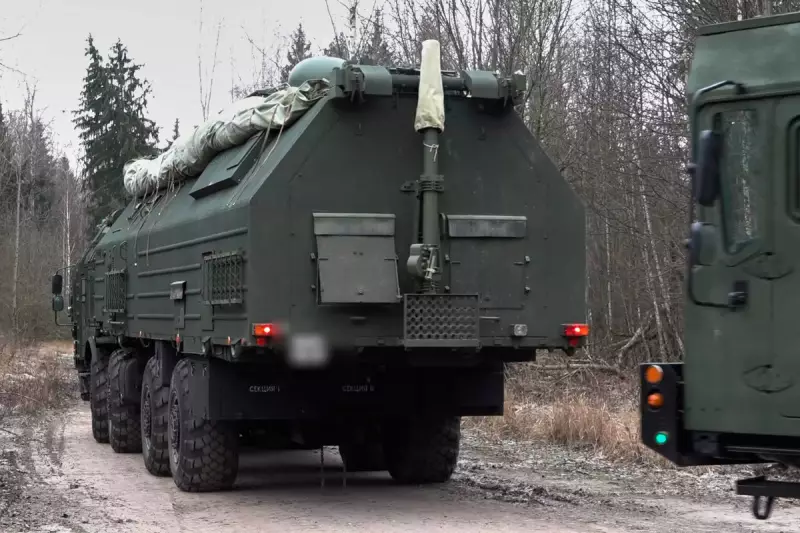
Russia has formally placed its advanced, nuclear-capable Oreshnik missile system into active military service, the country's defence ministry confirmed on Tuesday, 30 December 2025. The activation ceremony was held with troops in neighbouring Belarus, marking a significant strategic deployment during a critical phase of diplomacy over the war in Ukraine.
A Strategic Deployment Amid Delicate Diplomacy
The Ministry of Defence announced the system was now operational but provided no specifics on the number of missiles deployed or their precise locations within Belarus. This move fulfils a promise made by President Vladimir Putin in December, when he stated the Oreshnik would achieve combat readiness before the year's end.
This announcement arrives during a highly sensitive period for peace discussions. The development follows a meeting between former US President Donald Trump and Ukrainian leader Volodymyr Zelenskyy in Florida on Sunday, 28 December. Trump claimed the two warring nations were "closer than ever before" to a settlement, though he cautioned that the US-led negotiations could still fail.

Key stumbling blocks remain, including disputes over territorial withdrawals and the status of the Russian-occupied Zaporizhzhia nuclear power plant, one of the largest such facilities in the world.
Putin's Position of Strength and the Oreshnik's Capabilities
President Putin has consistently framed the negotiations from a position of military strength. At a meeting with senior officers on Monday, 29 December, he reiterated demands for buffer zones along Russia's border and claimed advances in Ukraine's Donetsk and Zaporizhzhia regions.
The Oreshnik system, whose name translates to "hazelnut tree," is a potent symbol of this posture. Moscow first used the experimental weapon in November 2024, striking a former Soviet missile factory in Dnipro, Ukraine.
Putin has publicly praised the system's formidable design, highlighting features that pose a direct challenge to Western defences:
- Hypersonic Speed: Its multiple warheads can approach targets at speeds of up to Mach 10.
- Interception Immunity: Russian officials claim the warheads cannot be shot down by existing missile defence systems.
- Dual-Capability: The missiles can be armed with either conventional or nuclear warheads.
- European Reach: The head of Russia's missile forces has stated the Oreshnik's range covers all of Europe, classifying it as an intermediate-range weapon (500-5,500 km).
Putin has explicitly warned that the system could be used against NATO allies who permit Ukraine to use their long-range weapons to strike inside Russian territory.
Broader Context and Treaty Implications
The deployment of the land-based Oreshnik further erodes the remnants of Cold War arms control. Intermediate-range missiles of this type were banned under the 1987 Intermediate-Range Nuclear Forces (INF) Treaty, a pact from which both the United States and Russia withdrew in 2019.
By stationing the system in Belarus, Russia extends its potential strike capability deeper into Europe, a move analysts see as both a tactical military enhancement and a strategic signal to the West during the ongoing Ukraine conflict. The activation underscores the complex and tense backdrop against which all diplomatic efforts to end the war are currently playing out.