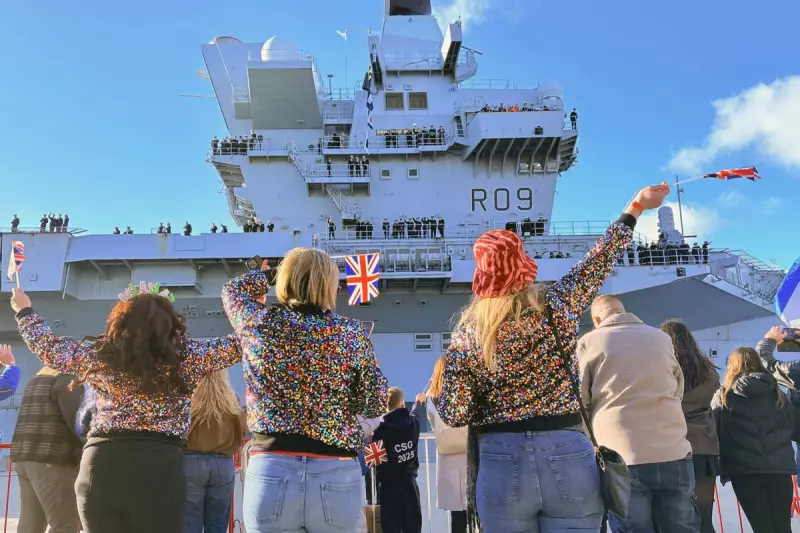
Emotional Homecoming for Thousands of Service Families
Thousands of British service personnel have been joyfully reunited with their loved ones just in time for the festive season, as the Royal Navy's flagship HMS Prince of Wales and its supporting vessels returned to their home ports. This marks the largest naval homecoming witnessed in two decades, bringing immense relief and happiness to families who had endured months of separation.
The arrival was strategically brought forward due to forecasts of severe weather conditions expected on Monday, ensuring the safe return of all personnel. The sight of cheering families and friends waving enthusiastically from the docks created a heartwarming scene at Portsmouth Naval Base.
Operation Highmast: A Global Deployment Concludes
The monumental homecoming concludes Operation Highmast, an extensive eight-month deployment that saw the carrier strike group cover approximately 40,000 nautical miles. The mission involved crucial diplomatic visits and military exercises with allied nations across multiple regions including the Mediterranean, Middle East, south-east Asia, and the Indo-Pacific, with significant engagements in Australia and Japan.

The deployment involved a substantial international force of more than 2,500 military personnel, comprising approximately 2,100 British personnel, 200 Norwegians, and similar numbers of Canadian and Spanish forces. During major exercises, these numbers swelled to an impressive 4,500 personnel demonstrating the scale of international cooperation.
Alongside HMS Prince of Wales, the Type 45 destroyer HMS Dauntless also returned to Portsmouth, while frigate HMS Richmond made its way back to Plymouth. The Norwegian vessel HNoMS Roald Amundsen returned to its home port in Norway, completing the coordinated return of the entire strike group.
Leadership Praise and Family Reunions
Defence Secretary John Healey MP expressed his pride in the deployment's success, stating: "The safe return of our carrier strike group marks the successful conclusion of one of the most significant UK deployments in years. Over the past eight months, our servicemen and women have demonstrated the very best of Britain's military."
He emphasized the strategic importance of the mission, noting that the personnel had operated seamlessly with 12 allies across vast distances, strengthening vital partnerships and demonstrating that Britain remains open for business and committed to global security.
Commodore James Blackmore, the Carrier Strike Group commander, highlighted the achievement of reaching full operating capability, calling it "a testament to the hard work both on Operation Highmast and of those who have served before us to reach this milestone."
The human stories behind the homecoming were equally compelling. Lieutenant Simon Hall from Yeovilton, Somerset, welcomed home his wife Lieutenant Commander Phoebe Hall with their five-year-old daughter Ophelia. "Phoebe joined in Japan so it's been four months of solo daddying whilst maintaining the day job," he shared, adding that having her back for the Christmas season was "the icing on the cake."
For the Aspin family, who traveled 350 miles from Manchester, the reunion marked the end of an eight-month separation. Anne Aspin and her children William, nine, and Jessica, thirteen, expressed both the difficulties of the extended absence and their excitement about having Chief Petty Officer Chris Aspin home for Christmas.
The Ministry of Defence underscored the economic significance of the deployment, noting that trade with the Indo-Pacific region alone is worth more than £280 billion – representing almost 20% of all UK trade. The carrier strike group hosted major trade and investment summits in Singapore, Australia, and Japan during its deployment, actively contributing to driving economic growth in the United Kingdom.