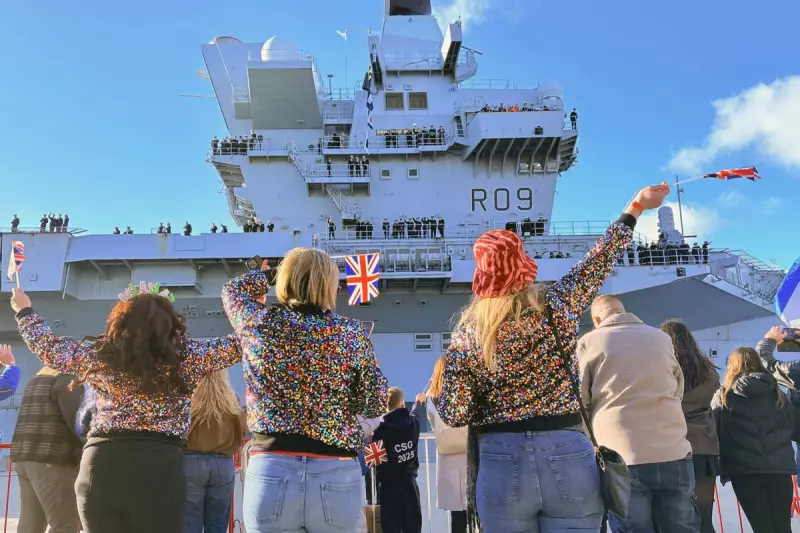
Thousands of British service personnel have experienced an emotional reunion with their loved ones just in time for the festive season, as the Royal Navy's flagship HMS Prince of Wales and its supporting vessels returned to their home ports.
Historic Naval Homecoming
This marks the largest naval homecoming in two decades, with the Queen Elizabeth-class aircraft carrier and the Type 45 destroyer HMS Dauntless sailing into Portsmouth Naval Base to cheering crowds of family and friends. The arrival was strategically brought forward due to forecasts of severe winds expected on Monday.
The homecoming wasn't limited to Portsmouth. Frigate HMS Richmond, also part of the carrier strike group (CSG), returned to Plymouth during the weekend, while the Norwegian vessel HNoMS Roald Amundsen headed back to its home port in Norway. Fast jet and helicopter crews were similarly reunited with their families at RAF Marham, RNAS Culdrose, and RNAS Yeovilton.

A Monumental Global Deployment
The naval ships concluded an extensive 40,000 nautical mile voyage as part of Operation Highmast. This eight-month deployment involved diplomatic visits and military exercises with allied nations across the Mediterranean, Middle East, south-east Asia, and the Indo-Pacific, including stops in Australia and Japan.
The scale of the operation was significant, involving more than 2,500 military personnel. This force comprised approximately 2,100 Britons, 200 Norwegians, and a similar contingent of Canadian and Spanish personnel. During the main exercises, these numbers swelled to around 4,500 participants.
Official Reactions and Family Joy
Defence Secretary John Healey MP hailed the deployment's success, stating: "The safe return of our carrier strike group marks the successful conclusion of one of the most significant UK deployments in years." He praised the servicemen and women for demonstrating the best of Britain's military and strengthening vital international partnerships.
Commodore James Blackmore, CSG commander, reflected on the achievement: "It has been a privilege to lead the nearly 4,000 soldiers, sailors, aviators and marines... The strike group has come home stronger for Nato than it departed." He also noted that the UK Carrier Strike Group had recently reached full operating capability, a key milestone.
The human stories of reunion were equally powerful. Lieutenant Simon Hall, from near Yeovilton, was at the jetty with his five-year-old daughter Ophelia to welcome home his wife, Lieutenant Commander Phoebe Hall. "Phoebe joined in Japan so it’s been four months of solo daddying whilst maintaining the day job," he said, adding that having her back for the festive season was "the icing on the cake." Young Ophelia simply said, "It’s been hard."
The Aspin family travelled 350 miles from Manchester for their reunion. Anne Aspin and her children William, nine, and Jessica, 13, had not seen Chief Petty Officer Chris Aspin for the entire eight-month deployment. "It’s been hard," Anne admitted. William said he was "looking forward to him being back," while Jessica offered a touch of teenage humour: "I haven’t missed beard rash and him standing in front of the TV, but I’ve missed him a lot."
An MOD spokesman highlighted the deployment's economic significance, noting it showcased that Britain is open for business. Trade with the Indo-Pacific region alone is worth over £280 billion, accounting for nearly 20% of all UK trade. The carrier strike group hosted major trade and investment summits in Singapore, Australia, and Japan, helping to drive economic growth back in the UK.