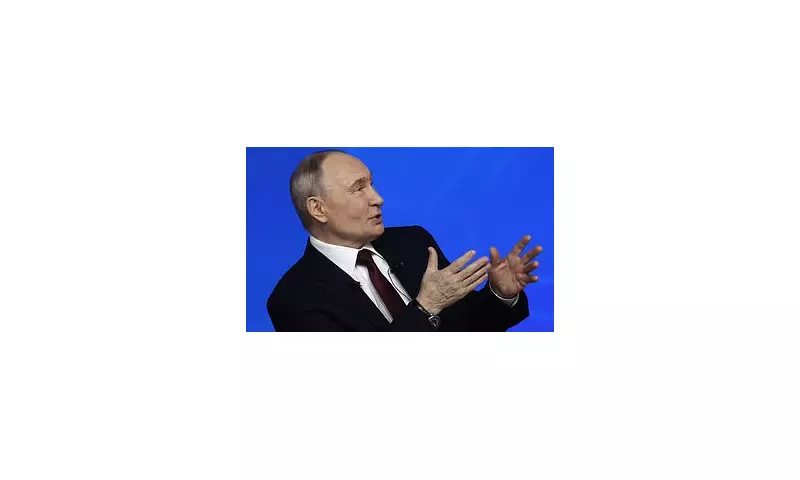
Russian President Vladimir Putin has issued a stark warning about the potential for nuclear conflict while simultaneously dismissing the possibility of peace negotiations with his Ukrainian counterpart, Volodymyr Zelensky. The comments came during a wide-ranging press conference in Moscow, where Putin projected confidence in Russia's military position but acknowledged the severe human cost of the ongoing war.
Putin's Defiant Stance on War and Diplomacy
During the lengthy session with journalists, the Russian leader was unequivocal in his rejection of engaging with President Zelensky. He stated that talks with the current Ukrainian leadership were pointless, insisting that Russia would only negotiate with the United States regarding the conflict's future. This position effectively slams the door on direct Ukrainian involvement in any near-term diplomatic settlement.
Putin framed the invasion, which began on 24 February 2022, as a necessary 'special military operation' to protect Russian interests. He presented a grim assessment of the battlefield, claiming that Ukrainian losses are five times higher than Russia's, a figure that cannot be independently verified and is disputed by Western intelligence. Despite these assertions, he admitted that the war has required a significant mobilisation of Russian society and the economy, with over 600,000 troops currently deployed in Ukraine.

Nuclear Rhetoric and International Tensions
The most alarming segment of the conference centred on nuclear weapons. Putin explicitly warned that the risk of nuclear war was rising, a statement designed to deter increased Western support for Kyiv. He argued that Russia's nuclear doctrine, which allows for use in response to existential threats, is clear and that Moscow is prepared to defend its sovereignty.
This nuclear sabre-rattling coincides with reports of US nuclear weapons being stationed in several European NATO countries, a point of deep contention for the Kremlin. Putin suggested that the withdrawal of these weapons could be a subject for discussion with Washington, linking strategic arms control to the broader European security crisis precipitated by his invasion.
The Human and Political Cost
Beyond the geopolitical posturing, the press conference touched on the war's profound domestic impact. Putin confirmed that 617,000 Russian troops are fighting in Ukraine, with 244,000 of those mobilised specifically for the conflict. He offered rare, if limited, condolences for the fallen, stating that every loss is a tragedy, though he quickly pivoted to justifying the sacrifices as essential for the motherland.
The Russian president also addressed the recent death of opposition leader Alexei Navalny, calling it a 'sad event' but denying any state involvement. He revealed that a prisoner swap involving Navalny had been discussed days before his sudden death in an Arctic penal colony, claiming he had agreed to the exchange on the condition that Navalny never return to Russia.
As the war approaches its third year with no end in sight, Putin's press conference signals a hardening of positions. The combination of dismissed diplomacy, heightened nuclear rhetoric, and a focus on direct dealings with the US suggests a prolonged and dangerous phase of the conflict lies ahead, with Ukraine's sovereignty and European security hanging in the balance.