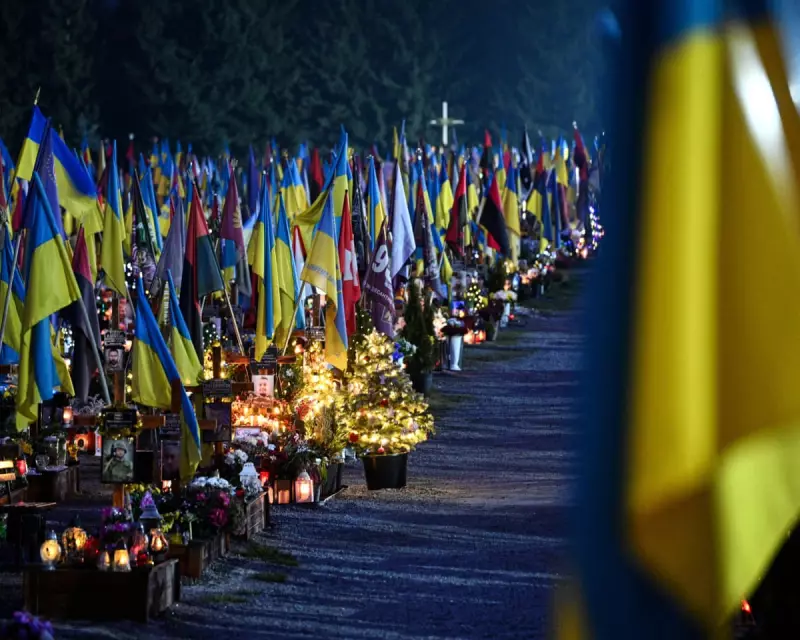
As the world prepared for Christmas, a sombre scene unfolded at the Lychakiv military cemetery in Lviv, Ukraine. On the day before Christmas Eve, the graves of fallen Ukrainian soldiers were decorated with Christmas trees and New Year ornaments, a poignant reminder of the heavy cost of war during a season of peace.
Pope's Call for Peace Meets Russian Rejection
This act of remembrance came as Pope Leo XIV made a heartfelt plea for a global ceasefire on Christmas Day. Speaking from his residence near Rome on Tuesday, the Pontiff expressed his "great sadness" that "apparently Russia rejected a request" for a truce. He renewed his call for "all people of good will to respect a day of peace" on the feast of the birth of Christ.
Russia has consistently dismissed calls for a ceasefire in its war on Ukraine, arguing that any pause would only provide a military advantage to Kyiv. The Pope's hopes for "24 hours of peace in the whole world" were dashed by this stance, highlighting the deep divisions the conflict has fostered.

Massive Russian Assault Casts Shadow Over Holidays
Simultaneously, a massive Russian drone and missile offensive brought devastation to Ukraine just two days before Christmas. The attack, which began overnight and continued into Tuesday morning, involved more than 650 drones and over 30 missiles.
The consequences were severe. At least three people were killed, including a four-year-old child. The strikes also cut power to several regions as Ukraine entered a period of intensely cold weather. The assault was so extensive that Poland scrambled fighter jets to protect its own airspace.
Ukrainian President Volodymyr Zelenskyy condemned the timing of the attack on Telegram, stating, "A strike before Christmas, when people want to be with their families, at home, in safety … Putin cannot accept the fact that we must stop killing."
Escalation and Strategic Moves on Both Sides
In response, Ukraine targeted Russian energy infrastructure, striking a petrochemical plant in the Stavropol region. Regional governor Vladimir Vladimirov reported a fire engulfing the industrial area, with footage showing towering flames.
This exchange of blows occurred against a backdrop of diplomatic activity. Over the weekend, separate meetings were held in Miami involving Donald Trump's envoy, Steve Witkoff, and representatives from Russia and Ukraine. While Witkoff described the talks as "constructive," no major breakthroughs were apparent.
President Zelenskyy confirmed he was briefed on the state of these talks on Tuesday, revealing that "several draft documents have now been prepared." These reportedly include an outline for ending the war, options for Ukraine's future security guarantees, and plans for postwar reconstruction.
On the ground, the Ukrainian military confirmed a tactical withdrawal from the eastern town of Siversk in the Donetsk region after fierce battles. The army stated the move was necessary "to preserve the lives of our soldiers and the combat capability of our units," adding that fighting continued on the town's outskirts. Russia had announced the capture of Siversk almost two weeks prior.
In a concerning development for nuclear safety, the director of the defunct Chernobyl power station, Sergiy Tarakanov, warned that another Russian strike could collapse the facility's internal radiation shelter. He told Agence France-Presse that a direct hit could cause a "mini-earthquake" in the area, jeopardising the structure. Full restoration of the shelter could take three to four years.
Meanwhile, in Moscow, Russian authorities opened a criminal case after an incident in southern Moscow injured traffic police officers. Several explosions were reported in the same area where Lt Gen Fanil Sarvarov was killed by a car bomb on Monday. Russian investigators are examining possible involvement by Ukrainian special services, though the reports could not be independently verified.
As Christmas arrived, the decorated graves in Lviv stood as a silent testament to a war that, despite calls for peace from the highest levels, showed no sign of a holiday ceasefire.