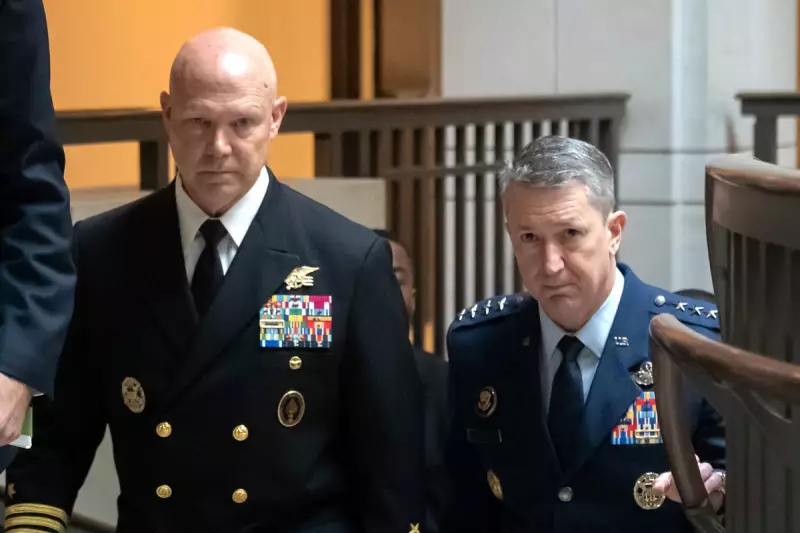
A top US Navy admiral, who reportedly authorised a lethal strike against survivors of an attack on a suspected narcotics vessel, faced a closed-door, classified briefing with senior lawmakers on Capitol Hill on Thursday. The hearing forms a crucial part of a mounting congressional investigation into the controversial military operation.
Mounting Pressure Over a Controversial Order
Admiral Frank “Mitch” Bradley, joined by General Dan Caine, Chairman of the Joint Chiefs of Staff, met with leaders of the House and Senate Armed Services and Intelligence committees. The briefing centres on a September 2nd incident in international waters near Venezuela, following a Washington Post report that Bradley ordered an attack on two survivors to comply with Defence Secretary Pete Hegseth’s directive to “kill everybody.”
Connecticut Representative Jim Himes, the top Democrat on the House Intelligence Committee, emerged from the secure briefing visibly shaken. “What I saw in that room was one of the most troubling things I’ve seen in my time in public service,” he told reporters. “You have two individuals in clear distress without any means of locomotion, with a destroyed vessel were killed by the United States.”

Demands for Transparency and Accountability
Lawmakers from both parties are now demanding a full accounting. Key questions include the precise nature of the orders given by Secretary Hegseth and the justification for the follow-on strike. Democrats are pressing the Trump administration to release the full video of the attack and all related written records and directives.
While Republicans controlling the security committees have not publicly called for the documents, they have pledged a thorough review. “The investigation is going to be done by the numbers,” said Mississippi Senator Roger Wicker, who leads the Senate Armed Services Committee. “We’ll find out the ground truth.”
The scope of the inquiry remains unclear, but lawmakers have formally requested:
- The executive orders authorising the operations.
- Complete videos from the strikes.
- The intelligence identifying the vessels as targets.
- The rules of engagement and criteria for determining combatants.
A Career Officer Under Scrutiny
At the time of the attack, Admiral Bradley was commander of the Joint Special Operations Command. A decorated Navy SEAL with over three decades of service, he was promoted to lead US Special Operations Command about a month after the September strike. His latest promotion to admiral was approved by a unanimous Senate voice vote this year, with senators from both parties previously praising his record.
Virginia Senator Mark Warner, ranking Democrat on the Senate Intelligence Committee, stated he had “great respect for his record” but was “expecting Bradley to tell the truth and shed some light on what actually happened.”
However, even supportive lawmakers like North Carolina Senator Thom Tillis have warned of consequences if wrongdoing is found. “Anybody in the chain of command that was responsible for it, that had vision of it, needs to be held accountable,” he said.
Pressure continues to build on Defence Secretary Hegseth, who has defended the operation, citing the “fog of war” and stating he “didn’t stick around” for the second strike but that Bradley “made the right call.” President Trump has stood by his defence secretary. Meanwhile, more than 80 people have been killed in a series of strikes against drug cartels that began in September, a campaign the administration justifies by labelling the groups “narco-terrorists.”
For critics like Connecticut Senator Richard Blumenthal, the questions about killing survivors stem from an operation already on shaky legal ground. “He may not have been in the room, but he was in the loop,” Blumenthal said of Hegseth. “And it was his order that was instrumental and foreseeably resulted in the deaths of these survivors.”