The Miniature Missile Changing Modern Warfare
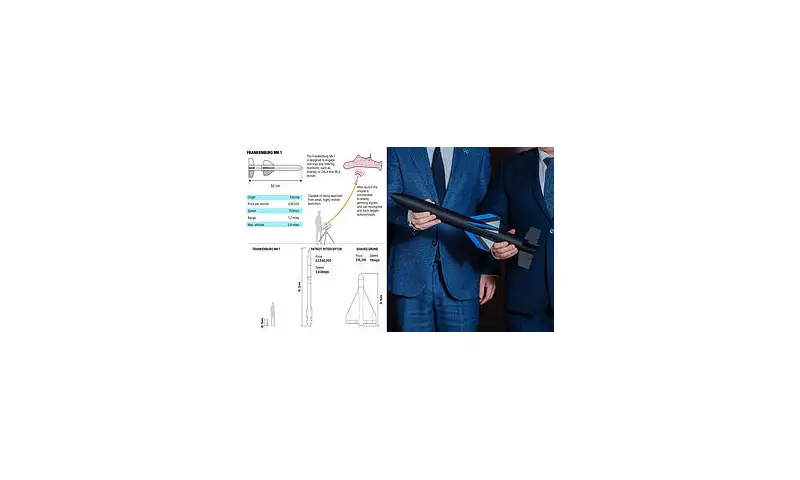
Defence experts have revealed that a missile no larger than a French baguette could become the most crucial weapon in contemporary conflict zones. The revolutionary Mark 1 missile, developed by Frankenburg Technology, measures just 65cm - smaller than the average human arm - yet promises to fundamentally alter how nations counter drone threats.
Kusti Salm, chief executive of Frankenburg Technology and former top civil servant in Estonia's defence ministry, stated unequivocally: "We aim to produce missiles 10 times cheaper and 100 times more than what's currently possible." This ambitious production target addresses what Salm describes as the urgent need to "redefine the economies of air defence."
The Economic Imbalance in Air Defence
The pressing need for cost-effective defence solutions became starkly evident on September 9, when NATO deployed F-16 fighter jets valued at approximately £500,000 to intercept 20 Russian drones that had breached Polish airspace. This military response, while effective, highlighted a severe economic imbalance: Russia's Iranian-designed Shahed drones cost merely £50,000 each.
"Such military tactics are not economically sustainable in the long-term," defence analysts note, pointing to Russia's strategy of deploying cheap, scalable drone technology that overwhelms traditional defence systems both numerically and financially.
The Mark 1 missile represents a paradigm shift in defence manufacturing philosophy. Designed specifically for serial production rather than bespoke performance, it strikes a careful balance between affordability and capability. Factories have already been established in two NATO nations with the ambitious goal of producing hundreds of missiles daily.
Technical Specifications and Capabilities
This cutting-edge interceptor boasts several remarkable features that position it as a game-changer in drone defence:
- World's smallest guided missile designed to intercept low, slow massed UAVs at altitudes up to 2 kilometres
- Advanced AI-driven targeting system providing real-time situational awareness
- Capable of operation from both moving platforms and static installations
- Doesn't require persistent data link to launcher after firing, reducing vulnerability to electronic interference
- Reaches speeds of approximately 750 mph, significantly outpacing Shahed drones that travel at 115 mph
Although the company hasn't confirmed a final price, Salm indicated the Mark 1 would cost roughly one-tenth of existing rocket defence systems. For context, a European IRIS-T missile markets for around €400,000, while Patriot interceptors can exceed £3 million.
The development programme has included 53 live fire tests to date, with current accuracy rates at approximately 56% - a figure Frankenburg hopes to improve to 90% as the technology matures.
The Escalating Drone Threat
Russia's drone offensive has intensified dramatically throughout the Ukraine conflict. In September alone, Moscow launched nearly 6,900 drones at Ukraine, including more than 3,600 Shahed models, according to Commander-in-Chief Oleksandr Syrskyi.
Ukrainian sources estimate Russia produced over 6,000 one-way attack UAVs in 2024, with production numbers continuing to increase through 2025. Originally designed in Iran and mass-produced in Russia under the name Geran-2, these drones have become central to Vladimir Putin's military strategy, frequently targeting cities and civilian infrastructure.
The threat has extended beyond Ukraine's borders, with Belgium's main international airport in Brussels forced to cancel dozens of flights last week after drone sightings prompted temporary closure. Drones have also been observed near military installations, prompting Britain to deploy troops and military equipment to assist Belgian air defence.
Sir Richard, Britain's chief of defence staff, acknowledged that while the origin of these incursions remains unconfirmed, it's "plausible" they were ordered by Moscow.
Western Response and Innovation
Salm has been vocal in his criticism of Western efforts to counter the drone threat, accusing allies of doing "virtually nothing" to address the recurrent violations of European airspace. He identifies short-range air defence (SHORAD) as the "biggest need in the world" over the next five to ten years if NATO hopes to effectively counter Russian capabilities.
Ukraine is pursuing its own solution, developing cheap interceptor drones costing between $1,000 to $5,000 per unit, capable of reaching speeds up to 330 kilometres per hour before impact.
Meanwhile, Frankenburg has assembled an elite team of defence experts, including chief engineer Andreas Bappert, designer of the highly sought-after Iris-T air defence system, and the chief engineer working on the Spear III missile at MBDA UK.
"They are doing stuff that you cannot learn over a weekend from YouTube videos, as you can with drones," Salm remarked, emphasising the sophisticated expertise required for missile development. "There are no Rocket Science for Dummies books that you can order from Amazon."
As Russia continues to refine its drone manufacturing capabilities, the race to develop affordable, effective countermeasures has become one of the most critical fronts in modern defence technology. The Mark 1 missile represents a significant step toward rebalancing the economic equation of aerial warfare, potentially providing NATO forces with a sustainable defence against the growing swarm of unmanned threats.