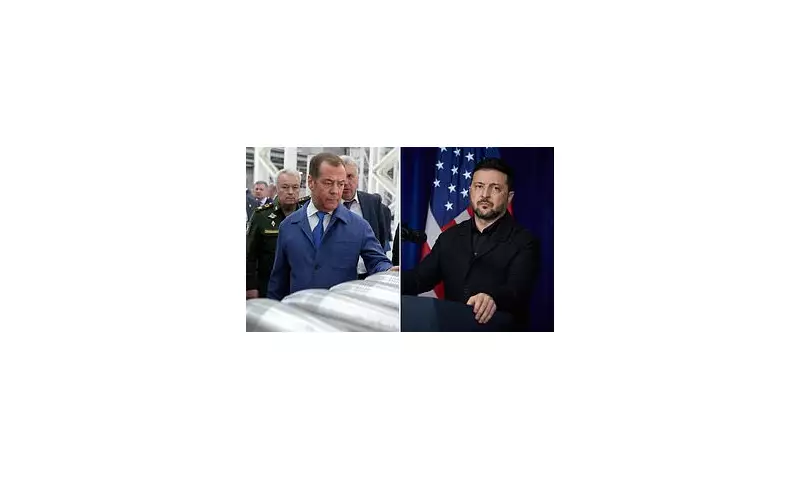
A close ally of Vladimir Putin has issued a gruesome public threat to kill Ukrainian President Volodymyr Zelensky and put his preserved body on display in a Russian museum. The threat from former president Dmitry Medvedev follows Moscow's claim that Ukraine attempted to assassinate Putin using dozens of long-range drones.
Kremlin's Graphic Threat and Alleged Assassination Plot
Dmitry Medvedev, deputy head of Russia's Security Council, issued the direct threat on social media platform X. He referred to Zelensky with a profanity and wrote that the Ukrainian leader "will have to stay in hiding for the rest of his worthless life." Medvedev later expanded on Telegram, stating it was "very important" that after Zelensky's "imminent demise," his "body, preserved in alcohol, be displayed in the Kunstkamera" science museum in St. Petersburg. This museum historically housed collections of curiosities assembled by Russian tsars.
The threat was framed as retaliation for what Moscow alleges was an attempted strike on Putin's state residence. Russian Foreign Minister Sergei Lavrov claimed that on the night of December 28-29, Ukraine launched 91 long-range drones at the presidential residence on the shores of Lake Valdai in the Novgorod region. The Russian defence ministry stated all drones were destroyed, with 41 intercepted over Novgorod and 49 more heading towards the Valdai palace.

Kyiv Dismisses Claims as 'Fabricated' Hoax
Ukrainian officials have vehemently denied the Russian account, labelling it a complete fabrication. A Ukrainian source told media the claim was "lies." Experts and local reports cast significant doubt on the Kremlin's story. Residents near the heavily fortified Valdai residence reported no explosions or air defence activity that night. The palace is known to be protected by over 20 modern air defence systems, which reportedly remained silent.
Military analysts also noted that any drone flight path from Ukraine would have had to traverse multiple layers of Russian air defences long before reaching the remote Valdai region, making such a mass attack highly improbable. Ukraine's Foreign Minister, Andrei Sybiha, asserted that Russia invented the story to "create a pretext and false justification for Russia's further attacks against Ukraine" and to undermine peace efforts.
Escalating Rhetoric and International Peace Moves
The alleged drone incident and subsequent threats come amid a critical diplomatic moment. US President Donald Trump met with Zelensky in Florida last Sunday, stating afterwards they were "getting a lot closer, maybe very close" to a deal to end the war. Trump also spoke with Putin by phone on Monday, calling the conversation "productive" and expressing hope to resolve key issues for peace. When asked about the alleged attack on Putin's residence, Trump said he learned of it from Putin and was "very angry," but acknowledged US intelligence might not have evidence and said "We'll find out."
Meanwhile, Kremlin loyalists have escalated their rhetoric. Russian state TV presenter Vladimir Solovyov, recently decorated by Putin, falsely accused Britain's MI6 of orchestrating the alleged drone attack, offering no evidence. He ominously urged Ukrainians in several major cities to evacuate, hinting at a potential nuclear response. "The games are over, finished," Solovyov warned, stating Russia's retaliation would "go beyond the usual framework."
The situation underscores the dangerously volatile nature of the conflict, where unverified allegations can trigger extreme threats from the highest levels of the Russian government, further complicating fragile international peace initiatives.