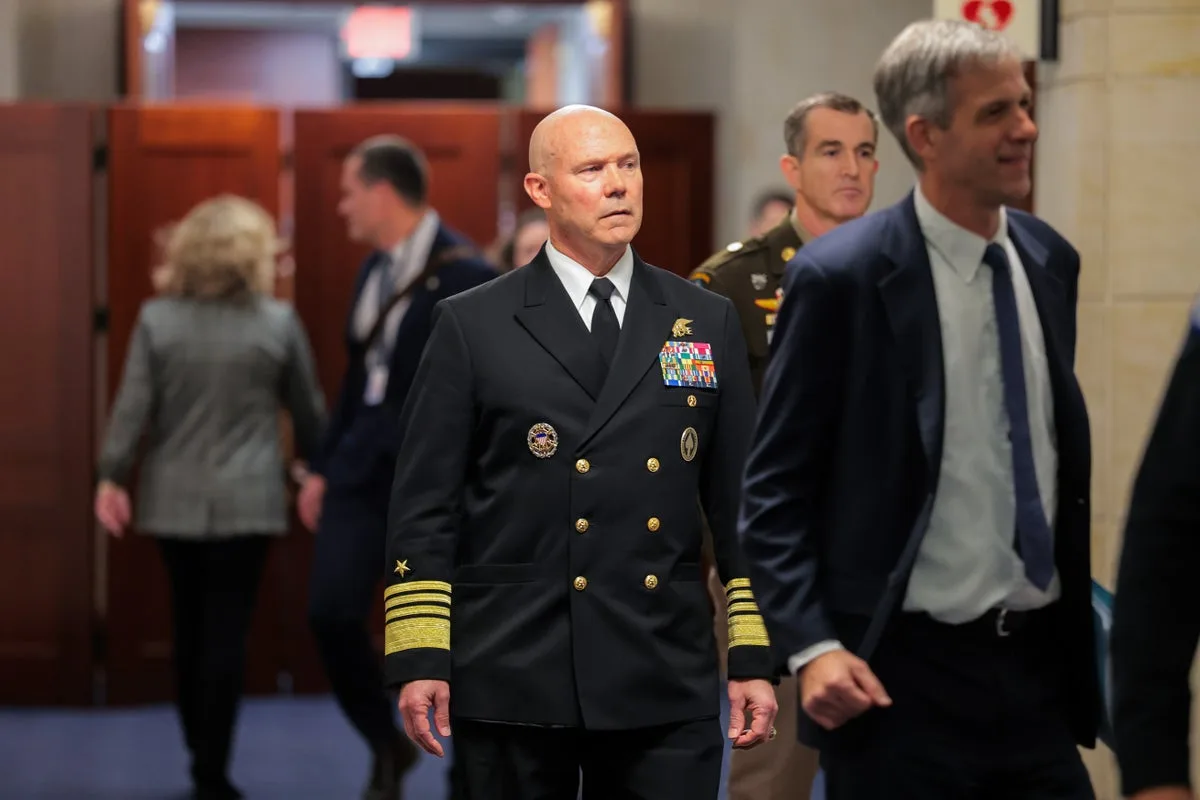
A senior United States Navy admiral has told lawmakers that Defence Secretary Pete Hegseth did not order the second missile in a controversial 'double tap' strike on a suspected drug vessel in the Caribbean, which killed survivors. The closed-door briefing on Capitol Hill, intended to address concerns the strikes could constitute war crimes, instead left several politicians deeply unsettled after viewing classified footage of the incident.
Graphic Footage and 'Clear Distress'
Admiral Frank 'Mitch' Bradley, the respected Navy SEAL officer who leads US Special Operations Command, spent Thursday answering questions from members of the House and Senate Armed Services and Intelligence Committees. He presented video of the lethal strikes carried out on September 2.
Democratic Representative Jim Himes, a ranking member of the House Intelligence Committee, emerged from the session visibly shaken. He described the footage to reporters as "one of the most troubling things I’ve seen in my time in public service." Himes detailed that the video showed two individuals in clear distress, without any means of locomotion, with a destroyed vessel, who are killed by the United States.
The briefing was part of an effort to conclude that Hegseth was not responsible for the order to fire the second missile. Republican Representative Rick Crawford, chairman of the House Intelligence Committee, said he felt "confident" in Hegseth following the admiral's explanations.
Unfolding Controversy and Conflicting Accounts
The incident began on September 2 when the Trump administration targeted what it claimed was a Venezuelan "narco vessel" in the Caribbean. This was part of a broader crackdown that has reportedly killed more than 80 people in three months. The first missile strike killed nine people and set the boat ablaze, but failed to eliminate all on board.
It was revealed last week that a second strike was subsequently ordered to kill the two remaining survivors. This led to accusations from figures on both the political right and left labelling Hegseth a "war criminal," following a Washington Post report which suggested the second strike resulted from his earlier command to "kill everybody." Hegseth has firmly denied this allegation.
Initially, the Defence Secretary and the White House dismissed reports of the second strike as "fabricated, inflammatory, and derogatory." However, White House Press Secretary Karoline Leavitt confirmed on Monday that the second strike did occur and stated that Admiral Bradley gave the order.
Mounting Questions and Demands for Accountability
Key details surrounding the decision-making process remain under intense scrutiny. According to defence officials cited by the Wall Street Journal, it took an hour after the first strike for survivors to become visible on the live video feed. Admiral Bradley reportedly considered the proximity of other "enemy" vessels and a belief they were communicating via radio before authorising the second attack.
While both Bradley and Hegseth were reportedly watching the operation unfold via live feed, the Defence Secretary claimed this week that he "moved on" to his next meeting before the second strike and did not personally see the survivors. This assertion has prompted further inquiries from senators.
Independent Senator Angus King of Maine told CNN, "I want to see his calendar for that day. I want to know what meeting he went to. I want to know how long he was, where he was." Republican Senator Thom Tillis of North Carolina emphasised the need for accountability, stating, "if someone knowingly launched a second missile at that boat, which led to the deaths of the other two, then they have to be held accountable."
Despite the controversy, Hegseth has publicly stood by Admiral Bradley, hailing him as an "American hero" on social media and during a Cabinet meeting. He stated, "Admiral Bradley made the correct decision to ultimately sink the boat and eliminate the threat." The episode continues to raise profound legal and ethical questions for US military operations.




