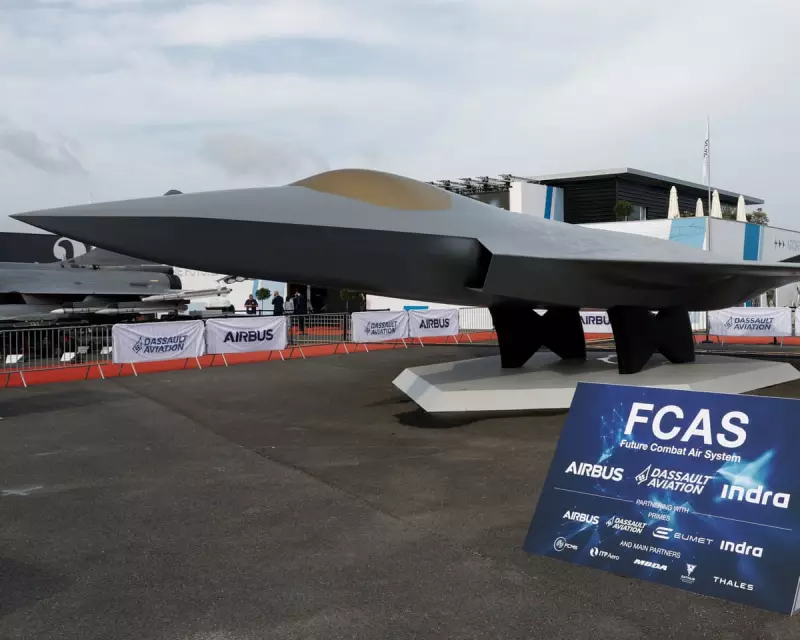
The ambitious Franco-German project to build a next-generation fighter jet, a cornerstone of European defence cooperation, is under severe threat due to intense corporate rivalries between the lead contractors. The Future Combat Air System (SCAF) is designed to be a sixth-generation stealth aircraft, but its future is now clouded by disputes over leadership and control.
Corporate Clash Threatens Strategic Ambition
Olivier Andriès, the chief executive of French engine-maker Safran, has publicly revealed that relations between the French aerospace champion Dassault and the German unit of Airbus are "extremely difficult" and "very strained." This clash centres on a fundamental row over which company should lead the multi-billion euro programme. Safran, a global leader in engine production, is slated to co-produce the turbines for the advanced warplane alongside Germany's MTU Engines.
Andriès made these candid remarks to reporters in London on Tuesday, where he was visiting to lobby UK government ministers. He expressed uncertainty about whether the partnership had reached a breaking point, stating, "I can't answer" that critical question. However, he pointed to a significant political counterweight to the corporate discord.

Political Resolve Versus Industrial Friction
Despite the profound tensions at the corporate level, there remains a "strong willingness" from the highest political offices in both nations to salvage the deal. Andriès confirmed that the offices of French President Emmanuel Macron and German Chancellor Friedrich Merz are actively seeking a solution. "I know that on the political side there is still very strong willingness... to strike a deal and to solve it," he stated.
The SCAF programme is envisioned as a technological leap forward, combining stealth capabilities with cutting-edge electronics, weaponry, and the ability to operate alongside drone 'wingmen'. Its development places it in direct competition with other next-generation projects, namely the UK-Italy-Japan Global Combat Air Programme (Tempest) and the United States' future fighter initiatives.
Broader Context and UK Connections
The SCAF turmoil unfolds as European defence leaders, including Airbus's own CEO, have questioned the logic of multiple, parallel fighter jet projects on the continent, suggesting efforts may be duplicated. Andriès noted that, in contrast to the lead partner dispute, cooperation on other SCAF components like the engine has been "very smooth," with responsibilities clearly allocated from the outset.
Andriès's London visit also highlighted Safran's substantial UK footprint. The French-headquartered group employs 5,500 people in Britain across various sites, manufacturing landing gear, flight controls, and seats. He highlighted work at the company's Pitstone site in Buckinghamshire on developing electric motors with magnets that do not rely on rare earth metals—a crucial strategic aim given China's dominance of that supply chain. "Supply chains have been weaponised," Andriès warned, identifying reduced dependency as a key theme for the UK.
Separately, Safran, through its CFM International joint venture with General Electric, is pioneering an "open fan" jet engine design for the next generation of civil airliners, positioning itself against rivals Pratt & Whitney and Rolls-Royce. Andriès said the company is preparing for all scenarios as Airbus and Boeing consider their next moves for new single-aisle aircraft.