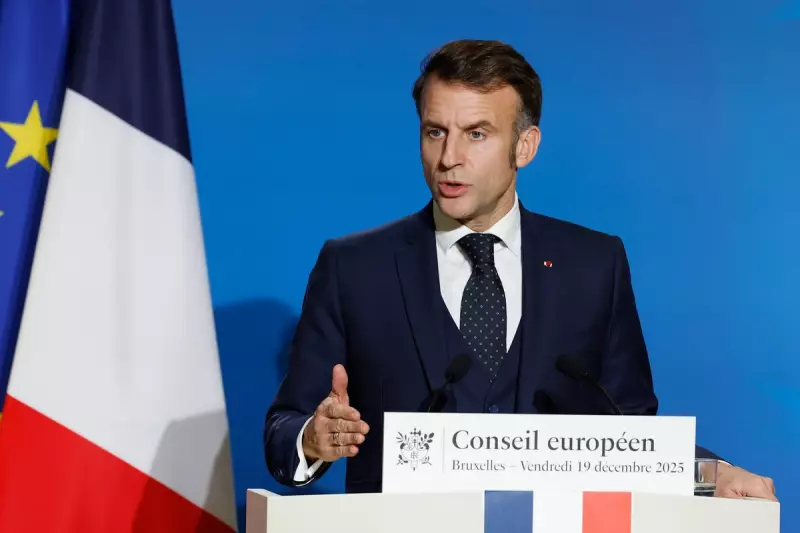
French President Emmanuel Macron has unveiled a major strategic commitment, confirming that France will construct a new, state-of-the-art nuclear-powered aircraft carrier. The announcement, made during a visit to French troops in Abu Dhabi, signals a significant expansion of the nation's naval power and a substantial increase in its defence budget.
A Strategic Power Projection for a Turbulent Era
Addressing military personnel, President Macron framed the decision as a necessary response to global instability. "In an age of predators, we must be strong in order to be feared, and especially strong at sea," he declared. He described the new carrier as a display of France's power "in the service of freedom on the seas and amid the turbulence of our times." The formal decision to launch the colossal programme was taken in the week preceding the announcement.
Specifications and Timeline of the New Flagship
The new vessel is designed to be a formidable successor to the current flagship, the Charles de Gaulle. Key specifications and comparisons include:

- Commissioning Date: Planned for 2038.
- Displacement: Approximately 78,000 tons, nearly double the 42,000 tons of the Charles de Gaulle.
- Length: 310 metres (1,017 feet), compared to 261 metres for the current carrier.
- Air Wing: Capacity for 30 French-built Rafale M fighter jets.
- Crew: Will accommodate around 2,000 sailors.
- Propulsion: Will retain nuclear power, ensuring long-range, endurance-focused deployments.
The French defence ministry emphasised that the carrier will enable heavily armed, long-range missions at short notice, repeatedly and for extended periods.
Economic and Defence Budget Implications
Macron positioned the project as a major industrial boon, stating it would benefit hundreds of suppliers, predominantly small- and medium-sized enterprises. He pledged personal oversight, with a visit to the shipyard scheduled for February 2026. The project comes with a hefty price tag; in 2023, then-Defence Minister Sébastien Lecornu estimated the cost of a new carrier at around 10 billion euros.
This investment is part of a broader defence spending surge. Macron has announced an extra 6.5 billion euros (£5.6 billion) in military funding over the next two years. His government aims for a defence budget of 64 billion euros in 2027, the final year of his second term. This figure represents a doubling of the 32 billion euro budget from when he first took office in 2017.
Concurrently, France plans to bolster its military personnel. With roughly 200,000 active troops and over 40,000 reservists—currently the EU's second-largest force after Poland—the goal is to expand the reserve force to 80,000 by 2030.