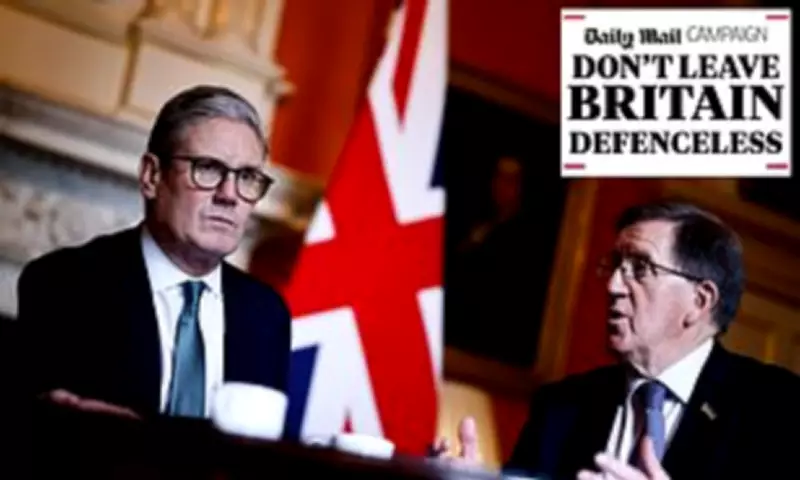
Former Labour Defence Chiefs Demand Welfare Cuts to Fund Military Spending
Two former Labour defence secretaries have issued a stark warning to ministers, urging them to slash welfare budgets to significantly boost spending on Britain's national security. In a scathing speech, former NATO chief Lord Robertson declared that Britain's security has been left 'in peril' due to Labour's failure to fulfil promises of increased defence funding.
Welfare Versus Defence: A Critical Priority Question
The Labour grandee, who authored the Government's strategic defence review last year, directly accused Chancellor Rachel Reeves of obstructing funding for the armed forces. He called on ministers to liberate cash by cutting what he described as a bloated benefits budget.
'The cold reality of today's dangerous world is that we cannot defend Britain with an ever-expanding welfare budget,' Lord Robertson told an audience in Salisbury. 'Britain's welfare budget is now five times the amount we spend on defence. So I ask, are we certain that this is the right priority - jeopardising people's future safety and security, while maintaining an increasingly unsustainable welfare bill?'

When questioned about Defence Secretary John Healey's reaction to his criticisms, Lord Robertson stated: '[He was] extremely, extremely angry with me, but sometimes you just have to say something. My country is in danger, so I felt that I had to speak out. That will be uncomfortable in the short term, but in the longer term, they know what they need to do.'
He further emphasised that 'many soldiers died as a result of the failure of the Labour government to act upon defence procurement' during the Afghanistan war.
Backing from Fellow Labour Peer
Lord Robertson received support from fellow Labour peer Lord Hutton, who served as both defence and work and pensions secretary in the previous Labour administration. Lord Hutton urged Prime Minister Keir Starmer to address this issue as the 'defining moment in his premiership', noting he has 'a very, very short period of time to start putting this right and sending out the signals to Putin' that Britain is serious about self-defence.
Speaking to Times Radio, Lord Hutton asserted the Government must 'get a grip on the rising welfare budget'. However, he cautioned that, nearly two years into the administration, 'there's no real sign that it's got any agenda for correcting the very steep rise in welfare payments'.
On Tuesday night, Labour's former deputy leader Harriet Harman suggested means-testing the pension triple lock, telling the BBC: 'If you're strapped for cash and need to divert some money to defence, that is one place to be looking.'
Treasury Demands and Political Reactions
Despite these urgent warnings, it has emerged that the Treasury is pressuring the Ministry of Defence to identify £3.5 billion in cuts this year. This amount almost exactly matches the cost of the Chancellor's recent decision to abolish the two-child benefits cap.
Conservative leader Kemi Badenoch warned that Labour's hesitation on this matter now represents an 'existential' problem for the nation, stating: 'We have got to spend more on defence.' She added: 'The Government does not have a defence investment plan. There is a welfare plan that runs to 2031 but no defence plan.'
Mrs Badenoch reiterated her offer to collaborate with Labour to implement welfare reductions, thereby freeing resources for defence. 'We used to spend one in every seven pounds on welfare,' she noted. 'Now it's one in every three pounds and a lot of that money has basically been swapped for defence.'
Shadow Defence Secretary's Critique
Shadow defence secretary James Cartlidge described it as 'extraordinary' that the Treasury is effectively demanding defence cuts to finance the removal of the two-child cap, which will provide thousands of pounds in additional benefits to some of Britain's largest jobless families.
'The fact you are seeing cuts at the Ministry of Defence at a time when we have got two wars on shows the Treasury is running defence policy,' Mr Cartlidge told the Daily Mail. 'Defence is paralysed. They need to get a grip. That means making tough decisions on spending so that the MoD can finally start ordering at scale and at pace, the munitions we need without which this country is at greater risk than it needs to be.'

He continued: 'We've got a former Labour defence secretary saying cut welfare to fund defence. We need the current defence secretary to thump on the door of the Treasury and say, enough is enough. Let's take some tough decisions and cut welfare to fund defence.'
Delays and Funding Black Holes
Last year, Defence Secretary John Healey informed MPs that he would publish the ten-year Defence Investment Plan by autumn. However, this deadline passed amid intense Whitehall disputes over financing. Downing Street was unable to specify yesterday when the plan would be released, despite it having been on the Prime Minister's desk for months.
Ministers are currently struggling to address a £28 billion funding shortfall in defence over the next four years. Chancellor Rachel Reeves has cautioned that she will not risk violating her fiscal rules by borrowing the money. She has also indicated reluctance to reconsider future defence spending until a planned comprehensive spending review in summer 2027.
Work and Pensions Secretary Pat McFadden is developing a welfare reform package but has warned against seeking substantial savings this year. This follows a failed attempt last year to reduce the budget by £5 billion, which resulted in a humiliating reversal due to Labour backbencher opposition.
Urgent Warnings and Government Response
Lord Robertson warned on Tuesday that the Government cannot afford further delays on defence spending decisions. In his speech, he highlighted a 'corrosive complacency' at the highest levels of government that is placing Britain 'in peril' while it is 'under attack'. He specifically criticised 'non-military experts in the Treasury' for what he termed 'vandalism'.
The peer cautioned: 'We three reviewers, a former defence secretary, a former general and a current foreign policy guru, were hired by Keir Starmer and John Healey to look at every aspect of UK defence, which we did with the aid of more than 150 experts and an unprecedented public consultation. If our recommendations were implemented, then we might be prepared for an opponent like Russia or a China in ten years' time. What is happening in the world today does not give us anything like ten years.'
Downing Street rejected suggestions that government indecision is endangering Britain. Nevertheless, Lord Robertson's assessment gained support from other senior defence figures.
General Sir Richard Barrons, co-author of the Government's strategic defence review, noted there is 'an enormous gap between where we have to be to keep the country safe in the world we now live in and where we actually are'.
Tan Dhesi, Labour chairman of the Commons defence committee, which has been attempting to persuade Chancellor Reeves to testify on the funding crisis, remarked it is 'damning that a man of Lord Robertson's stature and experience has to speak out publicly to get his message heard'.
However, General Sir Gwyn Jenkins, the current First Sea Lord, insisted there is no complacency at the top of government, telling MPs: 'This could not be taken more seriously at the moment. I see no sign of complacency among anybody that I work with or provide advice to.'