
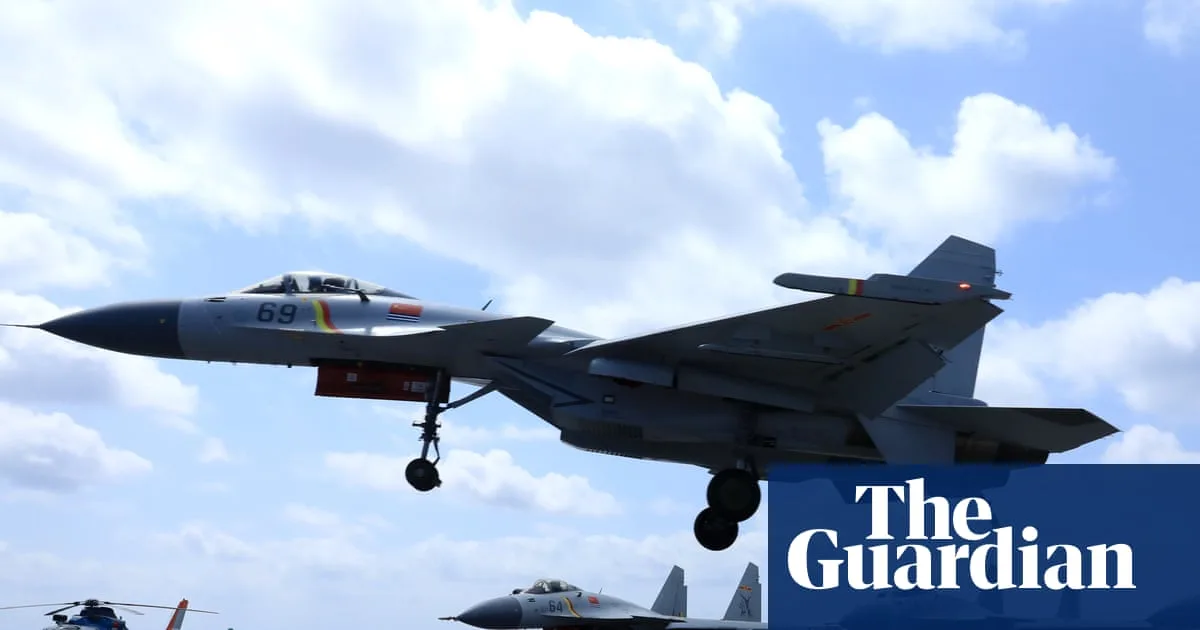
Japan's Prime Minister Sanae Takaichi has vowed to 'respond calmly and resolutely' after Chinese military aircraft were accused of locking their radar on to Japanese fighter jets near the Okinawa islands. The alleged incident occurred on Saturday, prompting Japan's foreign ministry to summon China's ambassador on Sunday.
According to Japan's defence ministry, Chinese J-15 fighter jets from the aircraft carrier Liaoning directed their fire-control radar on to Japanese F-15s twice, at 4.32pm and again about two hours later. A fire-control radar lock is considered one of the most threatening acts a military aircraft can take, as it signals a potential attack. No visual confirmation was possible due to distances involved, and no damage or injuries were reported.
Japan's defence minister, Shinjiro Koizumi, described the incident as 'dangerous and extremely regrettable', stating that the radar illuminations went beyond what is necessary for safe flight. Vice-foreign minister Funakoshi Takehiro summoned China's ambassador, Wu Jianghao, to make a strong protest.
China has rejected Japan's claims as 'completely inconsistent with the facts', accusing Japan's self-defence forces of maliciously following and harassing the Liaoning carrier group during its training drills. Senior Colonel Zhang Xiaogang, spokesperson for China's defence ministry, said Japan repeatedly sent aircraft into exercise zones that China had demarcated and announced in advance. A Chinese foreign ministry spokesperson urged Japan to immediately stop its dangerous moves and accused it of hyping the issue to build tension.
The incident is the latest in a series of bilateral disputes, following Takaichi's comments that a PLA attack on Taiwan could trigger Japanese military involvement. Takaichi has refused to withdraw her remarks, despite calls from Donald Trump to avoid escalation. In response, Beijing has reimposed a ban on Japanese seafood and increased military activity near disputed territories.




