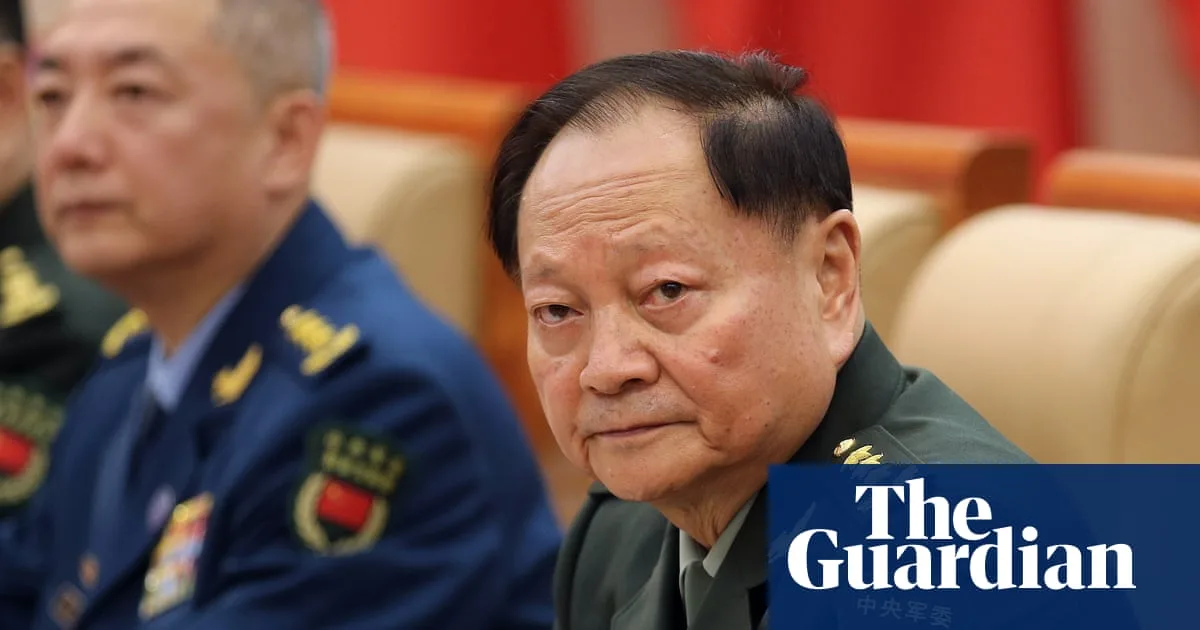
In a dramatic turn of events that has sent shockwaves through China's political and military establishment, General Zhang Youxia, the nation's second-most powerful military figure, has been placed under investigation for serious disciplinary violations. The move represents what analysts are calling the most significant purge within the People's Liberation Army since the Mao era.
A Ceremony That Concealed Impending Doom
Standing mere inches from President Xi Jinping during a military ceremony in late December, General Zhang Youxia appeared to occupy a position of immense privilege and trust within China's hierarchy. Photographs from the event show the 75-year-old general positioned directly to Xi's left, with Zhang Shengmin and Liu Zhenli completing the front row of military leaders. This physical proximity to China's supreme leader seemed to confirm Zhang's status as a trusted ally in the highest echelons of power.
Yet just weeks after this public display of unity, China's defence ministry announced that both Zhang Youxia and fellow Central Military Commission member Liu Zhenli were under investigation for "suspected serious violations of discipline and law" – the Communist Party's standard euphemism for corruption allegations. While neither man has been formally removed from their positions, experts suggest the investigation almost certainly presages their political demise.
The Most Significant Military Purge in Decades
Neil Thomas, a fellow on Chinese politics at the Asia Society thinktank, described the development as "easily the most significant PLA purge in the post-Mao era." He emphasised the extraordinary nature of the situation, noting that "it would be like arresting the chairman of the US joint chiefs of staff for corruption."
The official PLA newspaper elaborated on the charges in a Sunday editorial, accusing Zhang and Liu of having "seriously betrayed the trust and expectations" of both the party and the Central Military Commission. The editorial further alleged that the officers had "fostered political and corruption problems that undermined the party's absolute leadership over the military," suggesting that political disloyalty may have been as significant a factor as financial misconduct.
A Trusted Figure's Sudden Fall from Grace
What makes Zhang's investigation particularly remarkable is his recent history as a seemingly protected figure within Xi's inner circle. Alfred Wu, an associate professor at the National University of Singapore, noted that Zhang's nomination to the Central Military Commission at the 2022 party congress occurred when he was already past normal retirement age, indicating special favour from the leadership. "Corruption does not just happen overnight," Wu observed, suggesting that Zhang's fall represents a dramatic reversal of fortune.
Zhang's credentials had previously marked him as an almost untouchable figure within military circles. As a fellow "princeling" – the son of revolutionaries who served under Mao Zedong – he shared Xi's elite political pedigree. Furthermore, he was one of the few serving generals with actual combat experience, having served as a frontline officer during China's 1978 conflict with Vietnam.
Power Struggle or Corruption Crackdown?
Experts are divided on whether corruption allegations or political power dynamics provide the true explanation for Zhang's downfall. Dennis Wilder, a senior fellow at Georgetown University and former CIA analyst, suggested that "a power struggle was a more likely explanation than corruption." He characterised the purge as being about "a general that became too powerful" rather than primarily about financial misconduct.
Zhang represents the most senior figure in a series of recent purges of top PLA officials, including former defence minister Li Shangfu, who was removed from the Central Military Commission in 2023 and expelled from the party in 2024. According to reports in The Wall Street Journal, Zhang's downfall may be linked to his previous promotion of Li Shangfu, suggesting complex networks of patronage and loyalty within the military hierarchy.
Xi's Absolute Authority Asserted
Whatever the specific allegations against Zhang, analysts agree that his investigation demonstrates Xi Jinping's determination to assert absolute control over China's military establishment. "The fact that Xi is purging his right-hand man in the military is a shocking development which suggests Zhang was guilty of a significant betrayal of Xi's trust," said Neil Thomas.
Thomas further explained Xi's motivation, noting that "for Xi, there's nothing more important than strengthening party discipline and ensuring it does not go the same way as the Soviet Communist party, which in his view was rendered ineffective by corruption." He emphasised that "no one is safe in Beijing because Xi puts the party above any individual."
The party's control over the armed forces remains central to its grip on power, and Xi appears willing to pay any price to maintain that control. The current situation has created what some observers describe as a somewhat absurd configuration within the Central Military Commission, which now effectively consists of just two individuals: Xi himself and the commission's anti-corruption chief, Zhang Shengmin.
Implications for Taiwan and Military Readiness
For Western analysts and military strategists, the crucial question concerns what these purges mean for China's military capabilities and particularly its readiness regarding Taiwan. US intelligence believes Xi has ordered the military to be ready to win a conflict over Taiwan by 2027, making the current period crucial for military modernisation efforts.
Some analysts argue that the purges make an attack on Taiwan less likely in the short term, as the military may lack the high-level decision-making capacity required for sophisticated operations. "It gives the US military more time to prepare for a Taiwan conflict," suggested Dennis Wilder.
Others caution against such assumptions, noting that the ousted officers could be replaced by younger, more aggressive commanders who may be less likely to question their leader's directives. Lyle Goldstein, director of the Asia programme at Defense Priorities, pointed to China's recent display of new weaponry during September's military parade as evidence of continued military ambition. "I think it would be a major mistake to assume that the Chinese military lacks capable senior officers or that it is less likely to move against Taiwan due to this recent shakeup of the CMC," he warned.
More Investigations Likely to Follow
One point of consensus among China watchers is that the investigations will not end with Zhang and Liu. Scholars of the Chinese Communist Party describe corruption as an inherent feature of the system rather than an occasional malfunction. As Zhang and Liu undergo interrogation about their specific alleged offences, their testimony is likely to implicate additional figures within the military hierarchy.
"More arrests are likely," predicted Alfred Wu, suggesting that the current investigations represent merely the beginning of a broader campaign to purge the military of perceived disloyalty and corruption. The coming months will reveal whether Xi's consolidation of power strengthens China's military readiness or creates dangerous instability within its command structure.




