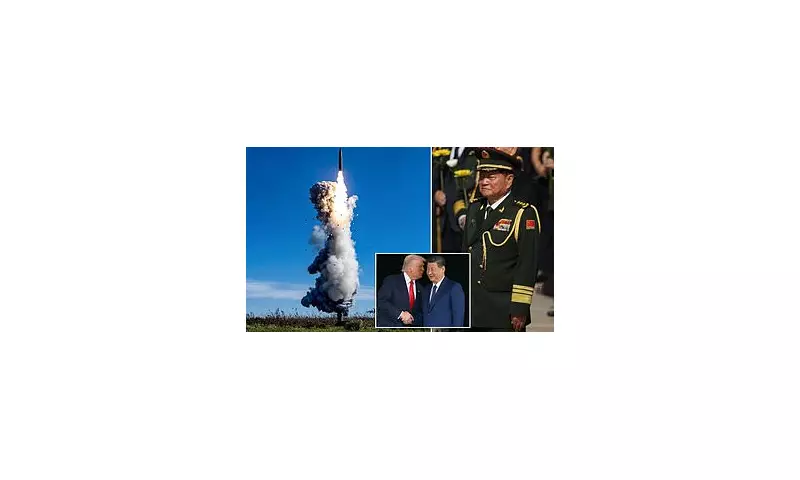
China's Highest-Ranking Military Officer Toppled in Dramatic Anti-Corruption Purge
The highest-ranking uniformed officer in China has been dramatically removed from his position in a sweeping anti-corruption campaign that has plunged the world's largest military into a state of significant turmoil. General Zhang Youxia, once considered President Xi Jinping's untouchable right-hand man, has experienced a spectacular fall from grace following a high-stakes investigation launched by the secretive Central Military Commission.
Nuclear Secrets Allegations Raise Global Stakes
Reports emerging from intelligence circles suggest General Zhang may have compromised China's most sensitive nuclear secrets, potentially providing American intelligence agencies with what analysts describe as the 'crown jewels' of Beijing's strategic arsenal. This development creates unprecedented leverage for the United States as President Trump prepares for crucial summit talks with Xi Jinping this April.
The timing of this military upheaval is particularly significant, coming just days after the Trump administration's new National Defense Strategy explicitly prioritised 'Western Hemisphere dominance' as a key strategic objective. The removal of General Zhang leaves President Xi without his most experienced military advisor at a critical juncture in international relations.

Purge Consolidates Power While Removing Moderating Voices
While this extensive purge undoubtedly consolidates President Xi's absolute authority within China's military establishment, it simultaneously strips away important moderating influences from the command structure. Security experts express growing concerns that an unchecked Beijing leadership could now more easily miscalculate strategic moves concerning Taiwan or the South China Sea.
Official state media outlets have vaguely cited 'grave violations of discipline and law' as justification for General Zhang's removal. However, insiders with knowledge of the situation claim the allegations extend far beyond typical corruption charges, suggesting the general may have leaked core technical data regarding China's nuclear weapons capabilities to American intelligence services.
Analysis of the Allegations and Their Implications
Brent Sadler, a military diplomat with extensive experience in Asia who served twenty-six years in the Navy, emphasised the extraordinary gravity of these accusations. 'The allegations of leaking sensitive Chinese nuclear weapons information would be remarkable and if true highly likely to result in the General's execution,' Sadler explained. 'Yet, getting the full extent of what information was passed will be likely shrouded in secrecy for years to come.'
Former State Department consultant John Sitilides, now a National Security Senior Fellow at the Foreign Policy Research Institute, presents an alternative perspective suggesting the world may be witnessing an elaborate strategic deception. 'This bizarre story seems to be an information warfare operation against the U.S., as well as against Xi's internal Communist Party rivals,' Sitilides warned, proposing that the allegations might serve as a smokescreen for deeper political manoeuvring.
Expert Skepticism and Historical Context
Several prominent China observers have expressed skepticism regarding the official narrative surrounding General Zhang's downfall. Neil Thomas, an expert with the Asia Society's Center for China Analysis, highlighted significant logistical challenges in any potential nuclear secrets transfer, noting that General Zhang's communications were constantly monitored and he rarely met anyone without accompaniment.
Zhu Zhiqun, director of The China Institute at Bucknell University, offered additional context: 'The purge of top brass is often framed as corruption cases, but the reality may be more complicated... It may be an indication that (Xi's) power is constantly being challenged by people around him.'

Unprecedented Military Command Restructuring
The scale of President Xi's military restructuring has reached unprecedented levels, with the Central Military Commission's high command being dramatically reduced from seven members in 2022 to just two today. This radical consolidation effectively eliminates all moderating voices within China's military leadership, creating what analysts describe as an absolute autocratic command structure capable of triggering conflicts without internal restraint.
General Zhang's specific alleged transgressions include accepting bribes for official acts, including involvement in the promotion of former Defense Minister Li Shangfu, who was himself removed from his position in 2023 for corruption and subsequently purged from the Communist Party the following year.
Historical Parallels and Future Implications
Brent Sadler draws attention to historical parallels, noting that this represents neither the first nor likely the last of President Xi's extensive purges. 'They go to his highest level leadership, to include close childhood friends and otherwise staunch Xi supporters,' Sadler told the Daily Mail. 'Expect more of these anti-corruption purges that really are more about Party discipline than what we in the West would consider corruption.'
More than 200,000 officials have been removed from their positions since President Xi assumed power in 2012, with the current investigation reportedly extending to confiscating mobile phones and other electronic devices from military personnel connected to General Zhang's command network.
Taiwan Timeline and External Aggression Concerns
Security analysts are particularly concerned that President Xi's internal 'house-cleaning' operations within the military may actually serve as a precursor to external aggression, specifically regarding China's publicly stated 2027 timeline for Taiwan. Sadler emphasised: 'These purges and leadership shuffles should not be viewed as influencing one way or another the very dedicated buildup for an armed showdown over Taiwan—a goal to be ready to prevail in by 2027. That clock continues to tick and all indications are that preparations are proceeding unabated despite this and similar past purges.'
The Communist Party's deeply ingrained culture of secrecy continues to complicate foreign intelligence gathering and fact-based assessment of these dramatic developments, ensuring that the complete truth behind General Zhang's downfall may remain obscured for the foreseeable future.