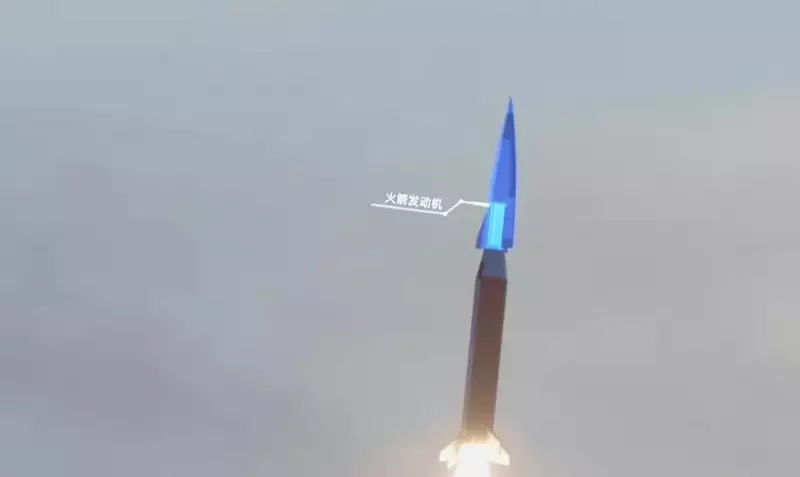
A new, remarkably inexpensive hypersonic missile developed in China has the potential to dramatically reshape the international defence landscape, according to military analysts. The weapon, which costs a mere fraction of comparable American systems, could place advanced strike capabilities within reach of smaller nations worldwide.
The 'Cement-Coated' Missile: A Cost Revolution
The missile in question is the YKJ-1000, produced by the Chinese aerospace firm Lingkong Tianxing. It has garnered the nickname the "cement-coated" missile due to its innovative use of materials, including foamed concrete within its heat-resistant coating. This approach is a key factor in its staggeringly low production cost.
Reportedly priced at approximately 700,000 yuan (£74,100 or $99,000), the YKJ-1000 stands in stark contrast to the price tags of US missiles, which typically range from $4 million to $15 million. This makes the Chinese weapon roughly 40 times cheaper than the average American equivalent.

Expert Analysis: A Game-Changer for Global Defence
Military commentator Wei Dongxu, speaking to state broadcaster CCTV, highlighted the disruptive potential of the missile's "dirt cheap price." He suggested it could become extremely popular on the international market, particularly among countries that lack indigenous hypersonic technology.
"If this missile were introduced on the international defence market, it would be formidably competitive," Mr Dongxu stated, as reported by the South China Morning Post. He emphasised its 1,300-kilometre range, high destructive power, and strong penetration capability as factors that, combined with its low cost, would likely make it a "hot commodity."
This development underscores Beijing's capacity for the mass production of advanced weapons at minimal cost. Experts believe that if such systems become widely exported, they could alter the balance of power in regional conflicts, enabling smaller nations to challenge larger, traditionally better-equipped adversaries.
Broader Context of Chinese Military Innovation
The revelation of the YKJ-1000 comes amidst broader showcasing of China's military technological advances. In November 2025, the People's Liberation Army (PLA) demonstrated staged ground invasions using "robot wolves," part of its development of "integrated manned-unmanned combat" tactics.
Footage aired on state television showed these four-legged robots deployed as a first wave in drone-led amphibious assaults. This focus on robotics and cost-effective missile technology illustrates the dual tracks of innovation within China's largely state-controlled defence industry, even as it faces internal challenges such as slowed procurement due to anti-corruption campaigns.
The introduction of the YKJ-1000 missile represents a significant shift in defence economics. By leveraging civilian-grade materials and simplified manufacturing processes—such as replacing explosive separation nuts with electric ones and using die-cast structural parts—China is poised to offer a new class of affordable, high-performance weaponry that could redefine accessibility to hypersonic capabilities across the globe.