Mass evacuation warnings from Israel have upended the lives of thousands in southern Lebanon, reshaping the region as families flee their homes in panic. The warnings come suddenly: text messages pinging thousands of phones, automated calls from strange numbers, and hard-to-read maps shared on social media by an Israeli military spokesperson.
Some maps cover broad swaths of Lebanon, while others pinpoint specific buildings. In many cases, there is no warning at all before strikes, which have continued despite a nominal ceasefire between Israel and the Iran-backed Hezbollah militant group. The warnings trigger frantic efforts to gather children and elderly relatives, leaving families with agonizing choices as they race to the blurry edges of the red-shaded zones. Entire villages have emptied, with over a million people fleeing at the height of the fighting. Unlike Israel, Lebanon lacks air raid sirens, missile defenses, and designated bomb shelters.
Israel's Justification and Criticism
Israel says the warnings aim to keep civilians out of harm's way, claiming that Hezbollah has positioned fighters, tunnels, and weapons in civilian areas across southern Lebanon, from which it has launched hundreds of drones and missiles into northern Israel. However, international law experts argue that Israel's warnings are inconsistent, often overly broad, and open-ended. They come as Israel states its intention to occupy a 10-kilometer (6-mile) wide buffer zone along the border and prevent residents from returning until the threat from Hezbollah is eliminated.

Panicked Flights and Chaos
The latest war erupted on March 2, when Hezbollah launched a surprise barrage of missiles into northern Israel in retaliation for U.S. and Israeli attacks on Iran. Since then, Israel has posted 132 online alerts, including seven covering over 50 towns since the ceasefire took effect on April 17. Residents say the narrowly targeted warnings often arrive with short notice, causing chaos and confusion.
Ward Zein al-Din, 56, recounted hearing glass shatter from shrapnel just minutes after her father received a call from the Israeli military that made him scream. They fled their southern village and took shelter in a school. “I didn’t think we would survive,” she said. Meanwhile, blanket warnings from Lt. Col. Avichay Adraee, Israel's Arabic-speaking military spokesperson, urge entire populations to relocate north of the Litani River, some 30 kilometers (20 miles) from the border. These warnings have also emptied Beirut's crowded southern suburbs, where Hezbollah has a strong presence, though many have since returned. The United Nations reports that large numbers remain displaced, including over 150,000 in tent camps.
“A legal tool is being used to achieve forced displacement,” said Hussein Badreddine, a Lebanese expert in international law at the University of Sydney. “When you evacuate entire areas and keep the orders open-ended, that’s when the legality comes into question.” The Israeli military responded that it issues warnings via phone, text, radio, social media, and leaflet drops, in accordance with international law principles of distinction, proportionality, and feasible precautions.
Deadly Strikes Without Warning
There was no warning on April 8, when Israel struck a hundred targets in rapid succession, killing more than 350 people, including in downtown Beirut. The military said Hezbollah commanders and operatives were expected to be present at many sites. More than 100 of those killed were women and children. Conversely, there have been warnings without strikes, such as an alert to attack the main border crossing between Lebanon and Syria, which forced its closure for days but never materialized.
A Family's Tragedy
Airstrikes shook the village of Kafr Tebnit when the war broke out. Adraee posted on X that residents should move to at least 1,000 meters outside the village. Hussein Farran headed to Nabatiyeh for work, while his wife Rola Nahleh and their 4-year-old daughter Amal joined relatives in Kfar Hatta, outside the red zone. A month later, at 11:29 p.m. on April 4, Adraee called for evacuation of Kfar Hatta—one of 26 urgent warnings posted between 10:30 p.m. and 6:30 a.m.

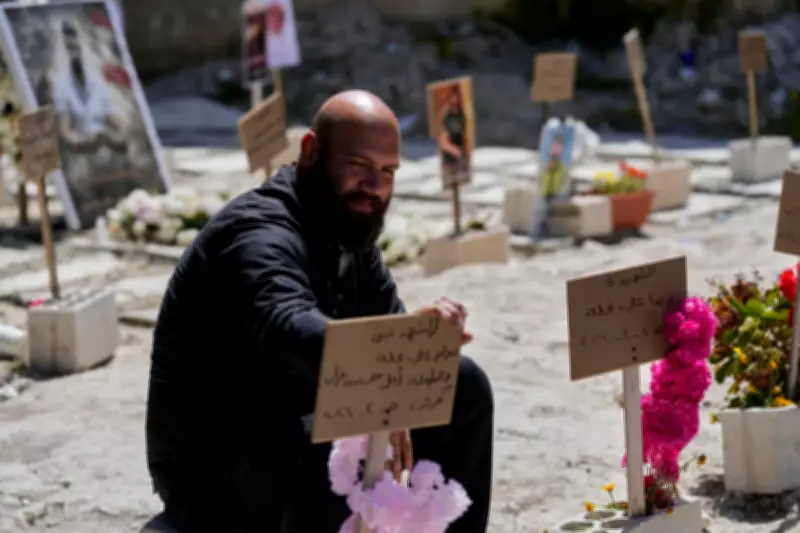
“When warnings are issued in the middle of the night, on platforms that not everyone uses, you can't expect everyone to get up and leave immediately,” said Kristine Beckerle of Amnesty International. “You have people stuck on the road for 12, 13 hours trying to leave. You have elderly people who can't move quickly.” Nahleh told her husband that hundreds were fleeing in pajamas. They agreed to wait until daybreak. Two Israeli missiles hit their apartment at around 3 a.m., killing Nahleh, her mother, father, brother, sister, and Amal. “Even if they gave us a warning, how does it justify killing a civilian family?” Farran asked, gazing at their graves marked with handwritten cardboard signs because proper burial was impossible. “They weren't given a real chance,” he said.
No Safety Even After Ceasefire
Ali al-Salim initially thought a call from a German number was a prank or scam, but the caller identified himself as an Israeli officer and ordered evacuation. He fled with his family from Siddiqin to a school in Haret Saida after 18 hours in traffic. Analysts say the Israeli military uses random international numbers since phone calls between the two countries are prohibited. “There is no way to know if a call is real or fake,” said cybersecurity expert Roland Abi Najem. “The Israeli military benefits from the chaos.” The military declined to comment on calling methods.
Days later, al-Salim learned his home was hit. The shelter proved dangerous too: on April 8, Israel struck a neighboring mosque where displaced people showered, knocking his 14-year-old son Ali unconscious and shredding his leg. “The bombing can happen at any moment. There is no safety at all,” said Ali, now on crutches. “I've never felt this kind of fear.” The ceasefire has done little to dispel it. Mohammad Shahadat, forced to flee Shaqra, returned after a week of calm, only to be back in a tent in Beirut after another Israeli warning. “We didn't know where to go,” he said.