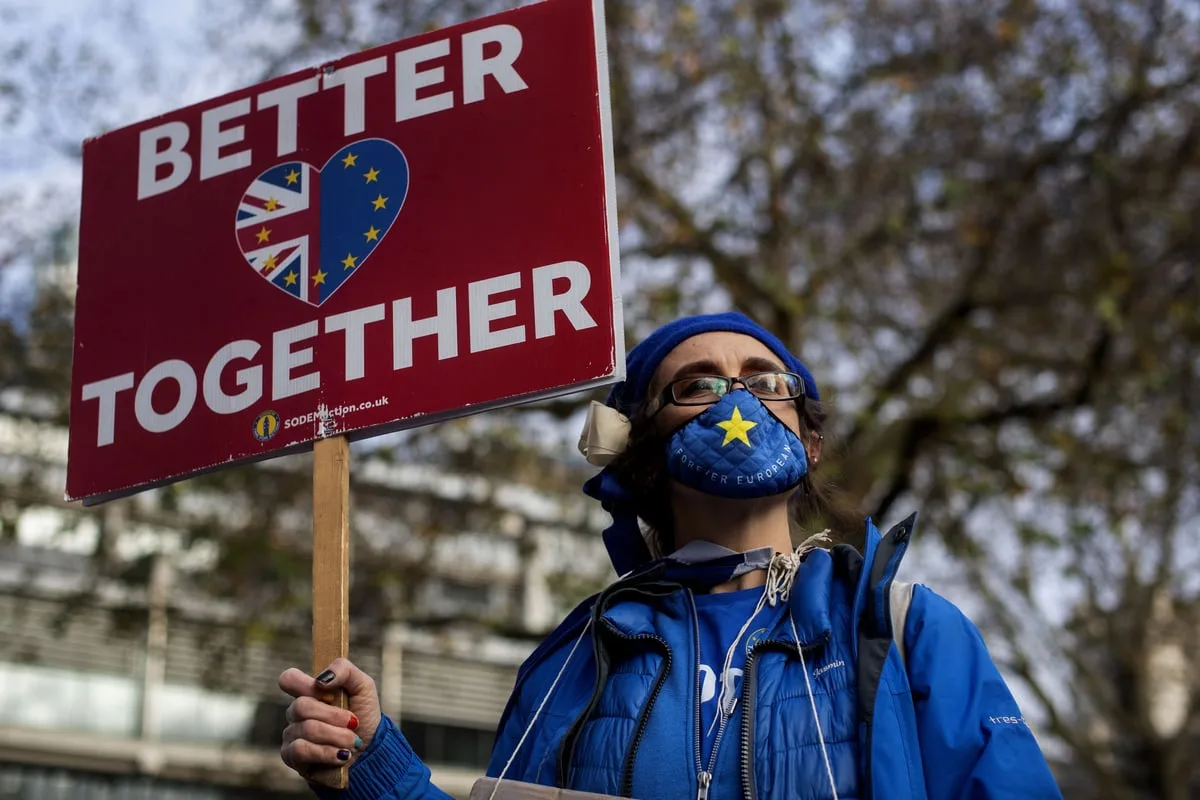
Poll Shows Majority of Britons Now Back Rejoining EU a Decade After Brexit
Majority of Britons Now Back Rejoining EU, Poll Reveals

Poll Reveals Growing Support for UK to Rejoin EU a Decade After Brexit Vote

More than half of British voters now support rejoining the European Union, according to comprehensive new research released ten years after the historic Brexit referendum. The study, conducted by the civil society group Best for Britain, maps shifting voter attitudes and suggests Labour's "muted" approach to EU relations could alienate key supporters.

Strong Backing for Full EU Re-entry Among Progressive Voters

The polling data shows that 53% of all voters favour a complete return to the EU, with support particularly strong among supporters of opposition parties. Specifically, 83% of Labour voters, 84% of Liberal Democrat voters, and 82% of Green party supporters back this policy. In contrast, only 39% of Conservative voters and 18% of Reform UK supporters endorse rejoining.

While 61% of voters overall support the government's current stance on EU relations, a mere 19% do so "strongly," indicating widespread lukewarm approval. Tom Brufatto, Director of Policy and Research at Best for Britain, warned of the risks inherent in "halfway house" approaches, stating that Labour's strategy may fail to satisfy either progressive or traditionally pro-Brexit constituencies.

Wide Pickt banner — collaborative shopping lists app for Telegram, phone mockup with grocery list

Labour's 'Strategy of Silence' Faces Criticism

At a Westminster event unveiling the research, polling expert Professor John Curtice criticised what he termed Labour's "strategy of silence" on Brexit. He suggested political calculations might need to shift, as losing liberal voters over EU policy could prove more damaging than losses to pro-Brexit parties. Curtice noted Labour is losing approximately one in four voters to the Lib Dems and Greens, compared to one in ten to Reform UK.

The research tested six potential scenarios for future UK-EU relations, including continuing with Labour's low-ambition policy, maintaining Boris Johnson's deal, further divergence, joining the customs union and single market, and full EU re-entry. Rejoining the customs union and single market—which Labour strongly opposes—would present significant political challenges by reopening past divisions.

Rule-Taking Dilemma and Economic Concerns

Brufatto explained that rejoining the customs union and single market would require "outsourcing large parts of all of our regulation," making it difficult for any party to "carry the public with us" through protracted negotiations. Labour's current policy of aligning with, but not joining, the single market means the UK has no say in shaping regulations, becoming a perpetual "rule-taker."

This dynamic is illustrated by negotiations over a sanitary and phytosanitary (SPS) agreement to reduce trading barriers for farm exports. Since Brexit in 2020, the UK has diverged on 76 rules and regulations related to these talks. Anand Menon, Director of UK in a Changing Europe, highlighted contradictions in Labour's vision, noting the party's chancellor acknowledges Brexit has cost the economy up to 8% of GDP, while proposed reset measures might yield only 1% growth.

Long-Term Outlook and Political Pressure

Menon added that Labour's sector-by-sector alignment strategy would require constant monitoring to prevent accidental divergence, creating administrative burdens in Westminster. Former Labour leader Neil Kinnock stated he believes Labour will eventually campaign for rejoining, though he offered no timeline. "I'm 84 now and probably won't see it, but the realisation [that it was best] and [in] the self-interest of the people, people will see it," he said.

The research underscores growing pressure on Labour to reconsider its EU policy as voter sentiments evolve. With progressive voters strongly favouring re-entry and economic concerns mounting, the party's cautious stance may need revision to maintain coalition support in upcoming elections.

Pickt after-article banner — collaborative shopping lists app with family illustration




