
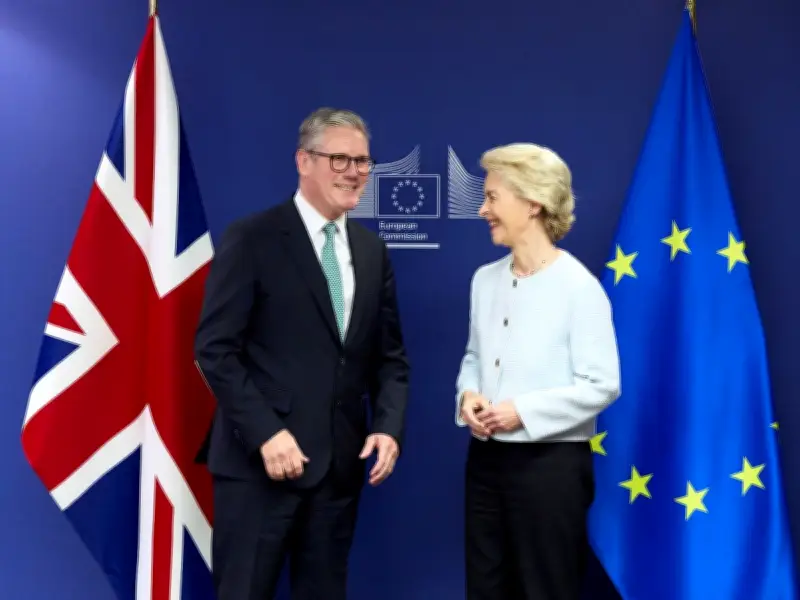
With Keir Starmer's premiership in peril and the 10th anniversary of the referendum approaching, rows over the future of Brexit have burst into the open once again. Until recently, Westminster wanted to talk about anything other than Brexit. The historic vote on June 23, 2016, sent shockwaves through the political establishment, and the years that followed resembled a Netflix drama with shock resignations, late-night votes, wrangling in the courts, and broken promises.
Labour's Shift on Brexit
Under the new stewardship of Keir Starmer, the former shadow Brexit secretary, a new position was eventually thrashed out in an attempt to lay the toxic divisions to rest. Fixing Boris Johnson's botched Brexit deal was to be the focus, but there would be no return to the EU, the single market, or the customs union. These were the 'red lines' set out in Labour's 2024 election manifesto, and Mr Starmer's focus once in Downing Street would be to 'make Brexit work'.
In his early days in No10, the Prime Minister put in the hard yards — and air miles — patching up relations with allies in European capitals. The 'reset' followed years of fractious relations under the Tories, notably including Liz Truss publicly suggesting in 2022 the 'jury was still out' on whether French President Emmanuel Macron was a friend or foe of Britain.
Renewed Debate on EU Membership
Now, with Mr Starmer's premiership in peril and the 10th anniversary of the referendum approaching, rows over the future of Brexit have burst into the open once again. Will the UK seek to renegotiate access to the customs union or single market? Will there be a willingness to accept freedom of movement? Will the government seek to rejoin the EU in the long-term? These will be just some of the questions pro-EU Labour members will be asking if a leadership contest and 'battle of the ideas' is triggered in the coming weeks.
Ex-Health Secretary Wes Streeting, who has made clear he will stand in any battle to be the country's next Prime Minister, has already floated the idea of rejoining the EU. 'We need a new special relationship with the EU, because Britain's future lies with Europe, and one day — one day — back in the European Union,' he said last month.
Meanwhile, ex-Greater Manchester Mayor Andy Burnham emerged victorious in last week's Makerfield by-election and is considered the frontrunner to replace Mr Starmer if a leadership contest is triggered. He was forced to hose down his own calls for Brexit to be reversed, saying last month Britain would be stuck in a 'permanent rut' if it gets stuck into arguing about membership of the EU again.
Government's Position
But as the government works towards the 22 July UK-EU summit, Nick Thomas-Symonds, the minister responsible for EU relations, told The Mirror: 'Labour has a duty to make sure this country stays united, and that our international relations serve every part of Britain. We've reset our relationship with the EU to be able to strike deals that help bring down the cost of the weekly shop and protect our economy, as well as a new youth experience scheme so young Brits can once again work, travel and study across Europe. We need to stay focussed on the future, not returning to the debates of the past which only serve to divide the country. That means rejecting comforting answers that might sound good, but are unrealistic and undeliverable.'
Public Opinion and EU Welcome
But even if Labour under a new leader adopts a position of rejoining the EU at some point in the distant future, would the UK be welcome to rejoin the bloc? Jean-Claude Juncker, former President of the European Commission, suggested not last week. He told the Financial Times: 'I don't think [rejoining] is possible. Because all of us, we are wounded to some extent by this… historic step the British have taken.' He claimed the majority of European governments would give the UK the cold shoulder. But others have suggested they would welcome Britain back, including Spain's socialist Prime Minister, Pedro Sanchez.
And where does the public stand 10 years on from the referendum? Elections guru Sir John Curtice told The Mirror: 'Well, if you take the average of the last half dozen polls, rejoin 60 [%], Leave 40 [%]. I've been running the average ever since 2016 — it's now just at a record high. But it's been about 57-58 point really since the autumn of 2022 — the Liz Truss fiscal event clearly helped to push public opinion in that direction.' While some people had changed their mind, he said another reason for the shift in opinion is down to those who didn't vote 10 years ago. He explained: 'The outlook of those who did not vote in 2016, which includes of course the now 10 years worth of population too young to vote in 2016. Younger voters are very clearly sharply in favour of rejoining and more broadly the outlook of those folk in general who didn't vote in 2016, it's something like 3-1 in favour of rejoining.'
But as debates within the Labour Party reopen, Sir John referred to the UK's previous referendum on the issue of Europe half a century ago — the European Economic Community as it was then known — when the public voted by a majority (67%) to stay in the bloc. He said: 'I'm basically of the view and have been for quite a while that the 2016 referendum will be no more successful than the 1975 was one in settling the issue.'




