

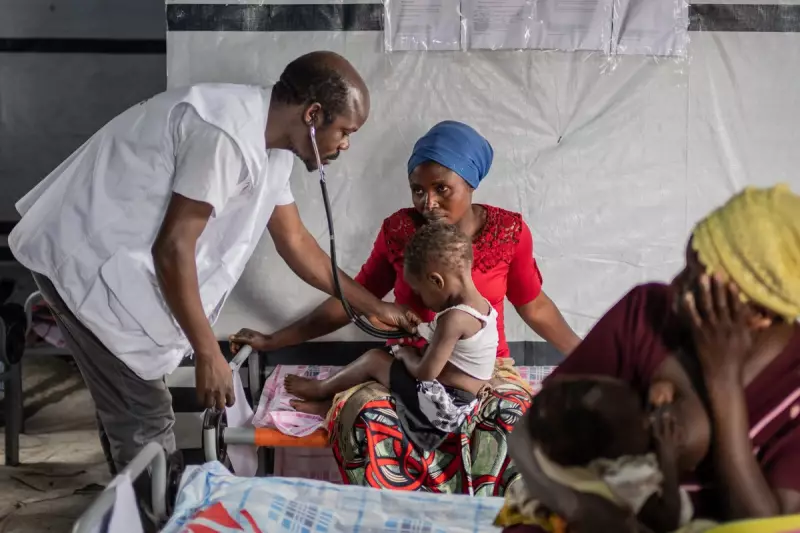
Vaccinations against measles have finally commenced in a rebel-controlled area of eastern Democratic Republic of Congo, arriving close to a year after a lethal outbreak of the disease first took hold.
A Long-Awaited Lifeline in a War Zone
The highly contagious disease has been spreading unchecked in parts of North Kivu province since early this year, a situation severely exacerbated by the seizure of territory by the Rwanda-backed M23 rebel group. This armed conflict has critically disrupted healthcare delivery in one of the globe's most severe humanitarian emergencies, according to local residents and aid organisations.
This week, in the area of Kachehembe, anxious parents have been queuing with their young children to receive the vital measles vaccine from the medical charity Médecins Sans Frontières (MSF), also known as Doctors Without Borders. Silas Bazimaziki Rugiriki, a father bringing his son for immunisation, told reporters that "children are suffering greatly from this disease."

A Crisis Compounded by Conflict and Displacement
The measles outbreak is stretching the already limited resources of a nation grappling with multiple health threats. Alongside the rebel insurgency, Congo has recently contended with outbreaks of Mpox and Ebola. Official figures show that as of July this year, the country had reported over 36,000 suspected measles cases and 565 deaths across nearly all of its 26 provinces.
In Kachehembe alone, MSF reports having treated at least 1,000 children for measles in 2025, with 11 fatalities. At a nearby hospital, Dr. Toussaint Selemani, medical director for MSF's measles response, confirmed 53 children were currently undergoing treatment.
The charity's vaccination campaign is targeting children under five, but its efforts are challenged by the mass displacement of families fleeing ongoing attacks by various armed groups. "The area is experiencing a constant influx of displaced families, which is increasing demand," Dr. Selemani explained.
Personal Stories of Fear and Survival
The human toll of the delayed response is starkly visible in local clinics. Sarah Noëlla, 37, watched over her two-year-old son, Fariji Jacques, who developed a fever last week before his eyes turned red and spots appeared around his mouth. "I thought it was the flu," she said.
Other mothers described the terrifyingly rapid deterioration of their children's health. Irène Shashire, 21, a mother of two, highlighted the desperate circumstances: "We are living in a war zone, we have nothing." Without financial means, families are entirely dependent on the free care provided by organisations like MSF.
The M23 rebellion, which escalated in January with the capture of key cities in the mineral-rich east, has resulted in thousands of deaths. Peace efforts, led by the United States and Qatar, are continuing amidst the complex crisis.






