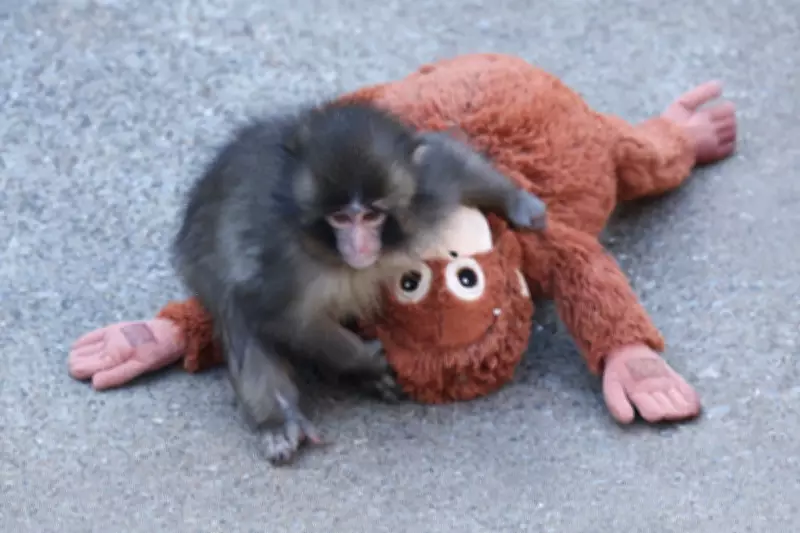
Viral Monkey Punch's Heartbreaking Search for Comfort
A baby macaque monkey named Punch has become an unexpected global sensation through videos showcasing his desperate search for companionship. After being abandoned by his biological mother and rejected by his troop at Japan's Ichikawa City Zoo, zookeepers provided the infant monkey with an orangutan plushie as a surrogate mother. The heartbreaking footage of Punch clinging to the soft toy has resonated with millions worldwide, but this emotional story carries deeper psychological significance.
The Historical Parallel: Harry Harlow's Groundbreaking Experiments
Punch's attachment to his inanimate companion remarkably echoes the famous psychology experiments conducted in the 1950s by American researcher Harry Harlow. These studies fundamentally challenged the prevailing behaviorist theories of the time and established crucial principles that continue to inform modern attachment theory.
Harlow's controversial experiments involved separating rhesus monkeys from their mothers at birth and raising them with access to two different surrogate "mothers." One surrogate consisted of a wire cage shaped like a monkey that provided food and drink through a small feeder. The alternative was a monkey-shaped doll wrapped in soft terry towelling that offered comfort but no nutritional sustenance.

Challenging Behaviorist Assumptions
At the time, behaviorism dominated psychological thinking, suggesting that babies formed attachments primarily to those who satisfied their biological needs like hunger and thirst. Behaviorists would have predicted the infant monkeys would spend most time with the wire mother that provided food.
Instead, Harlow's monkeys demonstrated a clear preference for the soft, comforting terry towelling mother, spending significantly more time clinging to this surrogate despite its inability to provide physical nourishment. This groundbreaking finding suggested that emotional needs—comfort, warmth, and kindness—were more fundamental to attachment formation than mere physical sustenance.
Foundations of Modern Attachment Theory
Harlow's research completely reoriented psychological understanding of attachment, forming the foundation for what would become attachment theory. This theory posits that healthy child development occurs when children form secure attachments to caregivers who provide emotional nourishment, attentiveness, and consistent care.
Conversely, insecure attachment develops when caregivers are cold, distant, abusive, or neglectful. The theory emphasizes that while physical nourishment is essential, emotional warmth and security are equally crucial for proper psychological development in both primates and humans.
Punch's Natural Experiment
While the Ichikawa City Zoo was not conducting a formal experiment, Punch's situation inadvertently created a natural parallel to Harlow's controlled studies. Just as Harlow's monkeys preferred their soft terry towelling mothers, Punch has formed a strong attachment to his IKEA orangutan plushie.
The zoo scenario lacks the comparative harsh wire mother option, but Punch's clear preference for the comforting plushie demonstrates the same fundamental need for emotional security that Harlow identified. The baby monkey sought a soft, safe space rather than merely physical nourishment, mirroring the experimental findings from seven decades earlier.
Ethical Considerations and Contemporary Relevance
Today, Harlow's experiments are widely viewed as ethically problematic, with primates now recognized as having rights approaching human rights in many contexts. The research would be considered cruel and unacceptable by modern standards, as scientists would not conduct similar experiments on human infants.
Nevertheless, Punch's viral story has renewed public interest in these historical experiments and their implications. The baby monkey represents more than just another internet animal celebrity—he serves as a poignant reminder of the universal need for emotional nourishment.

Punch's story underscores that all creatures, human and primate alike, require soft spaces and safe environments. Love, warmth, and emotional security prove fundamentally more important for wellbeing and proper functioning than physical nourishment alone. This viral phenomenon continues to demonstrate the enduring relevance of attachment theory principles in understanding emotional development across species.