

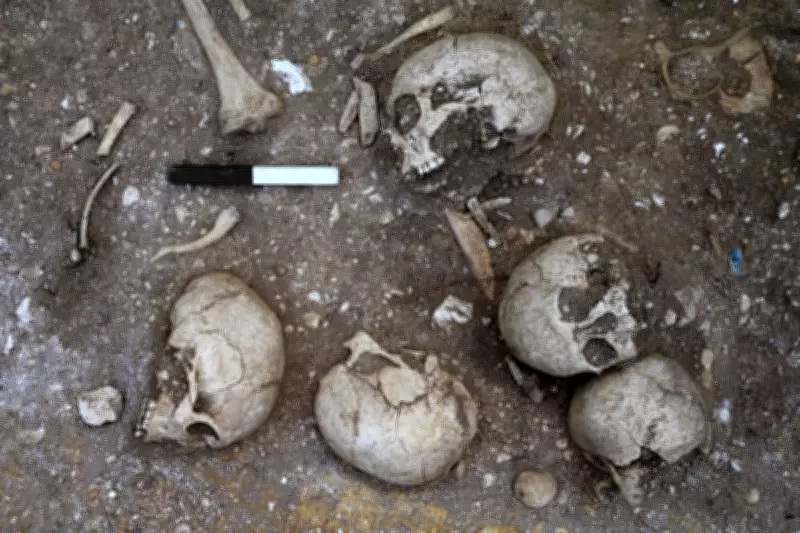
A remarkable archaeological discovery has been made by Cambridge University students during a routine training excavation, unearthing what appears to be a possible execution pit dating back to the turbulent ninth century frontier conflicts between Vikings and Saxons.
Student Training Dig Uncovers Dark Historical Secret
The extraordinary find occurred at Wandlebury Country Park near Cambridge, where undergraduate archaeology students participating in a field training exercise as part of their degree programme made the startling discovery. Working in conjunction with the Cambridge Archaeological Unit and local heritage charity Cambridge Past, Present and Future, which owns the parkland site, the students uncovered a burial pit containing human remains that tell a violent story from England's distant past.
Gruesome Details of the Discovery
The burial pit contained the skeletal remains of at least ten individuals, based on the number of skulls recovered from the site. Among these were four complete skeletons, with some positioned in ways that suggest they may have been bound or tied up before burial. The pit also contained dismembered remains including a disturbing cluster of skulls and a stack of leg bones, indicating these individuals met violent ends.

Archaeologists examining the site believe all the remains belong to young men who may have been victims of mass execution or simply discarded without ceremony following a battle. At least one individual shows clear evidence of decapitation, adding to the grim picture emerging from the excavation.
Historical Context of Frontier Conflict
Dr Oscar Aldred of the Cambridge Archaeological Unit, who led the excavation, explained the historical significance of the find. "Cambridgeshire during this period was very much a frontier zone where Saxons and Vikings clashed over territory across many decades," he stated. "We suspect the pit may relate directly to these conflicts that shaped the region's early medieval history."
Dr Aldred elaborated on possible interpretations of the burial, suggesting: "Those buried could have been recipients of corporal punishment, and that may be connected to Wandlebury as a sacred or well-known meeting place. It may be that some of the disarticulated body parts had previously been displayed as trophies, and were then gathered up and interred with the executed or otherwise slaughtered individuals."
Student Perspectives on the Find
For the archaeology students involved, the discovery provided an unforgettable educational experience that contrasted sharply with their expectations. Third-year student Olivia Courtney from Bath remarked: "Before we uncovered the first remains, our best find was a 1960s Smarties lid. I had never encountered human remains on a dig, and I was struck by how close yet distant these people felt. We were separated by only a few years in age, but over a thousand years in time."
Fellow undergraduate Grace Grandfield from York added: "I would never have expected to find something like this on a student training dig. It was a shocking contrast to the peaceful site of Wandlebury where we were working."
Notable Individual Among the Remains
One particularly striking discovery among the remains was a man estimated to have stood approximately 6 feet 5 inches tall - remarkably above the average male height of around 5 feet 6 inches during that historical period. Archaeologists believe his exceptional stature may have resulted from a growth condition.
Further examination revealed a 3-centimetre diameter hole in this individual's skull, suggesting he may have undergone an ancient surgical procedure. Dr Trish Biers of Cambridge University commented: "The individual may have had a tumour that affected their pituitary gland and caused an excess of growth hormones, which could explain both his unusual height and the possible medical intervention indicated by the skull modification."
Future Research and Public Engagement
Historic England, which is supporting the ongoing excavation work, has commissioned a new geophysical survey of the surrounding area. Archaeologists hope this advanced survey will reveal more about the broader archaeological context of the site and potentially uncover additional features related to the burial pit.

The significant discovery will feature in an upcoming episode of the popular television programme Digging For Britain, scheduled to air on BBC Two, bringing this remarkable find from a Cambridge student training exercise to national attention and highlighting the valuable contribution of archaeological education to our understanding of Britain's complex history.





