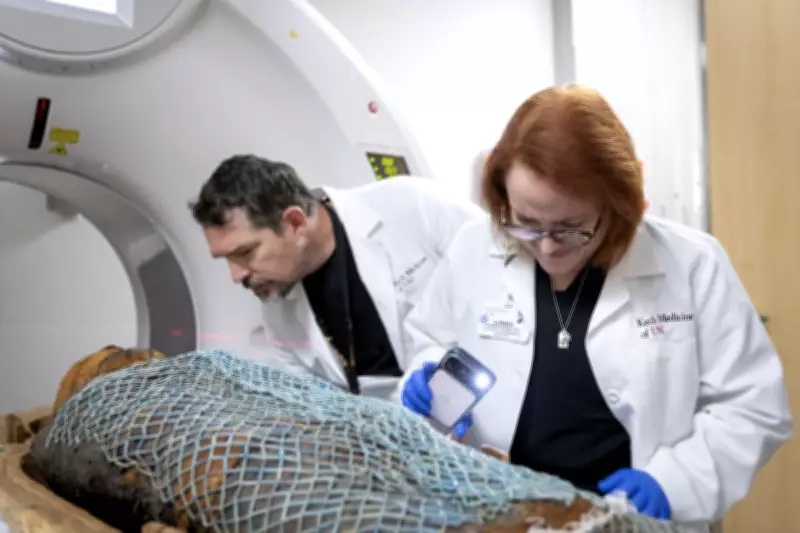
Advanced X-ray scanning technology has unveiled remarkable insights into the health and daily lives of ancient Egyptians, revealing conditions that remain prevalent in modern society. Researchers from the Keck Medicine team at the University of Southern California conducted sophisticated CT scans on two mummies dating back to 330BC and 190BC, providing a detailed glimpse into their physical ailments.
Detailed Analysis of Ancient Ailments
The first mummy, which was buried with various artefacts including scarab beetles and a fish, exhibited evidence of a collapsed lumbar vertebrae. This condition indicates the individual likely suffered from chronic lower back pain, a result of natural ageing processes and wear over time. Such back issues are remarkably common today, affecting millions of people worldwide and often linked to lifestyle factors and ageing.
Insights from the Second Mummy
The second mummy revealed a different set of health challenges, including significant dental problems and a severely deteriorated hip. These findings suggest that this individual was older at the time of death and may have experienced considerable discomfort from these conditions. Dental issues, in particular, are a widespread concern in contemporary healthcare, highlighting the timeless nature of certain health struggles.

Modern Science Illuminating Ancient Civilisations
The use of CT scanning technology has allowed scientists to create precise 3D digital models of the mummies, offering an unprecedented view into their anatomical structures. These models will be featured in an upcoming exhibit at the California Science Centre, starting from 7 February. The exhibit aims to demonstrate how modern scientific techniques can shed light on the lives and health of ancient peoples, bridging the gap between past and present.
Significance of the Findings
This research underscores the continuity of human health issues across millennia, showing that conditions like back pain and dental decay have affected individuals for thousands of years. By studying these ancient remains, scientists can gain a deeper understanding of the evolution of diseases and the resilience of the human body. The findings also emphasise the value of interdisciplinary approaches, combining archaeology with medical technology to uncover historical truths.
The Keck Medicine team's work represents a significant advancement in the field of bioarchaeology, providing tangible evidence of how ancient Egyptians lived and the health challenges they faced. As the exhibit opens, it will offer the public a unique opportunity to engage with these discoveries, fostering greater appreciation for both ancient history and modern scientific innovation.